Author
Ji Cheng, style Wufou (1582–c. 1642)
The treatise on garden art by Ji Cheng (style ...
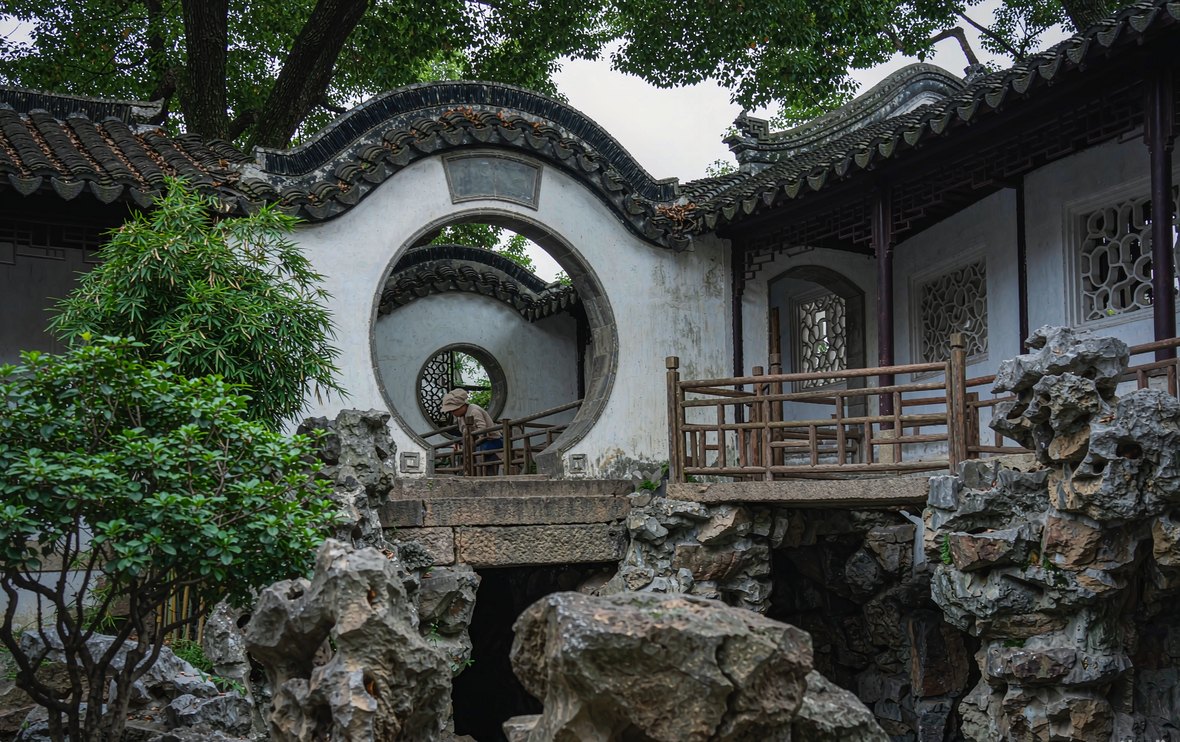
The treatise on garden art by Ji Cheng (style Wufou, 1582–c. 1642) of the Ming, drafted in 1631: three juan, the first systematic study of garden making in the world. Ji Cheng was a painter turned garden designer, "known in his youth for painting", who took up gardens in middle age and built famous ones at Zhenjiang, Changzhou, Yizheng and Yangzhou, among them the Garden of Waking and the Shadow Garden. The book is written in ornate parallel prose and is as beautiful as it is technical. The opening chapters set out the whole art in two phrases that have become its scripture: "made by human hands, yet as though opened by heaven" and "skilful in borrowing, precise in fitness". The chapters that follow treat siting, foundations, buildings, fittings, doors and windows, walls, paving, rockery, stone selection and borrowed scenery; the chapter on rockery discusses garden mountains, hall mountains and pool mountains in detail; the chapter on borrowing gathers "groves lingering by the water, each bound to the bamboo's cold rustle". Lost in China after the Ming, carried to Japan and revered there as the canon of garden making, it returned home in the 1930s. One book established the code of Eastern spatial aesthetics.
The first principle is eight characters: "made by human hands, yet as though opened by heaven." A garden is artificial, but it must appear natural. This is the strictest and the freest of standards: no symmetry, no mechanism; a mountain must "take truth as its falsehood and turn falsehood into truth"; water must "be traced to where it comes from and examined for where it goes". Every trace of the maker must hide inside the logic of nature. Ji Cheng attacked the vulgar fashion of his day — shrubs "arranged like candlesticks and flower vases", stones "set out like a forest of swords" — the disease of the mere craftsman.
Those eight characters are the outline of Eastern aesthetics. Against the geometric garden of the West, clipped and aligned at Versailles, the Chinese garden seeks the naturalist illusion in which "one walks inside a painting". Behind it lies a Chinese understanding of the relation between heaven's work and human effort: the highest skill is invisible skill. The idea comes from Zhuangzi — "carved and chiselled, and returned to plainness" — and it leads to every later Chinese aesthetic of making: gardens, stoneware, bonsai, dry landscapes.
The two methods of the book are yin and jie. Yin is to build according to what is there: siting comes first, and "for a garden site, mountain and forest is best", with heights and hollows, turns and depths to be followed rather than levelled. Jie is to borrow scenery: "of all things in garden making, borrowing scenery is the most important." Borrow far, borrow near, look up, look down, borrow in season: a pagoda beyond the wall, a bell from a neighbouring temple, the flowers of the four seasons, the clouds of morning and evening — and the garden's world extends without limit.
Precision in fitness is the art of measure: fitness of form and fitness of place — "where a pavilion suits, put a pavilion; where a terrace suits, put a terrace" — build nothing at random and nothing in excess. This method makes the Chinese garden a philosophy of space. Size does not matter: "there is no fixed rule for making a garden… let it arrive at natural delight of itself, without labouring the work of man." Half a mu can hold the thought of a mountain forest. City designers today speak of borrowed view and of the spirit of a place; Ji Cheng said it clearly four hundred years ago.
巧于因借,精在体宜。 — Skilful in borrowing, precise in fitness.——The Craft of Gardens, on building
The most technical contribution is the making of rockery. Garden mountains, hall mountains, tower mountains, pavilion mountains, study mountains, pool mountains, inner-room mountains and cliff mountains each have their own logic — "a mountain over a pool is the finest thing in a garden" — and each may be large or small, with subtler effects still. Stone setting follows the Taihu taste for the lean, the wrinkled, the pierced and the open, while warning that "stone without a mountain to support it will not stand": rock must work with planting, building and water. Water is "traced to its source and examined for its going", for only living water has spirit.
These details make the book a working manual. Garden engineering still reads it as required; the rockeries of the Humble Administrator's Garden and the Master of the Nets in Suzhou, and of the Ge Garden in Yangzhou, can be checked against its theory. Ji Cheng proved his learning in his own gardens at Waking and Shadow; the ye of the title means founding, the smelting of nature in one crucible.
The book had a hard fate. The late Ming edition circulated little, the Qing nearly lost it, and for a long time no copy existed in China. The text reached Japan, where scholars of the late Edo period found it and honoured it as the canon of garden making. In the 1930s Chinese scholars, Zhu Qiqian and Kan Duo among them, copied it back from Japan and printed it under the Society for the Study of Chinese Architecture: the book came home, a modern scholarly romance to set beside the recovery of the *Yingzao Fashi*.
Chen Zhi and others collated and annotated it and established it as the founding text of garden studies; the world now accepts it as the earliest systematic theory of garden design, about a century before the first European book on gardens. It is translated into English, French and Japanese; the classical gardens of Suzhou have entered the World Heritage list; garden makers worldwide follow its measures. Ji Cheng lived poorly and wrote for his fee. He could not have guessed that his little book in parallel prose would become, four hundred years later, the world's calling card for Eastern spatial aesthetics.