Key figures
Shang Yang · Han Fei · Li Si
The coldest and most controversial school amon...
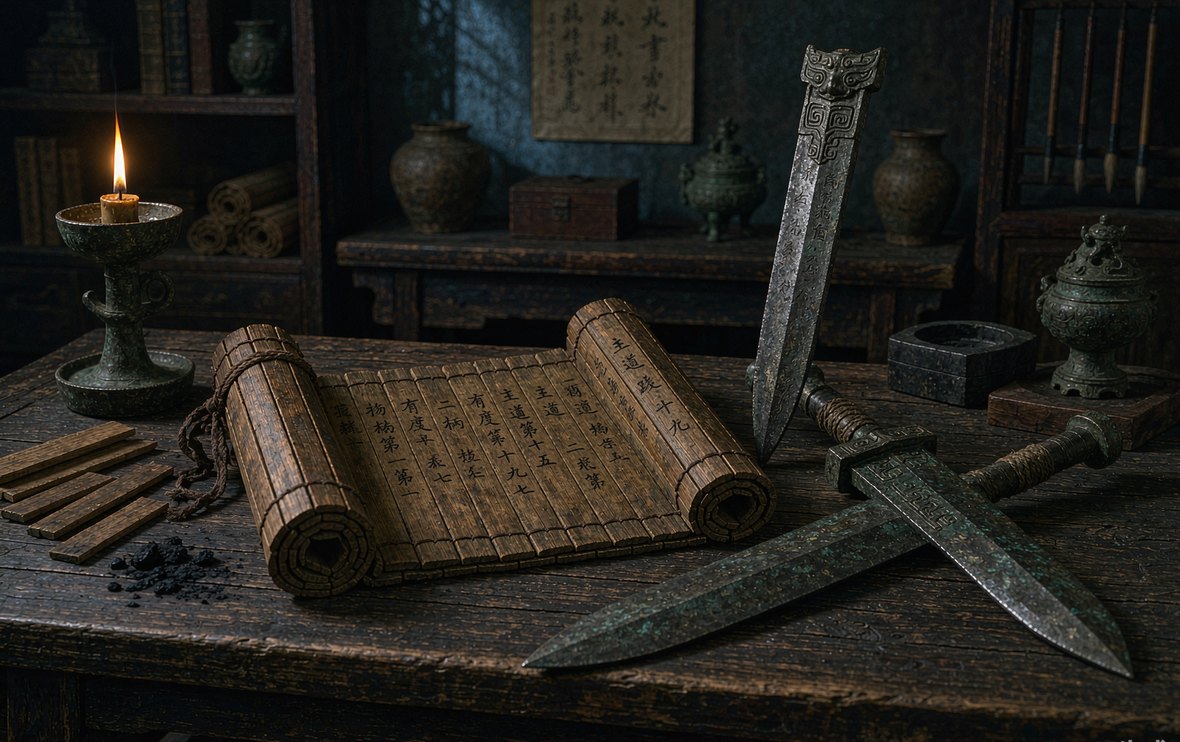
The coldest and most controversial school among the Hundred Masters. Confucians believed in moral education; the Legalists acknowledge only interest and harm. Confucians looked back to Yao and Shun; the Legalists face only reality. Shang Yang stressed “law” (fa), Shen Buhai “technique” (shu), Shen Dao “positional power” (shi), and Han Fei fused them into a complete, strikingly modern theory of power: law to set the rules, technique to manage the ministers, positional power to dominate the whole board. It was this body of thought that reforged the frontier state of Qin into a high-efficiency war machine, ended five hundred years of division, and shaped the underlying operating system of the centralized empire for the next two thousand years. Legalism was indeed cruel — book burning, collective punishment, harsh penalties for petty crimes are its birthmarks. But the seeds of equality in “when a prince breaks the law he shares the commoner’s penalty,” the reformist spirit of “do not model yourself on antiquity,” and the evolutionary view of history in “when the law moves with the times there is order” are equally its bequest to China. Only by reading the Legalists does one read the other half of Chinese politics.
The entire institutional design of Legalism rests on a nearly ruthless judgment of human nature: “ministers serve their own great advantage”; “even parents treat their children with a calculating mind.” This goes further than Xunzi — Xunzi hoped education would transform human nature, while the Legalists simply bypassed education and steered behavior directly through structures of interest: generous and reliable rewards, heavy and certain punishments, so that people obey order automatically as they pursue gain and avoid harm.
This institutional thinking — “appeal to no one’s goodness, only guard against great evil” — quietly anticipates the modern spirit of the rule of law: a good institution does not assume everyone is a saint; it makes it impossible for bad men to do bad things. Shang Yang “moved the pole to establish trust,” spending fifty gold to buy the credibility of the government — the Legalists knew well that a system’s life lies not in the elegance of its clauses but in the certainty that commands, once issued, will be carried out.
Han Fei synthesized the three schools: law (fa) — written into registers and statutes, established in the offices, published to the people: rules must be public, uniform, and predictable. Technique (shu) — concealed in the ruler’s breast, quietly controlling the ministers: the sovereign must have the means to appraise, inspect, and detect treachery. Positional power (shi) — the wherewithal to overpower the many: the momentum of power matters more than personal worth — “Yao as a commoner could not govern three men; Jie as Son of Heaven could throw the whole world into chaos.”
This three-dimensional model was China’s earliest “science of power structure”: law solves the system’s predictability, shu solves the principal–agent problem, shi solves the source of legitimacy. For the next two thousand years, whatever dynasty proclaimed rule by virtue, the skeleton of governance remained Legalist — the phrase “Confucian outside, Legalist within” says it: Confucianism was the official rhetoric; law was the real engine.
国无常强,无常弱。奉法者强则国强,奉法者弱则国弱。 — No state is forever strong or forever weak: if those who uphold the law are strong, the state is strong; if they are weak, the state is weak.——Han Feizi · “You Du” (Having Standards)
Shang Yang’s reforms were a systematic institutional re-creation rare in the ancient world: the well-field system abolished, the cross-paths opened, private land ownership recognized; hereditary office and salary abolished, ranks of nobility granted for military merit, aristocrat and commoner competing on the same stage; households registered and the commandery–county system established, remaking a kinship state into an administered one. In twenty years Qin leapt from weak border state to the strongest of the Warring States — institutional efficiency was demonstrated to all of East Asia for the first time.
More far-reaching was the Legalist view of history: “There is no single way to govern an age, and one does not model the state on antiquity”; “when the law moves with the times there is order; when rule fits its age there is achievement.” This anti-revivalist, evolutionist stance was thunder at dawn in an era that worshipped the sage-kings of the three ancient dynasties. Later, Wang Anshi, Zhang Juzheng, and modern reformers all claimed Shang Yang’s lineage — and the loneliness and tragedy of reformers has replayed in the same script for two thousand years: Shang Yang torn apart by chariots, Wu Qi dismembered, Han Fei dead in prison. Those who build the engine for empire are usually the first run over by it.
The Legalists helped Qin absorb the six states and gave China “one script, one gauge for axle-widths” — henceforth the empire had its institutional template of grand unification: commanderies and counties, household registration, appointed officials, documentary administration. Han inherited the Qin system, and for a hundred generations the Qin political order was carried on. In today’s administrative map, bureaucratic system, and instinct for a unified market, one can still hear, deep down, the footsteps of the Legalists.
But the price was equally heavy: harsh laws, cultural control, the people treated as instruments — the Qin, dead in its second generation, demonstrated in fifteen years the limit of pure Legalism. Rulers after the Han learned balance — Confucian surface over a Legalist frame, virtue as master and punishment as servant, wrapping the steel bones of Legalism in the warmth of Confucianism. That tension forms the long-term structure of Chinese politics: honoring Confucius and Mencius in ideals, applying Han Fei in operations; seeking efficiency in institutions, warmth in the human heart.