Founder
Mozi (Mo Di, c. 468–376 BC)
The school that most resembles a populist part...
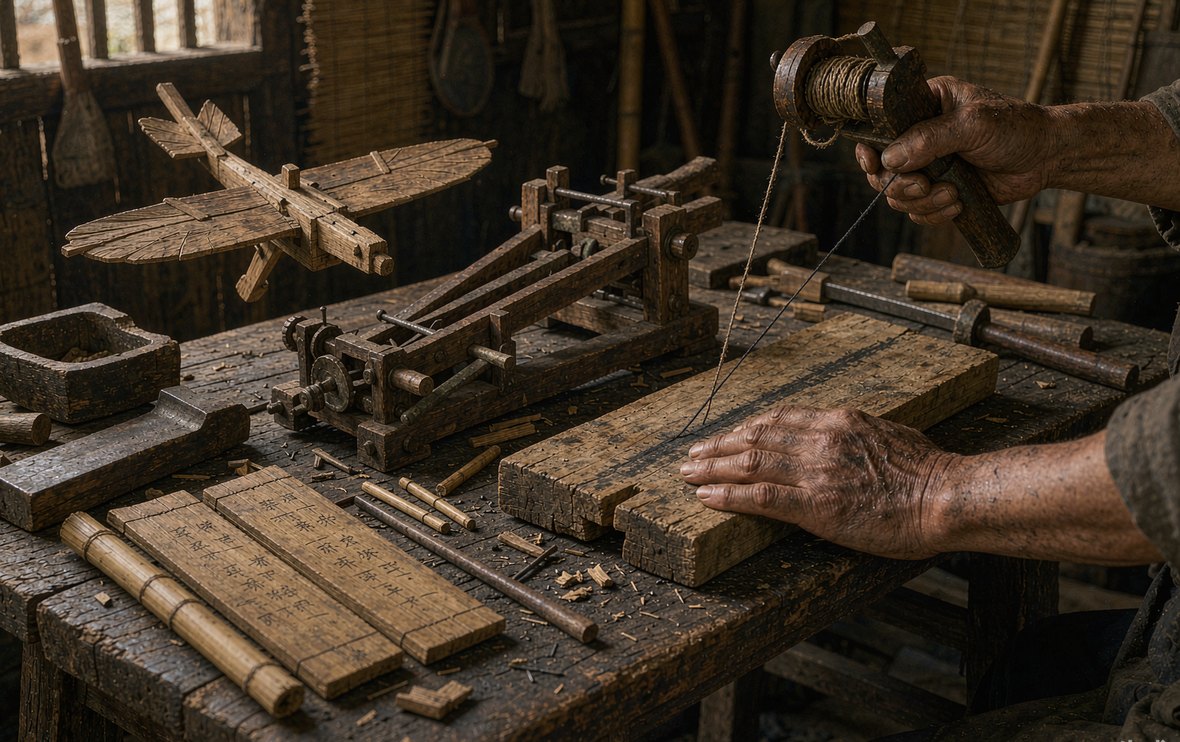
The school that most resembles a populist party among the Hundred Masters. Its founder Mozi (Mo Di) came from the artisan class; his followers were mostly craftsmen and men-at-arms, with tight organization, a supreme leader called the Juzi, and a shared discipline — through boiling water and onto blades, they did not turn their heels. In the Warring States era Mohism ranked with Confucianism as a “conspicuous school”: Han Fei said “the conspicuous schools of the age are Confucianism and Mohism,” and Mencius’s furious denunciations are themselves proof of its momentum. The Mohists taught universal love (jian ai, love without gradations), non-aggression (fei gong, opposition to wars of conquest), exalting the worthy (shang xian, appointing regardless of kinship), frugality in use and moderation in burial (against extravagant rites and music), and developed astonishing early shoots of logic (Mohist disputation) and natural science (mechanics, optics, geometry). After Qin and Han the school vanished for two thousand years, only rediscovered in the Qing — but its ideals of universal love and non-aggression, and its method of experiment and verification, were so far ahead of their time that reading them today is like lightning across a night sky.
Confucians taught that “love has gradations,” radiating outward from the near to the far; the Mohists insisted on cutting that arc: “Treat another’s state as your own, another’s family as your own, another’s person as your own.” Universal love was no sentimental slogan but an argument from interest: disorder in the world arises from “mutual injury” — everyone loving self and not others, so the strong bully the weak and the many oppress the few; conversely, “whoever loves others is loved by them in return,” so universal love is the game strategy with the lowest total social cost.
In a patriarchal clan society this was near heresy — how could love not distinguish near from far? Mencius denounced it as “abandoning one’s father.” But seen from a distance, the Mohists were the school closest to “the equality of persons”: the reason for loving does not change with blood or rank. Read two thousand years later, “love one another universally; benefit one another mutually” is almost a herald of modern public ethics and the idea of fraternity — and the ages of its burial remain one of the most lamentable forks in the history of Chinese thought.
Mozi distinguished “attack” (gong) from “punitive campaign” (zhu): invading an innocent state is an attack, a great harm to the world; chastising a guilty tyrant is a punitive campaign, a righteous act. He ran the cold arithmetic: a single war “in spring wastes the people’s plowing and planting, in autumn their harvest and gathering,” seizing their wealth and costing their lives — even in victory, “reckon what is gained and it is less than what is lost.” Measuring war by the ledger of people’s livelihood turned moral condemnation into economic argument.
The Mohists did not stop at argument; they organized for action. To stop Chu from attacking Song, Mozi walked ten days and ten nights to the Chu capital, ran a war-game against Gongshu Ban — nine attacks, nine repulses — and finally persuaded the King of Chu to stand down: the modern ideal of international mediation performed in person by a commoner scholar twenty-three centuries ago. Their siege engines and city-defense regulations (the chapters on defending cities) form the earliest system of military engineering — its logic: only the ability to fight can end fighting; that is true non-aggression.
爱人利人者,天必福之;恶人贼人者,天必祸之。 — Whoever loves and benefits others, Heaven will surely bless; whoever hates and harms others, Heaven will surely curse.——Mozi · “Fa Yi” (On Standards)
The records in the Mojing (Mohist Canon) startle historians of science: the mechanics of lever and fulcrum (“the near end short, the far end long”), the camera-obscura experiment of the inverted image (“the shadow is inverted where the rays cross at a point”), a proto-binary proposition (“one is less than two yet more than five”), and strict geometric definitions of circle, plane, and straightness — “a circle: one center, equal lengths all around.” Mohist disputation further developed a reasoning framework of “cause, principle, kind” and a logic of “name, proposition, inference” — the only system of thought in pre-Qin China that could stand beside Greek logic and Indian Nyaya.
With the unification of Qin and Han, Mohism — for its organization and its hostility to ritual and music — was suppressed by the state and became a lost learning; the shoots of science and logic snapped, and Chinese thought turned inward toward mind and nature. This interruption has been chewed over by modern scholars like a famous case: had Mohism not died, might Chinese civilization have taken another path of knowledge? History has no ifs — but the torn pages of the Mojing remind posterity: that road was not one China never walked.
The Mohists had an organizational discipline rare among the schools of the Warring States: leadership passed through the Juzi system; disciples “took the Juzi for a sage, all willing to go before him”; discipline was iron — “through fire and onto blades, dying without turning a heel.” They wore short coarse cloth, ate greens and wild herbs, supported themselves by their own labor, and stood ready to die for principle — Meng Sheng leading one hundred eighty-five disciples to die together in keeping a promise to Lord Yangcheng is the most tragic scene of the pre-Qin age.
This near-religious devotion made the Mohists formidable in a chaotic age and sowed the seeds of their extinction: a moral threshold set too high, a love that ran against human feeling, an independent organization incompatible with royal power. After the Han, universal love sank into popular chivalry, non-aggression became a gene of peace, and the shoots of science waited two thousand years for rediscovery. The Mohists disappeared — but whenever the nation met its crises, among those who stepped forward and spent their whole households to relieve the calamity, there were always the souls of Mohists.