Author
Shen Kuo (1031–1095)
The notebook of the Northern Song scientist Sh...
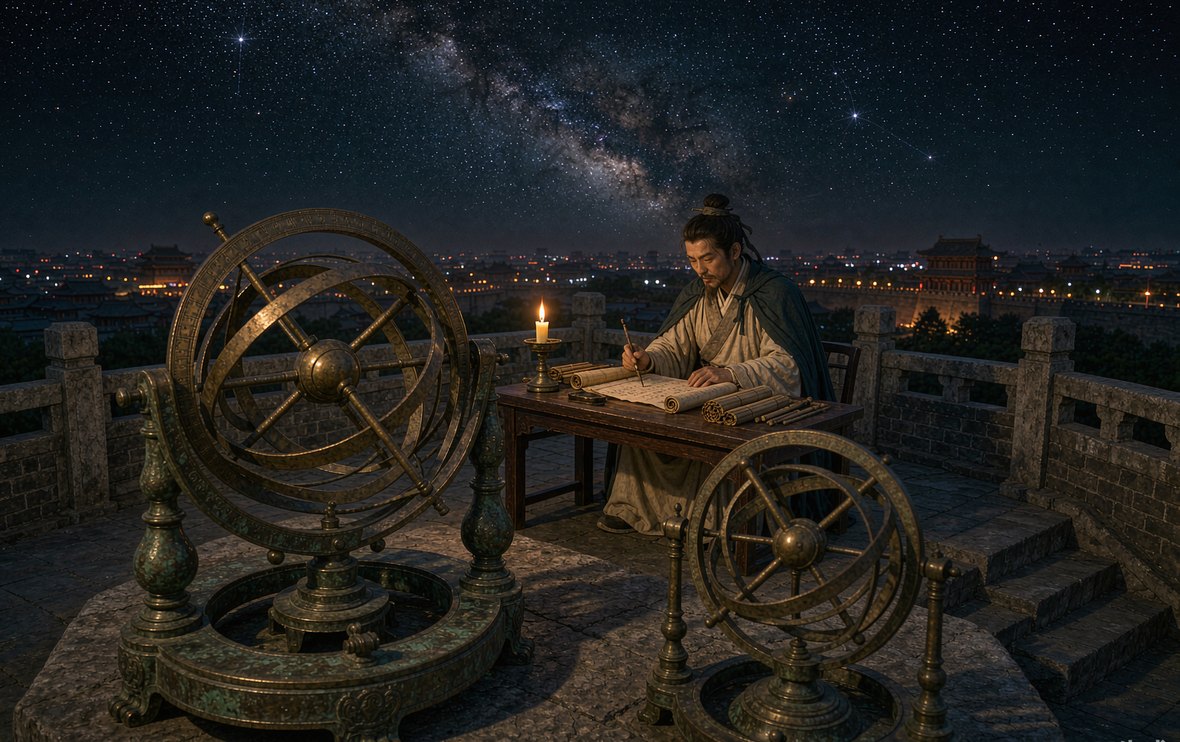
The notebook of the Northern Song scientist Shen Kuo (1031–1095), written in retirement at Dream Pool Garden near Zhenjiang: twenty-six chapters, with the later *Supplemental* and *Further Brush Talks*, 609 entries in all, ranging across astronomy, mathematics, physics, geology, geography, biology, medicine, military affairs, literature, historiography, music, painting and calligraphy. Joseph Needham called it "a milestone in the history of Chinese science". Within it shine discoveries of world class: the earliest record of magnetic declination, four centuries before Europe; the only contemporary account of movable-type printing; the mathematical inventions of packed-pile series and the arc method; the naming of petroleum, with the prophecy that "this thing will surely come into wide use". It is also a panorama of Song civilisation — the craftsmen Bi Sheng, Wei Pu and Yu Hao are known to us only because Shen Kuo wrote them down. A scholar's notebook became the first window onto Chinese science and Song society.
The *Dream Pool Essays* is a notebook, yet it does the work of scientific history. Shen Kuo drew on a lifetime of travel and observation as an official, ordering what he saw into entries. The astronomical chapters record his rebuilding of instruments as director of the observatory, and his dismissal of ignorant placement officials; the mathematical entries set out the packed-pile method for summing series of higher order, and the arc method for approximating the length of a bow-shaped arc; the physical entries note the pinhole image, the inverted image in a burning mirror, and the needle that "always leans slightly east" — magnetic declination, recorded systematically four hundred years before Columbus.
Needham's phrase "a milestone in the history of Chinese science" is exact, because entry by entry the book fixes the true waterline of eleventh-century Chinese science: not legend or conjecture, but observation that can be checked and repeated. In an age before the history of science existed as a discipline, a Chinese scholar filed the records himself. The value of the book has only grown with time.
The book preserves several world firsts. The chapter on crafts records that in the Qingli era the commoner Bi Sheng made movable type from baked clay — characters cut in clay, fired hard, a forme printed and the type used again — the only contemporary document of the invention, and the reason Bi Sheng's name survives. Chapter twenty-four notes petroleum seeping from the ground in Shaanzhou, its smoke "very thick"; Shen Kuo made ink from the soot and wrote that "this thing will surely come into wide use". He gave the substance its Chinese name, and the prophecy came true a thousand years later.
Beyond mathematics lie insights in earth science. Observing oyster shells and gravel bands in the cliffs of the Taihang Mountains, he concluded "this was once the seashore" and argued that the North China Plain had been built up by river silt — the earliest statement of alluvial formation. Seeing the peaks of Mount Yandang "all enclosed within the valleys", he explained their steepness by water erosion — a theory of landform six hundred years before the West. Medicine and pharmacology, plants and animals, music theory, painting and calligraphy: each has its own entries. It is a polymath's full accounting of his age.
予退处林下……思平日与客言者,时纪一事于笔,则若有所晤言,萧然移日。 — In retirement beneath the trees… I recall what I once said to guests, and now and then set down a matter with the brush; it is as if I were speaking with someone, and the quiet day slips away.——Shen Kuo, preface to the Dream Pool Essays
Shen Kuo's achievement rested on a rare intellectual character: he was not content with hearsay and always sought the reason. He observed the pole star for three months and drew more than two hundred diagrams to correct the offset between the pole star and the celestial pole. Sent on mission to the Khitan, he surveyed the route as he went. He fought floods, toured Zhejiang, compiled a calendar — every posting became an occasion for inquiry. His methodological self-awareness is rarer still: he rejected "deciding by conjecture" and insisted on "verifying by practice" and "reasoning from principle" — an early form of empirical discipline.
He was also a failed reformer and a demoted official. Caught in the factional wars of the New Policies and blamed for the disaster at Yongle Fort, he was disgraced in old age and retired to Dream Pool for eight years, turning a lifetime of observation into notes: "In retirement, deep in solitude, I kept no company… of state counsels and matters touching the court I dared not write privately." Failure in office bought success in knowledge: the world lost a capable minister and gained an imperishable book.
The *Dream Pool Essays* set the standard for the scholarly notebook. From the Song and Yuan onward the biji became a chief channel for preserving knowledge — Hong Mai's *Rongzhai Suibi*, Wang Yinglin's *Kunxue Jiwen*, Fang Yizhi's *Wuli Xiaoshi* all descend from it. The movable type of Bi Sheng, Yu Hao's *Timberwork Manual*, Wei Pu's calendrical astronomy: all are achievements in craft and science that the official histories never noticed, and without Shen Kuo these names would be silence. The notebook supplies the other half of a civilisation that official history leaves out.
What strikes a reader today is the dignity of curiosity. Why does a lodestone lean east? Why does one sound make another thing resonate? Shen Kuo did not always answer correctly, but he recorded every question with respect. Whether a civilisation has a future in science depends on whether anyone takes small strange things seriously. In six hundred entries Shen Kuo told posterity that to look carefully is itself a noble vocation.