Compiled
Fixed under the Han · 246 problems · 9 chapters
The founding work of ancient Chinese mathemati...
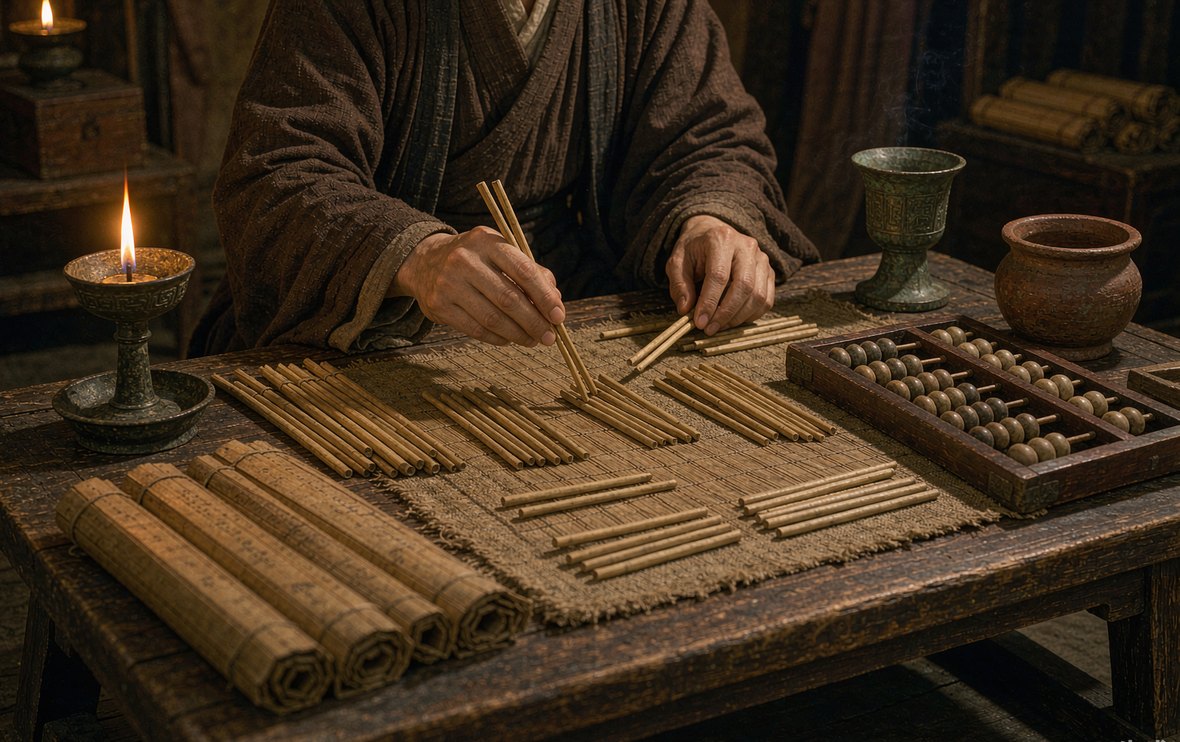
The founding work of ancient Chinese mathematics, compiled in the Han dynasty and fixed in form by the first century AD: nine chapters, 246 problems, moving from field measurement and grain exchange to the method of equations and the right triangle — a complete system of practical mathematics. Its form is the triad of problem, answer and method (shu): pose a real situation, give the number, then generalise the procedure. It prizes algorithmic efficiency above deductive proof, and stands beside Euclid's *Elements* as one of the two great wellsprings of world mathematics. In the third century Liu Hui wrote a commentary whose "circle-cutting" procedure closed in on pi until the commentary itself became an independent masterpiece. Negative numbers, proportion, the method of excess and deficiency, root extraction, elimination in simultaneous linear equations — achievements that led the world by centuries, sometimes by a millennium. From the Han classic to the arithmetic primers of today, the bloodline of Chinese mathematics has never stopped flowing.
Every problem in the Nine Chapters has three parts. The question (wen) sets out a concrete situation — "Now there is a field fifteen paces wide and sixteen paces long; what is its area?" The answer gives the number. The method (shu) generalises the procedure — "Method: take half the width and multiply by the length." The 246 problems look scattered, but they fall into nine chapters: square fields (area), millet and grain (proportion), distribution by rank, lesser breadth (root extraction), consultation on works (volume), equitable transport (taxation), excess and deficiency (surplus and shortfall), equations (simultaneous linear systems), and the right triangle. From field tax to irrigation works, mathematics here grows always out of the soil of daily life.
This algorithm-centred form stands in sharp contrast to the Greek axiomatic tradition: the *Elements* asks why something holds, the Nine Chapters asks how it is calculated. Neither is higher; they are two complementary paths. The Chinese algorithmic lineage ran from the Nine Chapters through the "celestial unknown" and "four unknowns" methods to the abacus, and it speaks uncannily to an age in which algorithm is program.
The list of firsts is astonishing. The chapter on equations sets simultaneous linear equations on counting rods and solves them by repeated multiplication and elimination — the same procedure as modern elimination, a millennium and a half before Europe. The rules for positive and negative numbers — "same name, subtract; different names, add" — form the world's earliest systematic treatment of negative quantities, and the mnemonic survives in classrooms today. The method of excess and deficiency solves linear problems from two trial assumptions; Arab mathematicians knew it as hisab al-khataayn, "the reckoning of the two errors", a trace of its westward travel.
The root-extraction chapter gives complete procedures for square and cube roots; the right-triangle chapter states the gou-gu relation — "multiply each leg by itself, add, and extract the root" — and applies it to surveying. Underneath it all lies a single habit: the universal, re-callable procedure rather than the isolated trick. For the next thousand years Chinese mathematics stayed at the world frontier, and its foundation was laid here.
析理以辞,解体用图。庶亦约而能周,通而不黩。 — To analyse principle in words, to dissect the figure by diagram: thus may one be concise yet complete, penetrating yet not muddled.——Liu Hui, preface to his Commentary on the Nine Chapters on the Mathematical Art
In 263 the Wei mathematician Liu Hui annotated the Nine Chapters and doubled its worth, supplying a reason for every method. His "circle-cutting" procedure inscribed ever finer polygons in a circle: "cut it finer and the loss grows smaller; cut again and again until no further cutting is possible, and the polygon coincides with the circle with nothing lost" — the first stirrings of the idea of a limit. He obtained pi of about 3.1416, the sharpest value of its age. His principle of "complementing by shifting in and out" proved the gou-gu relation by cutting and rearranging areas, joining geometric intuition to algebraic operation.
Liu Hui thus changed the character of the book: from a manual of algorithms to a system in which method and reason stand together. The commentarial tradition continued without a break — Li Chunfeng in the Tang, Jia Xian in the Song with his "diagram of the sources of root extraction" (Jia Xian's triangle, six hundred years before Pascal). A single classic kept growing through a thousand years of glosses: a living tradition.
Fixed under the Han, the Nine Chapters became the official textbook of mathematics. The Tang founded a school of calculation with it at the head of the "Ten Mathematical Classics" and set a civil-service examination in mathematics; Song editions appeared, and in the Yuan and Ming it was folded into the abacus tradition. Korea, Japan and Vietnam taught from it as well — the Sinographic world shared one mathematical inheritance. In 1607 Matteo Ricci and Xu Guangqi translated the *Elements*, and the two traditions met face to face. Qing scholars recovered the text: Dai Zhen copied it out of the *Yongle Encyclopedia*, and the old mathematics saw the light again.
Seen from today, its significance reaches beyond the history of mathematics. It proves that this civilisation possessed not only poetry and ritual but exact calculation and abstract intelligence. The habit of putting algorithm first that it shaped is finding fresh value in the age of computer science. From the exercise style of Chinese textbooks to the cultural gene behind the olympiad fever, the line still runs. The Nine Chapters is another boundary stone of the Chinese rational spirit.