Author
Song Yingxing (1587–c. 1666)
The world’s first comprehensive encyclopedia o...
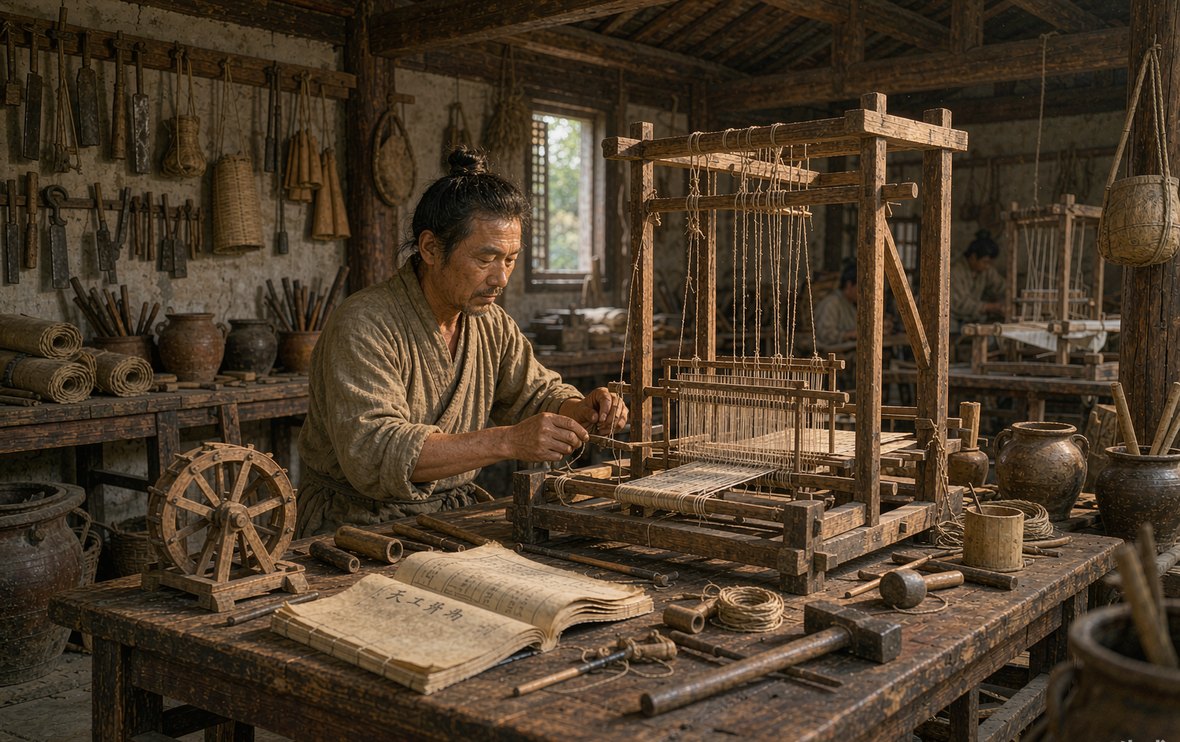
The world’s first comprehensive encyclopedia of agricultural and handicraft production, printed in 1637 (the tenth year of Chongzhen, late Ming), written by Song Yingxing, a juren from Fengxin, Jiangxi. In three juan and eighteen chapters with more than 120 illustrations, it covers from rice cultivation, sericulture, and silk reeling to metallurgy, boats and carts, coal mining, and papermaking — nearly the whole of China’s productive technology of the time, its text and pictures together like a documentary film of Ming technology. The title “Tian Gong Kai Wu” — “heaven’s work, opening things”: nature creates, and human skill takes its part, joining the work of heaven to the strength of men. Song Yingxing completed this turn of knowledge on the road of repeated examination failures: “this book has nothing whatever to do with pursuing rank” — he gave up the eight-legged essay to write the biography of artisans and farmers. The book was once lost in China, yet circulated and was translated in Japan, France, and England; Darwin called it an “authoritative work”; in the twentieth century it was brought back from Japan, a first-hand treasury for the study of Chinese science and technology.
The very order of the chapters is a declaration: Naigai (Grains) first, Naifu (Clothing) second, followed by Zhangshi (Dyeing), Cuijing (Grain milling), Zuoxian (Salt-making), Ganxi (Sugar-making); and Zhuyu (Pearls and Jade) placed at the very end of the book. Song Yingxing’s preface says it plainly: “prize the five grains, slight gold and jade” — the people’s food is the root, ornaments the branch. In the arrangement of a technical book, a plain care for the people is written down.
This stance is unique among state-commissioned classics: the official histories recorded emperors and generals; farmers, artisans, and merchants entered no biography. Song Yingxing wrote biographies for plows and harrows, looms and hammers, furnaces and carts, raising the ingenuity of craftsmen to the same height of observation as the sages. The Tiangong Kaiwu is thus not only a technical record but a document of values: the true foundation of a state lies not in the gold and silver of the treasury but in the rice in the fields and the hands of the artisans.
The eighteen chapters weave a complete web of production: Naigai records rice and wheat — seed selection and soaking, transplanting, fertilizing, disaster prevention, even rice rotation with lime to neutralize acid soils; Naifu details the structure of the figure-weaving loom (“hua ji”) and the division of labor among weavers of gauze, silk, and cloth; Cuijing records grain processing with water-powered hammers and mills; Zuoxian the three methods of sea, well, and lake salt; Ganxi the full process of cane sugar.
The handicraft chapters go deeper still: Wujin (Metals) records coal mining and smelting — vertical-shaft mining, the “burn orpiment to find coal” gas-detection method, the co-fusion (guan-gang) steel process, lost-wax casting; Taoyan (Ceramics) records brick, tile, and porcelain — the seventy-two steps of Jingdezhen blue-and-white, “a single vessel passes through seventy-two hands before it is done”; Zhouche (Boats and Carts) records the forms and structures of canal barges and sea ships; Shajing (Papermaking) records the boiling, dipping, and drying of bamboo paper and bark paper — every chapter with its working drawings, machine forms and operating postures drawn as pictures. This was the seventeenth century’s most complete atlas of production technology.
生人不能久生,而五谷生之;五谷不能自生,而生人生之。 — Humans cannot live on by themselves, yet the five grains give them life; the five grains cannot grow of themselves, yet humans give them life.——Song Yingxing, Tiangong Kaiwu · “Naigai” (Grains)
The 121 illustrations are a great innovation: the ox-plowing picture, the hua-ji loom, the water hammer, the iron smelting furnace — all drawn to scale of machine structure, with figures showing operating postures — even the illiterate could read the pictures and understand. Song Yingxing knew the bottleneck of technology was transmission: “among artisans, none serves as teacher” — vague writing and the craft dies; hence pictures to certify text, numbers to fix measures — the dimensions of the plow, the parts of the loom, the heat of the furnace — all made buildable from the page.
This consciousness of “standardized documentation” gives it value beyond any notebook: researchers in twentieth-century agricultural, textile, and metallurgical history reconstructed Ming water hammers, hua-ji looms, and smelting furnaces from the book’s data, and all ran as at first. What a technical book fears most is “knowing that it works but not by what measure”; every picture and every dimension in the Tiangong Kaiwu is a reproducible key left for posterity — the first faint voice of modern engineering documentation.
The fate of the Tiangong Kaiwu makes one sigh: printed in the late Ming, reprinted in the early Qing; but when the Qianlong emperor compiled the Siku Quanshu, phrases like “northern captives” and “northeastern barbarians” gave offense, the book was excluded, and it gradually scattered in China. Abroad it thrived: it reached Japan in the late seventeenth century, becoming the “learning of the opening of things” widely cited in Edo scholarship, with dozens of Japanese printed and manuscript editions; in the late eighteenth century it reached France, where the sinologist Stanislas Julien translated selections on sericulture and papermaking — Darwin, in The Variation of Animals and Plants under Domestication, called ancient Chinese works on silkworm raising “authoritative,” and his citation came from here.
Not until 1927 did the scholar Tao Xiang reprint it from Japan’s Kanseido edition, and “the encyclopedia of seventeenth-century Chinese crafts” returned to its homeland. Since the 1960s the Tiangong Kaiwu has been translated into many languages, and Song Yingxing’s statue stands in his native Fengxin. A technical book written for artisans, going around the earth and back to China — proving precisely the words of its preface: “heaven overspreads, earth upbears; the things that fill them number in the ten thousands.” The road to knowing the world has never run only through the court.