Date of Compilation
From the Yu-Xia era · edited under Zhou
China’s earliest anthology of state documents,...
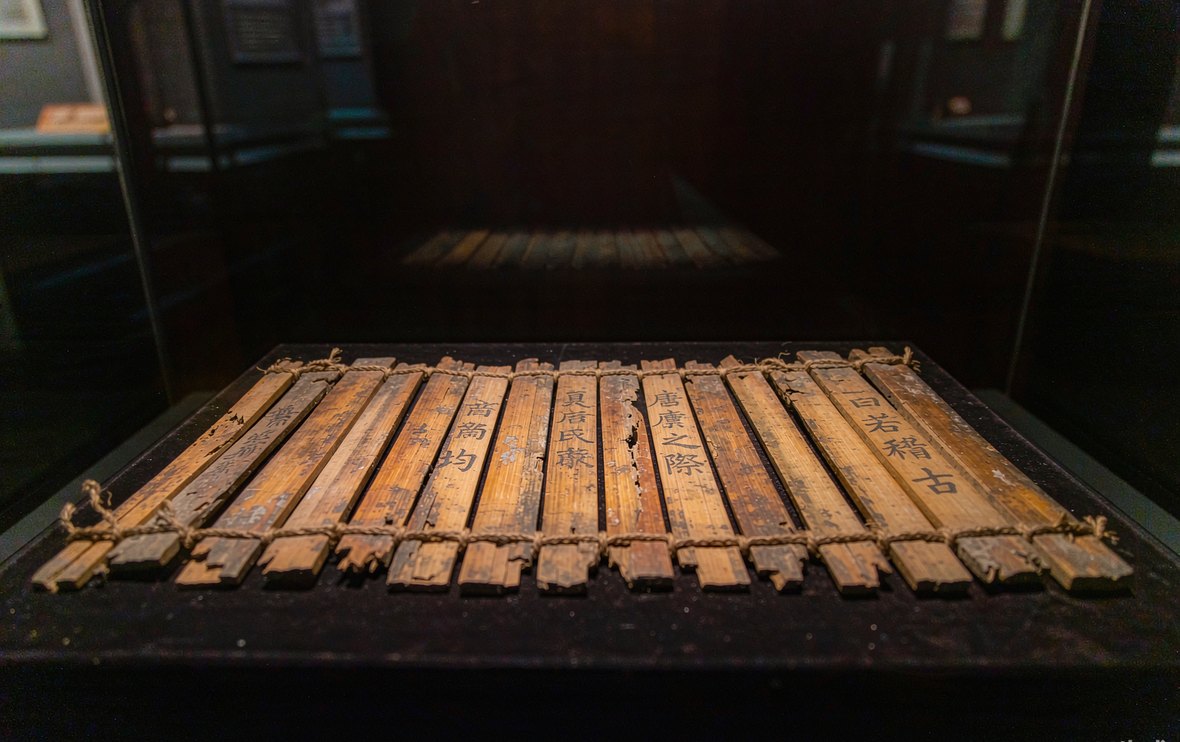
China’s earliest anthology of state documents, reaching from the legendary Yu and Xia to the Spring and Autumn era, gathering the six genres of official writing — canons, counsels, instructions, proclamations, harangues, and commands — and recording the political scenes of Yao and Shun’s abdication, Yu the Great’s flood control, the revolutions of Tang and Wu, and Pan Geng’s move to Yin. It is called "the ancestor of books of statecraft": the philosophers cited it as authority, emperors honored it as a manual of rule, and both the people-first doctrine that "the people are the root of the state" and the world-vision of "harmonizing the myriad states" began here. Its fate was especially perilous: after the Qin burning, the ninety-year-old Fu Sheng recited twenty-eight chapters from memory; Han-era disputes between the Old and New Text followed; Mei Ze presented an "old text" in the Eastern Jin; and in the Qing, Yan Ruoqu, with over a hundred ironclad proofs, judged twenty-five chapters forged — the authentication history of one book is half the history of Chinese scholarship. Those three-thousand-year-old conversations on the Mandate of Heaven, the people’s hearts, and virtuous rule remain the living source of Chinese political language.
The Book of Documents’ extraordinary quality is its "presence at the scene": not later retrospection but the original paperwork of political decision. The Pan Geng chapters record a ruler’s repeated persuasions before moving the capital, alive still in the simile "like threads on the warp, orderly and unbroken"; the Harangue of Tang records Tang’s oath before attacking Jie — "This sun, when shall it perish? We shall perish with you!" — the people’s curse on a tyrant, preserved whole; the Great Proclamation and the Proclamation to Kang record the Duke of Zhou’s instructions to kinsmen and the Shang people around his eastern campaign, each political move in clear view.
This makes the Documents China’s first-hand source in political science: two models of succession (abdication and revolution), two grounds of legitimacy (the Mandate of Heaven and the people’s hearts), two arts of governance (virtue and punishment) all make their first systematic appearance in these ancient texts. Confucius taught from it — "the teaching of the Documents makes one broadly informed and far-sighted"; emperors kept it as a manual of governance — what was called ancestral instruction mostly set out from here.
"The people are the root of the state; when the root is firm, the state is at peace" — from the Songs of the Five Sons: the stability of any regime lies in the people, the Documents’ loudest political thesis. A more systematic statement appears in the Counsel of Gao Yao: "Heaven sees as my people see; Heaven awes as my people awe" — Heaven’s intent appears through the people’s sentiment, the popular heart being the display of Heaven’s heart. The Great Oath goes further — "Heaven sees as my people see; Heaven hears as my people hear" — seating the people as the final judge of political legitimacy.
This doctrine ran deep: Mencius’ "the people are most precious; the ruler is least," Xunzi’s "the ruler is the boat, the people the water," Tang Taizong’s "water can carry the boat and capsize it" are all its extensions. Reread two thousand years on, the Documents had long since fixed an iron law of Chinese politics — a regime’s survival depends not on armies and sacrifices but on how the people live.
天视自我民视,天听自我民听。 — Heaven sees as my people see; Heaven hears as my people hear.——Book of Documents, Great Oath
The transmission of the Documents is a bibliographic thriller: when Qin burned the books, Fu Sheng of Jinan hid the hundred-chapter Documents in a wall; civil war in early Han destroyed most of it — from the wall only twenty-nine chapters remained, and he was past ninety. The court sent Chao Cuo to receive them; the old man recited from memory, and the text was fixed in Han clerical script — this is the New Text Documents.
For four hundred years the Old and New Text schools fought over authenticity and contents; in the Eastern Jin Mei Ze presented a fifty-eight-chapter "Old Text," honored as orthodox from Tang through Song for a thousand years. Not until the early Qing did Yan Ruoqu, in his Evidential Commentary on the Old Text Documents, peel through one hundred twenty-eight arguments to prove twenty-five chapters later forgeries — thirty years by a lonely lamp, all to verify one ancient book. This battle of authenticity was Chinese philology’s summit duel, and the scholarly ethos of "seeking truth from facts" flourished from it.
The Canon of Yao opens with a political blueprint: "He made bright his lofty virtue, and the nine kin grew close; the nine kin being harmonious, he ordered the hundred officials; the hundred officials being brightened, he harmonized the myriad states." From personal virtue outward to family concord, ordered officialdom, and the concord of all states — a political imagination extending layer by layer, setting the basic grammar of how Huaxia would order both internal order and the outer world: persuading by virtue and transforming by culture, not conquering by force.
"Heaven’s work — man carries it out" — humans should govern the world in the pattern of Heaven’s way; "his light shone to the four quarters" — civilization’s radiance should reach all directions. This world-vision shaped the later tributary system and the ideal of cultural radiance, and shaped the Chinese imagination of good politics: true strength is not territory or arms, but virtue sufficient to bring near and far to peace. Three thousand years on, "harmonizing the myriad states" still hangs in contemporary China’s diplomatic language — the oldest book of statecraft still speaks.