Lineage of composition
Fu Xi drew the trigrams · King Wen arranged them · Confucius wrote the commentaries
Honored as “the first of all classics,” the I ...
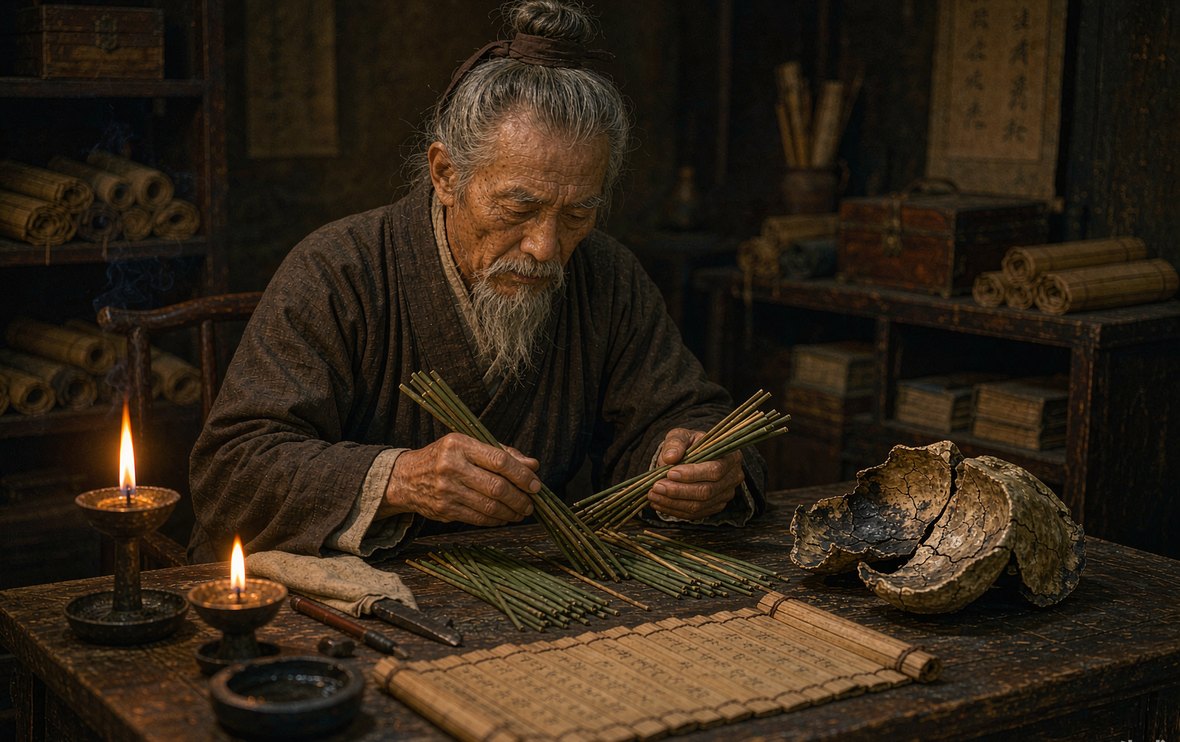
Honored as “the first of all classics,” the I Ching is China’s oldest ur-text of thought. It began in divination, matured in the early Zhou, and settled into a symbolic system of sixty-four hexagrams and three hundred eighty-four lines; with the philosophical elaboration of the “Ten Wings” (the Yizhuan commentaries), it rose from a book of divination to a cosmology that expounds the very logic of change. The binary symbols of yin and yang lines, the generative logic of the four images and eight trigrams, and the dynamic worldview of “when exhaustion is reached, change comes; when change comes, there is penetration; when there is penetration, it endures” — these form the underlying language of Chinese thought. For two thousand years it served at court as the grammar of imperial decision-making and among the people fed the hundred streams of Chinese medicine, fengshui, and divination; more, with the eight characters “strive without cease, carry all things with ample virtue,” it became the motto of Tsinghua University and a self-portrait of the national character. To read the I Ching is to grasp the basic posture with which the Chinese observe the world: everything is changing, and change itself has laws.
The whole edifice of the I Ching is built from only two symbols: the yang line (—) and the yin line (--). The two primal forces generate the four images, the four images generate the eight trigrams, and the eight trigrams toss and combine into the sixty-four hexagrams — a base-two symbolic system that can derive every type of situation covering heaven, earth, and human affairs. When Leibniz saw the diagram of the sixty-four hexagrams in their primordial arrangement, he marveled that it coincided exactly with his binary arithmetic: yin and yang were 0 and 1.
More astonishing still is its power of abstraction: the hexagrams and lines refer not to concrete things but to structures of situation (Qian as vigor and initiative, Kun as receptivity, Jiji as completion, Weiji as incompletion). This is one of humanity’s earliest exercises in “modeling thought” — compressing a complex world into symbols, then deriving possibilities from the symbols. Looking back after three thousand years, those two strokes of line were China’s earliest prophecy of the information age.
“Yi” carries three senses: change, simplicity, and constancy. The very arrangement of the sixty-four hexagrams is itself a treatise on change: Tai at its height turns to Pi; Pi at its depth returns to Tai; when Stripping is exhausted, Return begins; when Loss reaches its limit, Gain arrives. Each hexagram’s six lines climb from bottom to top, tracing the full cycle of a thing from germination and growth through zenith to turning point and decline — “the sun at noon begins to set; the moon when full begins to wane.” Even heaven and earth cannot endure in one state — how much less human beings.
The wisdom distilled from this ran deep in Chinese life: in prosperity, know fear — “in safety do not forget peril, in survival do not forget perishing”; in hardship, do not give up — “exhaustion yields to change, change to penetration, penetration to endurance.” The Yizhuan raised the cycle to a moral demand: heaven’s movement never rests, therefore the noble person strives without cease; earth bears all things without discrimination, therefore the noble person carries all things with ample virtue. A book of divination ends by teaching how to stand in an uncertain world.
穷则变,变则通,通则久。 — Where there is exhaustion, change comes; where there is change, there is penetration; where there is penetration, there is endurance.——Zhouyi · “Xici” II (Great Commentary)
The I Ching divines good and ill fortune, but the Yizhuan accomplished a decisive translation: “A family that accumulates goodness will surely have abundant blessing; a family that accumulates evil will surely have abundant calamity.” Fate is not the dice of the gods but the long accumulation of conduct; the hexagram indicates the trend, but the final decision remains with the human — “blessing from heaven, advantage without fail” presumes that “human planning” came first. “The maker of the Changes — did he not live in anxiety and care?” The whole book is steeped in clear-eyed preparation for the turn of fortune.
This sense of crisis became a fundamental emotion of Chinese culture: Fan Zhongyan’s “first to worry over the world’s worries,” the preventive logic of regimen in the Zhouyi Cantongqi, Chinese medicine’s “treat before illness arises” — all issue from here. It shaped a core character of Chinese civilization: no rescue from the other shore, but provision in this world — preparing for rain before it falls, advancing virtue and refining one’s work, keeping the reins of fate in one’s own hands.
The Yijing began as the Zhou royal house’s book of divination; the Yizhuan (Ten Wings), written by Warring States Confucians, gave the hexagrams and lines philosophical interpretation: in the Qian hexagram the image of the “dragon” is read as the six stages of a noble person advancing in virtue and work; in the Kun hexagram “frost, then solid ice” is read as checking evil at its first signs. This exegetical method — citing the classic to clarify meaning — completed the book’s philosophical metamorphosis and opened the later tradition of “the Six Classics annotating the self.”
Its influence long overflowed classical studies: the yin–yang diagnosis of Chinese medicine, the orthodox and the unexpected in strategy, the interplay of hard and soft in calligraphy, the curves and concealments of gardens — all carry the genes of Yi learning. Shao Yong’s image-number studies in the Song, Zhu Xi’s Original Meaning of the Zhou Changes, down to modern mathematical research — two thousand years of commentary form an independent history of interpretation. One may say the I Ching is the “source code” of Chinese thought: the cleverest minds of every age returned to those two strokes of line and set out again.