The four
Three Kingdoms · Water Margin · Journey to the West · Red Chamber
The collective name of *Romance of the Three K...
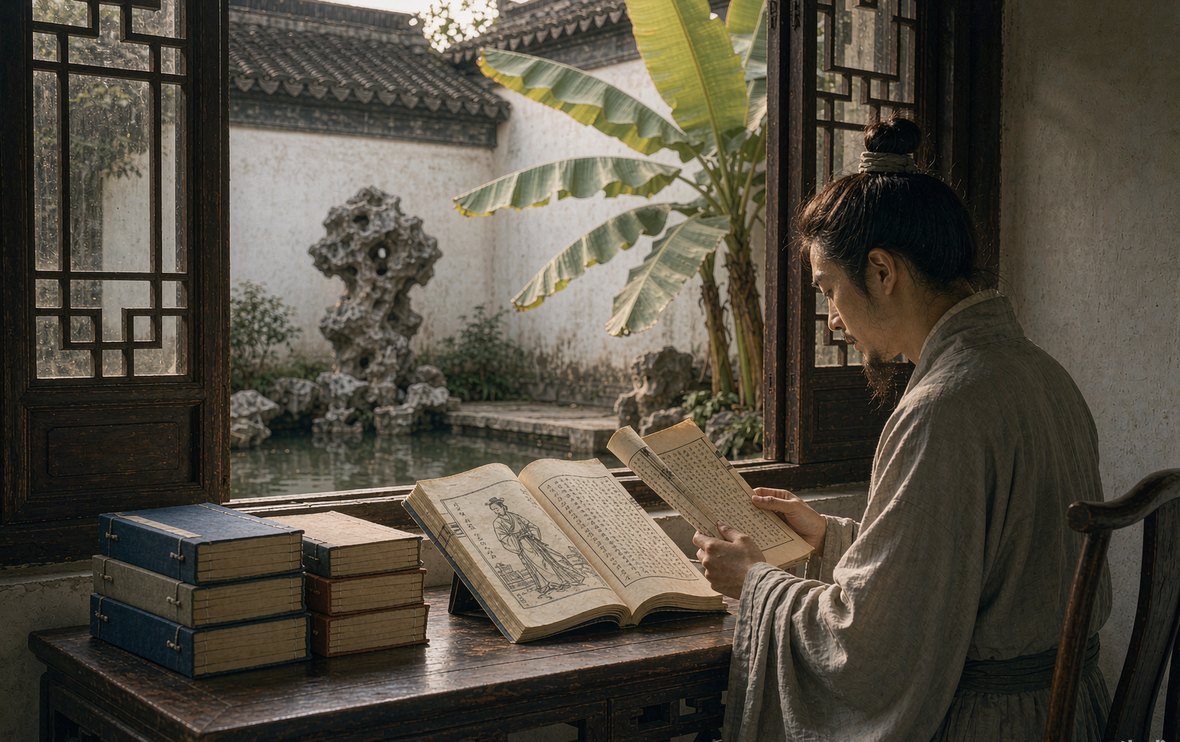
The collective name of *Romance of the Three Kingdoms*, *Water Margin*, *Journey to the West* and *Dream of the Red Chamber*: the four summits of the Ming and Qing vernacular novel, and the literary memory the Chinese hold most in common. Each opens a different dimension of the imagination. *Three Kingdoms* writes history and statecraft, with more than a hundred characters who live on the page. *Water Margin* writes the rivers-and-lakes world of outlaws and chivalry, 108 heroes gathered at Liangshan. *Journey to the West* writes gods, demons and self-cultivation, its eighty-one ordeals a map of the mind. *Dream of the Red Chamber* writes feeling and dissolution, a family history that becomes an elegy for a civilisation. All four grew from oral storytelling and accumulated texts, raised to perfection by Luo Guanzhong, Shi Nai'an, Wu Cheng'en and Cao Xueqin: vernacular literature came of age in them, and the novel rose from minor craft to canon. Opera, storytelling, film, television and games have retold them for four centuries. They are less four books than a public sphere of the Chinese spirit — without *Three Kingdoms* one does not understand strategy, without *Water Margin* the outlaw code, without *Journey to the West* self-cultivation, without the *Red Chamber* life itself.
The four novels form the four dimensions of the Chinese imaginative world. *Romance of the Three Kingdoms* opens with "the empire, long divided, must unite; long united, must divide" and writes loyalty and statecraft inside the cycle of history — the oath in the peach garden, the plan of Longzhong, the fire at Red Cliff — history become epic. *Water Margin* writes the world outside the system: oppression driving men to revolt, men driven up the mountain, a republic of 108 ranked brothers whose dream ends in amnesty and ruin; the limits of chivalry are explored to the end.
*Journey to the West* is a story of demons on the surface and of cultivation underneath: Monkey is the restless mind, the eighty-one ordeals are its road, and the rebel at last becomes a Buddha. *Dream of the Red Chamber* turns inward, to family and heart: the love of Baoyu and Daiyu, the decline of four great houses, and at the end "a vast white expanse, utterly clean". History, the outlaw world, gods and demons, human feeling — together the four books hold the whole of the Chinese imagination of its own world.
Their making is unusual: none is the work of one hand at one time. Each accumulated over centuries from histories, folk tales and storytellers' prompt books before a man of genius transmuted it. Luo Guanzhong worked from the popular *Tales of the Three Kingdoms*, Shi Nai'an gathered the Liangshan cycle, Wu Cheng'en shaped the pilgrimage legends, and Cao Xueqin wrote from his own family's ruin. This cumulative composition gives the books the smell of the soil they grew in.
Their canonisation is equally remarkable. The Ming and Qing state denounced novels as licentious and seditious and banned them without success. Commercial presses and great commentators fixed the texts — Jin Shengtan on *Water Margin*, Mao Zonggang on *Three Kingdoms*, the Red Inkstone on the *Red Chamber*. Liang Qichao's call for a revolution in fiction raised the novel to legitimate literature, and after the vernacular movement the four became the foundation of Chinese-language education. The finest models of vernacular prose are in these four books.
滚滚长江东逝水,浪花淘尽英雄。是非成败转头空。青山依旧在,几度夕阳红。 — The rolling Yangtze flows east; its waves wash away all heroes. Right and wrong, success and failure, are emptiness in a turning of the head. The green hills remain: how many times has the sunset glowed red?——opening poem of Romance of the Three Kingdoms
They long ago passed beyond literature to become a second mother tongue. Three visits to the thatched cottage; everything is ready but the east wind; driven up the mountain; when you see injustice, draw your sword; havoc in heaven; fiery eyes that see through all disguise; a vast white expanse, utterly clean — the idioms are countless. "You are just like Sister Lin" and "he is a latter-day Zhuge Liang" fill ordinary conversation. A Chinese who has never read the novels still lives inside the web of meaning they wove.
Their afterlife is a spectacle in itself: Peking opera's Three Kingdoms and Water Margin plays, Yuan Kuocheng's broadcast storytelling, the 1986 television *Journey to the West*, the 1987 *Red Chamber* that emptied the streets, strategy games and *Black Myth: Wukong* reaching the world. For four centuries each generation has retold the four stories in its own medium. A shared national text means that strangers possess the same heroes and the same tears.
Each travelled differently. *Three Kingdoms* is read in East Asia as a manual of war and of management, and the game industries of Japan and Korea mine it still. *Journey to the West* is translated into dozens of languages; the Monkey King is a familiar figure worldwide, and *Dragon Ball* descends from him. *Water Margin* reached English readers as *All Men Are Brothers* in Pearl Buck's translation and shaped American sinology. *Dream of the Red Chamber* has two complete English versions, by David Hawkes and Yang Xianyi, and is regarded as the highest achievement of Chinese literature.
In recent years *Black Myth: Wukong* sold tens of millions of copies worldwide, and players abroad read *Journey to the West* to follow the story — an old text reborn among the young through a game. The four prove one thing: a truly great story does not age, it only changes clothes. In the inner world of the Chinese these four old friends are always present.