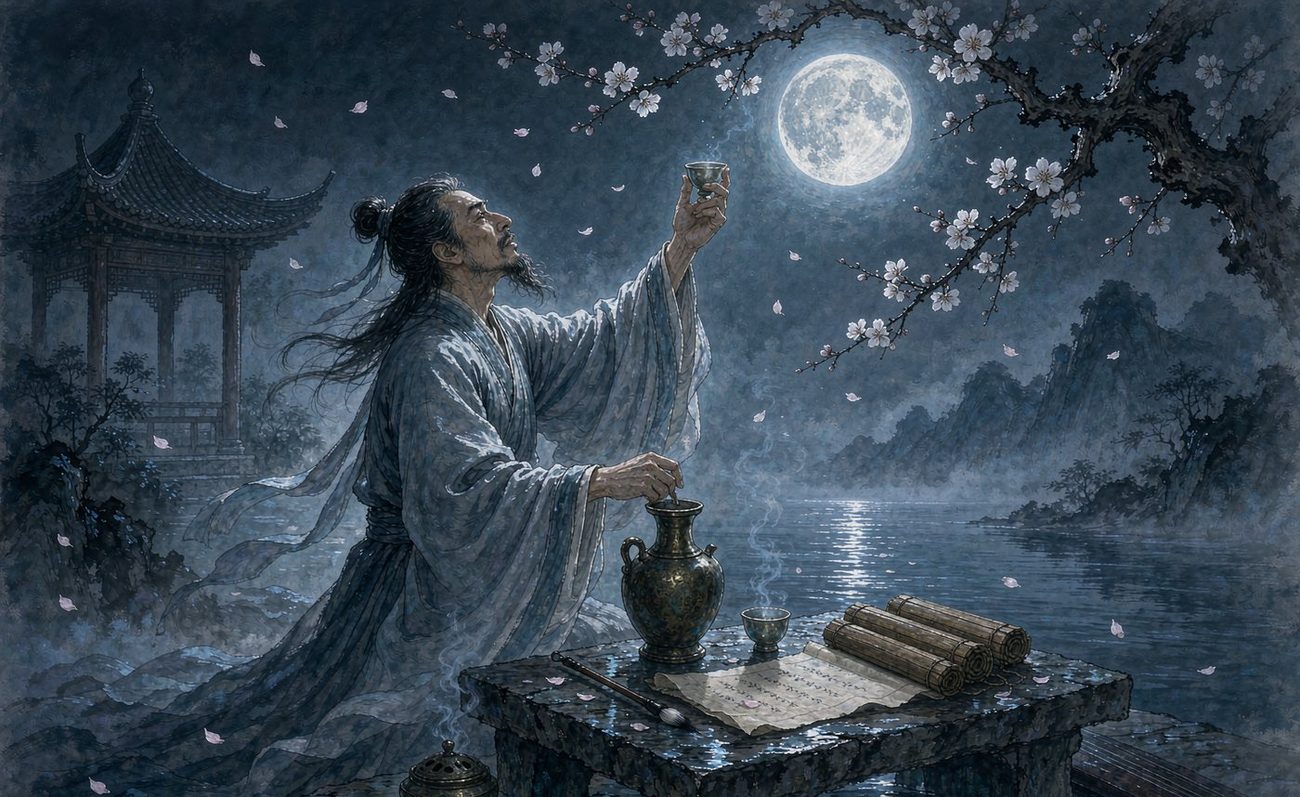
01
Tang PoetryPoetry
The air of the High Tang, a single word lasting a thousand years — the most radiant age of Chinese letters.
From the Book of Songs to Tang poetry and Song ci, China is a nation of poetry: Li Bai wrote a hundred poems on a measure of wine, Su Shi turned ci into a record of a life. Every Chinese speaker's “bright moonlight before my bed” is a line written a thousand years ago.
Over fifty thousand poems survive; Li Bai and Du Fu as twin peaks — the poetic gene of the mother tongue.
唐诗 Read the full entry “Tang Poetry” →
02
Song Ci Lyrics
Feeling in lines long and short, the graceful beside the bold: the utmost expression of Song literati spirit.
The literature of an era: Liu Yong, Su Shi, Li Qingzhao and Xin Qiji each opening a new realm.
Read the full entry “Song Ci Lyrics” →
03
Yuan Qu Opera and Songs
The birth of street-level letters: plain, alive, writing out every parting and warmth of the human world.
Twin summits of sanqu and zaju — Guan Hanqing, Ma Zhiyuan and Wang Shifu as the social conscience of the stage.
Read the full entry “Yuan Qu Opera and Songs” →
04
The Four Great Classical Novels
Gods and demons, history, chivalry, human feeling: four dimensions of imagination carrying the ultimate Chinese narratives.
Three Kingdoms, Water Margin, Journey to the West, Dream of the Red Chamber — the shared text and common language of the nation.
Read the full entry “The Four Great Classical Novels” →
05
Dream of the Red Chamber
The summit of classical fiction: one family history writing out the splendor and dissolving of the human world.
By Cao Xueqin — "since Dream of the Red Chamber, traditional thought and traditional writing alike were broken open."
Read the full entry “Dream of the Red Chamber” →
06
The Travel Diaries of Xu Xiake
Measuring mountains and rivers on foot: opening the tradition of field observation and travel writing.
Thirty years in the field — father of karst studies, and the man who set the Yangtze source right.
Read the full entry “The Travel Diaries of Xu Xiake” →