Two Forms
Sanqu songs · zaju drama
Yuan qu is the general name for the verse and ...
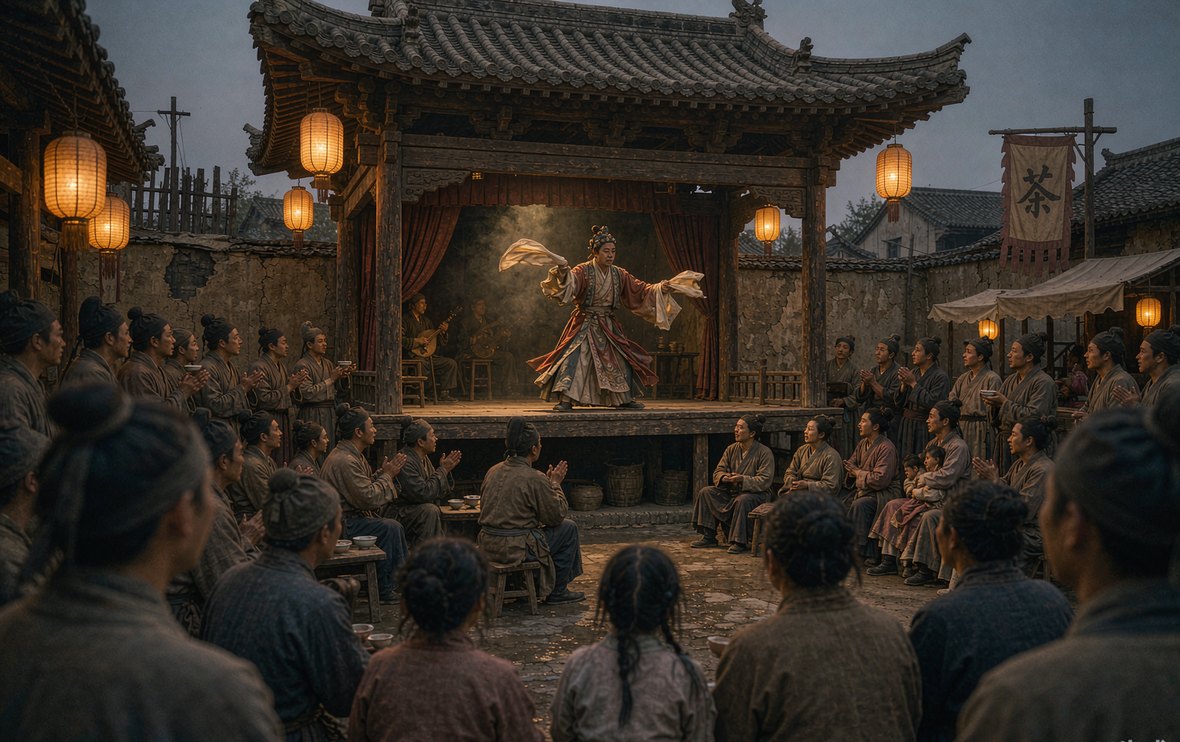
Yuan qu is the general name for the verse and drama that flourished under the Yuan, comprising sanqu songs and zaju plays; with Tang poetry and Song lyrics it is reckoned "the literature of its age." It arose in the market-place theaters: with the Mongol conquest and the suspension of the examinations for decades, great numbers of literati descended among the people and sold their talents to the stage — hence Guan Hanqing’s tearful indictment The Injustice to Dou E, Wang Shifu’s masterpiece The Romance of the Western Chamber with its vow "may all who love each other under heaven be joined," and Ma Zhiyuan’s twenty-eight characters of ink-wash austerity in "Autumn Thoughts." Yuan qu’s language is "native" and plain, a pleasure to all: "I am a copper pea that cannot be boiled soft, cooked done, pounded flat, or fried to popping — one ringing copper pea!" Guan Hanqing’s self-portrait is the very character of Yuan qu: pungent, vivid, close to the human world. If Tang poetry was aristocratic and Song lyrics scholarly, Yuan qu was of the marketplace: for the first time literature truly faced ordinary people.
In the early Yuan the examinations were closed for decades; the gate of advancement shut at once, and the ranking "nine ranks of scholars, ten of beggars" told the literati’s plight. Guan Hanqing, Ma Zhiyuan, and Wang Shifu turned into the trade: working with literary guilds, actors, and musicians to write for the entertainment quarters — for the first time in Chinese literary history, the finest talents systematically wrote for common audiences. An exile by misfortune, it was also an unexpected liberation: no longer writing to examination formulas, their pens held the living human world.
The descent brought a revolution of language: Yuan qu adopted colloquial speech, slang, and regional accents — even endearments and exclamations could enter song — with spoken parts witty and pungent. Wang Guowei praised it: "In expressing feeling it seeps into the heart; in depicting scenes it stands before the eyes; in telling a story it speaks from the mouth itself." For the first time the aesthetics of classical prose merged with the lifeblood of the vernacular, planting distant causes of later vernacular fiction and spoken drama.
The Injustice to Dou E is Yuan qu’s conscience: the widow Dou E, framed for murder, makes three vows at execution — her blood will fly onto a white silk banner, snow will fall in midsummer, and drought will hold three years — and all are fulfilled. "O Earth, if you cannot tell good from ill, what use are you as Earth? O Heaven, if you mistake the worthy and the wicked, in vain are you Heaven!" One frail woman’s accusation of heaven and earth is a trial of the whole machinery of injustice. Four centuries later Wang Guowei still ranked it "worthy of a place among the great tragedies of the world."
The Romance of the Western Chamber is love’s triumphal song: "Blue clouds above, yellow flowers below, west wind pressing, wild geese flying south" — the autumn farewell at the long pavilion speaks all parting grief; the line "may all under heaven who truly love each other be joined as husband and wife" tears a corner in the net of pedigree-marriage. Cui Yingying and Zhang Sheng pit private love against ritual propriety while Hongniang maneuvers with wit — on stage, for the first time, love defeated lineage. The greatness of Yuan drama: it does not merely entertain; it speaks for those who could not speak — widows, maids, poor scholars, courtesans all took the leading role.
兴,百姓苦;亡,百姓苦。 — When dynasties rise, the people suffer; when they fall, the people suffer.——Zhang Yanghao, "Meditation on Tong Pass," to the tune Shanpoyang
Yuan qu’s highest praise was "native color" and "true craft" — language unadorned yet perfectly fitted to the genre. Ma Zhiyuan’s "Autumn Thoughts" to the tune Tianjingsha is the extreme case: "Withered vines, old trees, crows at dusk; small bridge, flowing water, folk homes; ancient road, west wind, lean horse" — nine nouns, nine pictures; not one verb, yet the sorrow of travel suffuses the page; the last line, "The sun sinks west — the heartbroken one is at the sky’s edge," closes softly. Twenty-eight characters, crowned "the ancestor of autumn thoughts."
Zhang Yanghao’s "Meditation on Tong Pass" to the tune Shanpoyang is the extreme of thought: "Peaks gather like a crowd; waves rage like thunder; within and without the passes runs the road of Tong Pass" — and the closing lines "When dynasties rise, the people suffer; when they fall, the people suffer" — eight characters spelling out the truth of three thousand years of rise and fall; critical poetry in Chinese reached its summit here. Sanqu miniatures are dagger and javelin, clear water and cold pool: in refinement not yielding to shi and ci, in plainness brimming with delight — an ease between elegant and popular that Tang and Song never unfolded.
In the lineage of "each age its own literature," Yuan qu represents the coming of age of ordinary China: theaters stood everywhere, audiences numbered in the thousands, and plays became the common people’s lessons in history, morality, and feeling. Dou E’s wrong, Yingying’s devotion, Zhao Pan’er’s chivalry lived henceforth on people’s lips — many who could not read first met China from the stage. "The stage is a little world; the world is a great stage": Yuan qu made drama truly the nation’s parlor of the spirit.
Yuan zaju’s structure — four acts and a wedge, one lead singer — laid the foundations for the programmatic art of Ming-Qing chuanqi and Peking opera; the linguistic experiments of sanqu nourished the colloquial art of later novels like Jin Ping Mei and Dream of the Red Chamber. Wang Guowei’s History of Song and Yuan Drama won Yuan qu its place in literary history; today "may all who love each other be joined" is still a wedding blessing, and "copper pea" still a nickname for the unbending. Seven hundred years gone, Yuan qu’s vernacular and its fire still take the stage in Chinese daily life.