Author
Cao Xueqin (c. 1715–c. 1763)
The novel in chapters by Cao Xueqin (c. 1715–1...
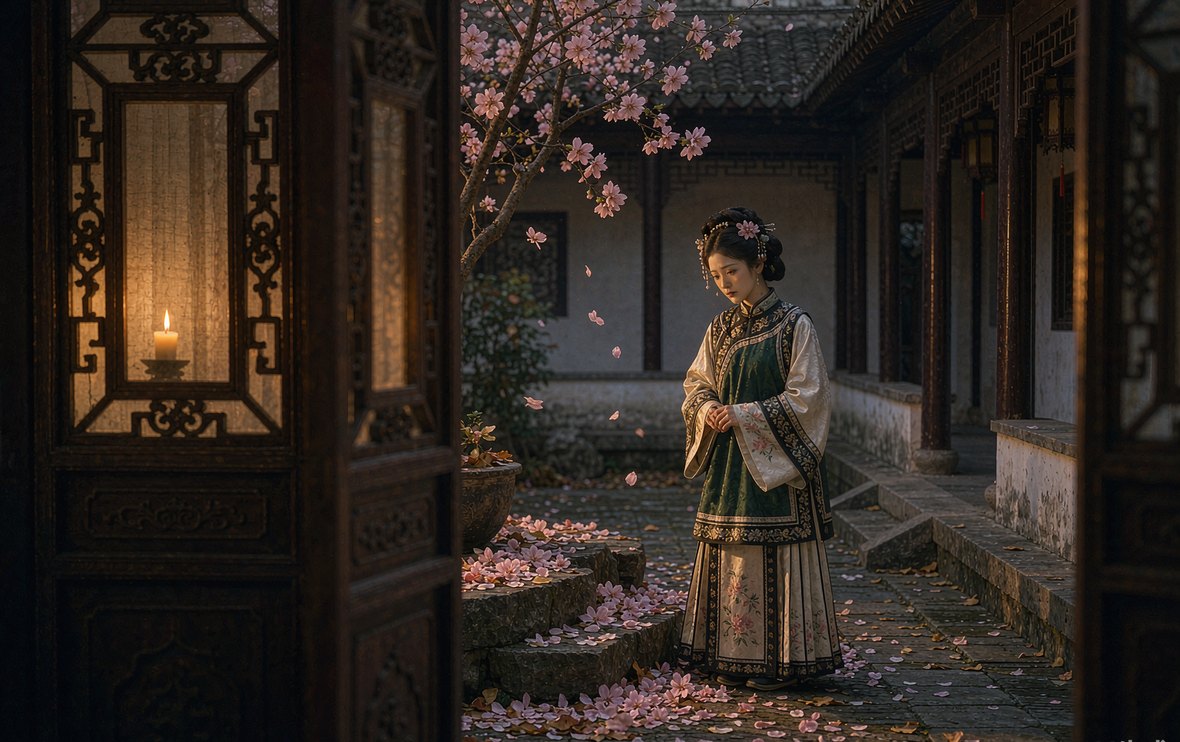
The novel in chapters by Cao Xueqin (c. 1715–1763), the first eighty chapters his and the last forty generally attributed to Gao E, first printed in 1791 as the Cheng-A edition, 120 chapters in all. Its frame is the rise and fall of the Jia household, its main line the love of Baoyu and Daiyu: the splendour and dissolution of a family that dined to music and used gold for horses. Grand View Garden is a utopia of youth and beauty; the ending, when the great house comes crashing down, is an elegy for a civilisation at its height and its end. More than four hundred characters speak in their own voices; poetry, gardens, dress, food and medicine are all exact. It has been called an encyclopaedia of Chinese traditional society. Lu Xun wrote that with *Dream of the Red Chamber* "traditional thought and traditional method were both broken". An unfinished book bred a discipline of its own, Redology, with scholars in every generation. The Chinese verdict is simple: without it one cannot understand Chinese feeling and Chinese grief.
On the surface the novel follows five generations of the Jia family, from the height of "no empty boast: halls of white jade, horses of gold" to confiscation, ruin and scattering. Cao Xueqin drew on the record of his own family of imperial textile commissioners and rendered the whole tissue of aristocratic life — ritual and display, the servant hierarchy, estate economics, marriage alliances — down to the thread. The rent collection by Wu Jinxiao shows the strain of the estate economy; Tanchun's management of the household shows the difficulty of reform; the funeral of Qin Keqing shows ritual at its most extravagant. A family chronicle becomes a social file on the last days of a system.
Deeper down it is the dusk of a civilisation. "The outer frame is not yet fallen, but the inner purse is empty" — the plight not of one house but of a whole dynasty at its prosperous height. Cao knew both splendour and "the whole family eating gruel and buying wine on credit", and that double experience let him see through the vanity of wealth and the necessity of its ending. "A vast white expanse, utterly clean": for the first time Chinese literature looked with such sober eyes at the closing of its own civilisation.
The garden is the book's greatest creation of space. Built for the Imperial Concubine's visit home, it becomes the kingdom of Baoyu and the girls: the Begonia Poetry Club, verses composed in the snow at Reed Snow Cottage, burying the fallen flowers, chasing butterflies, sleeping drunk on peony petals — the loveliest passages of their lives happen inside its walls. It is a real garden, with a real art of garden making, winding paths to hidden courts, borrowed views and facing views; and it is a spiritual enclave beyond reality, one wall shutting out the ritual and utility of the adult world so that sensibility can be briefly free.
Its people live by temperament. Daiyu is poetry incarnate — "pure I came, and pure I shall return". Baochai is ritual incarnate — "even in indifference she moves the heart". Xiangyun's gallantry, Tanchun's acuity, Miaoyu's purity, Qingwen's fire. Lu Xun said that the mist of grief lies over the whole garden, and that only Baoyu breathes it in and understands. The garden is finally searched and left to wither, and the destruction of that utopia is the most painful stroke in Chinese literature: beauty has nowhere to live in the world, and can only return to "the cave of a thousand reds, the cup of ten thousand beauties" — weeping and grief hidden inside the words.
假作真时真亦假,无为有处有还无。 — When false is taken for true, the true becomes false; where nothing is taken for something, the something returns to nothing.——the couplet of the Illusory Realm of Great Void, Dream of the Red Chamber
The book is framed on the chain "seeing form out of the void, drawing feeling from form, carrying feeling back into form, and awakening to the void through form", turning a love story into a meditation on existence. The song of the good and the good-for-nothing: "all men know that the immortals are well off, but they cannot forget fame." Zhen Shiyin's gloss: "the mean room stands empty, where once the tablets crowded the couch." Wang Xifeng, who calculated everything, "miscarried her own life". Every attachment ends in emptiness. Yet the book does not turn to nihilism: because parting is certain, meeting has weight; because beauty must end, it deserves devotion. Baoyu's "folly" is the best resistance to dissolution.
Its philosophical depth lies in the place it gives to feeling. The Red Inkstone commentary says the book's great theme is qing — feeling — and means by it not sentimentality but tenderness toward all life, plants and maids and actors alike, a love that makes no distinctions. Baoyu, beaten, still thinks of the old women who will suffer; he attends to Ping'er's toilet and changes Xiangling's skirt. To hold to "feeling toward the unfeeling" in a world of strict rank — that is the gentlest revolution in Chinese literature.
The novel circulates unfinished. Cao Xueqin "read it for ten years, revised it five times" and did not complete it; the manuscripts after chapter eighty were lost. Cheng Weiyuan and Gao E issued the 120-chapter version at the end of the Qianlong reign, and it is that version the world has read, while the discovery of the Red Inkstone annotated manuscripts — the Jiaxu, Jimao and Gengchen texts — let scholars glimpse Cao's own hand. The textual problem is still open. Around it three schools grew: the allegorists, the textual scholars, the critics; Hu Shi, Yu Pingbo and Zhou Ruchang each built a body of work, and Redology became the only modern discipline named after a single book.
Its reach abroad is just as deep. David Hawkes's translation, *The Story of the Stone*, is a landmark of the translator's art; sinologists abroad compare the novel to *In Search of Lost Time*. Grand View Gardens have been rebuilt in several cities, the 1987 television serial is rebroadcast endlessly, and "Red Chamber banquets" and Redology examinations proliferate. A manuscript of the eighteenth century is still the heart of Chinese cultural life. Cao Xueqin's "ten years of hardship, nothing ordinary": he earned it.