Representative poets
Qu Yuan · Song Yu · Han imitators
Three hundred years after the Book of Songs, a...
Three hundred years after the Book of Songs, a second sunrise of Chinese literature rose over the Yangtze valley. The land of Chu was steeped in shamanic rite and lavish imagination, and Qu Yuan, by himself, founded the Chuci form: “writing in Chu words, sounding Chu tones, recording Chu places, naming Chu things,” with the sighing particle xi carrying each line through three turns as the spirit roams heaven and the underworld. Li Sao, at over twenty-four hundred characters, is the first long lyric poem in Chinese literary history signed by its poet; the Nine Songs, the Heavenly Questions, and the Nine Pieces each excel in its own register. Qu Yuan raised his personal political tragedy into a narrative of nation and home, and wrote his own life into a model personality “rivaling the sun and moon in radiance” — for more than two thousand years after, at every national crisis, the Chinese would remember that hair-loosed figure chanting by the Miluo River. The Chuci and the Shijing are paired as “feng and sao”: one founded the realist tradition, the other opened the romantic lineage — with them, the two great genes of Chinese literature were complete.
Li Sao builds a vast symbolic universe: fragrant herbs (orchid, pollia, asarum) figure inner worth and self-cultivation — “at dawn I drink the dew that falls from the magnolia; at evening I eat the fallen petals of autumn chrysanthemums”; the fair beauty figures the ruler and the ideal — “I dread the fair one’s growing old”; hateful birds and foul things figure slanderous courtiers; the chariot and its horses figure the way of governing. It is the first time in Chinese literature that a complete, self-consistent symbolic language was established.
This invention rewrote the expressive tradition of Chinese: “fragrant herbs and fair beauties” became thereafter the universal code by which scholar-officials declared their ideals — Cao Zhi figured ruler and minister through a beauty; Zhang Jiuling spoke of himself through orchid and cassia; Xin Qiji’s “the moth brows have drawn envy” used the code as if born to it. Politics that could not be spoken outright thereby gained a speech of a thousand turns and ten thousand twists; the reticent depth of Chinese poetry is half the xing of the Shijing and half the imagery of the Chuci.
The Heavenly Questions fires off more than one hundred seventy questions in a breath: what was it before heaven and earth took form? Why do sun and moon not fall? How did Yu tame the floods? Why did Zhou of Shang perish? — from the origin of the cosmos to the rise and fall of history, from myth to physics. This is another rational spirit beyond the masters of the pre-Qin: no theses, only questions; no answers given, only wonder kept alive for the world.
This questioning spirit ran unbroken through later ages: Liu Zongyuan answered point by point in his “Tian Dui” (Answers to the Heavenly Questions); Zhu Xi took it into his Collected Notes on the Chuci with deep respect. Modern scholars marvel that this chain of interrogation — half astrophysics, half philosophy of history — mounted twenty-three hundred years ago, is the page of Chinese intellectual history closest to scientific curiosity. The poet’s seeking and the philosopher’s doubting become one in the Heavenly Questions.
亦余心之所善兮,虽九死其犹未悔。 — For what my heart holds dear, though I die nine deaths I shall not regret.——Li Sao (On Encountering Sorrow)
Qu Yuan’s life is a drama of character: royal birth, high office as Left Counselor, the strategy of allying Qi against Qin — then slander, estrangement, exile south of the Han river, and after the fall of the capital Ying, self-drowning in the Miluo. But his greatness lies not in what befell him but in his answer: “for what my heart holds dear, though I die nine deaths I shall not regret”; “all the world is muddy and I alone am clear; all men are drunk and I alone am sober.” He refused the fisherman’s drift with the current — better to cast himself into the Xiang stream than be sullied by the world’s dust; he kept cleanness and loyalty to the last moment of his life.
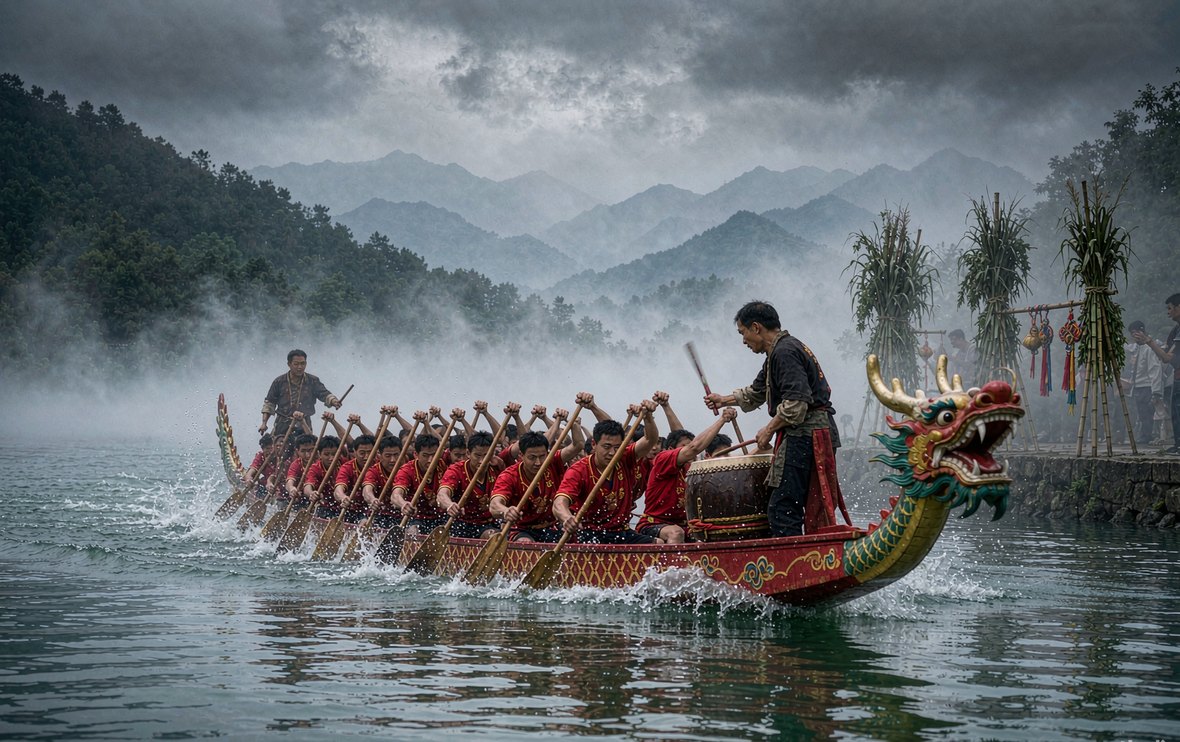
This force of character became the spiritual reference point of later scholars: Sima Qian “grieved for his resolve”; Wen Tianxiang, Tan Sitong, and Lu Xun claimed him as a fellow traveler. That the Dragon Boat Festival has endured two thousand years shows that what is honored is not a political failure but the quality the Chinese treasure most: to remain clear when the world is turbid; to remain loyal when hope is lost. The waters of the Miluo still wash the measure of the human heart.
The Shijing is realist and plain, the Chuci imaginative and resplendent; one north, one south — the Yellow River and the Yangtze–Han — together forming the two great genes of Chinese literature. Song Yu’s “Jiu Bian” after Qu Yuan opened the motif of “lamenting autumn”; the amplification of Han fu and the tragic passion of the Records of the Grand Historian were both nourished by the Chuci. Li Bai: “Qu Ping’s verses hang like sun and moon”; Du Fu: “climb in secret toward Qu and Song, and match them” — at the very depths of High Tang grandeur one still hears the echo of Chu skies.
Liu Xiang of the Western Han compiled the Chuci; Wang Yi wrote its Zhangju commentary; Zhu Xi its collected annotations — two thousand years of reading have made it a living tradition. Lu Xun called the Records of the Grand Historian “the last song of the historians, a Li Sao without rhyme” — which exactly marks its place: Li Sao is Chinese literature’s “Records of the Grand Historian with rhyme” — the nation’s spiritual history written in verse. Reading the Nine Songs at Mid-Autumn, chanting Li Sao at Dragon Boat Festival, the Chinese drink from the same spring.