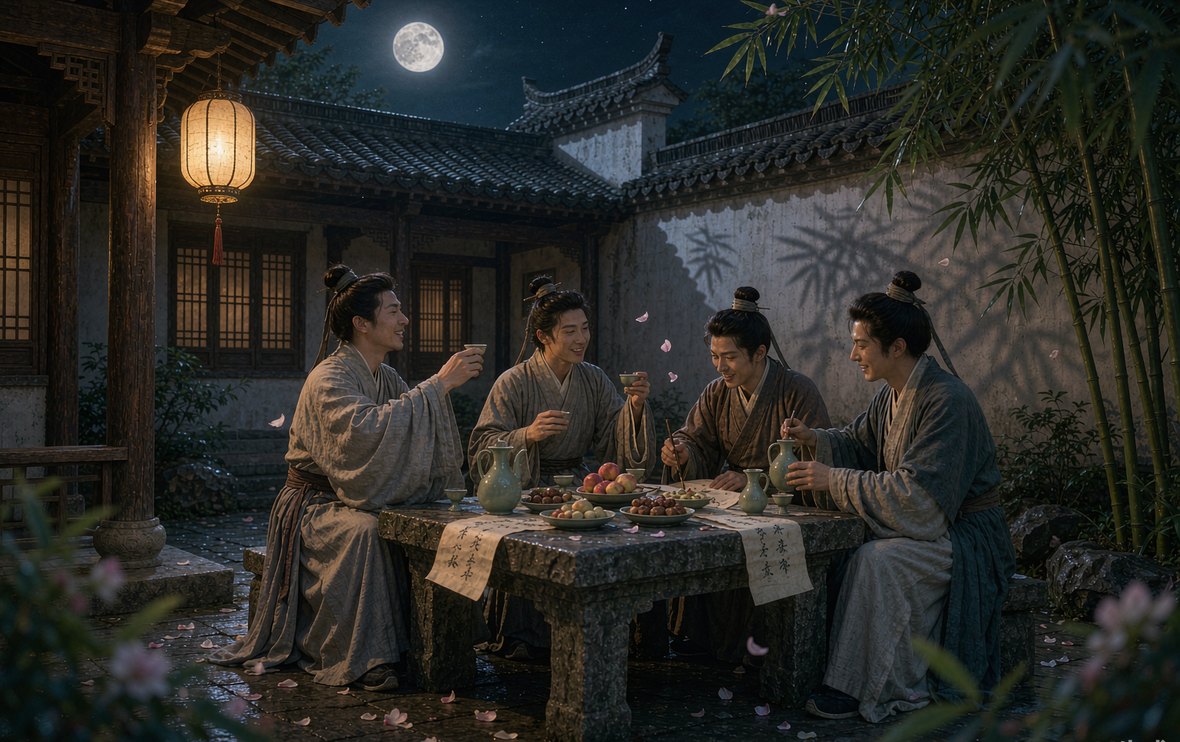
The golden age of poetry: in nearly three hundred years, some fifty thousand poems survive, masters stand like a forest, the forms are complete, and the range is boundless. The greatness of Tang poetry lies in pushing the phonetic beauty, imagistic beauty, and emotional beauty of the Chinese language to their limits at once — the same moon: Li Bai’s "moonlight before my bed" is homesickness; Zhang Ruoxu’s "who by the riverside first saw the moon?" is a question to the cosmos; Wang Wei’s "bright moon shining among pines" is Chan stillness; Du Fu’s "the moon is brighter over my home" is love in a broken age. The Four Masters of Early Tang broke the rococo of Qi-Liang verse; in the High Tang Li Bai and Du Fu rose as twin peaks; mid-Tang Bai Juyi and Han Yu each cut new paths; late Tang Li Shangyin and Du Mu left long echoes. Wen Yiduo called Tang poetry "the poetry of poetry, the summit of summits"; the Three Hundred Tang Poems remains the Chinese people’s poetic primer and spiritual homeland — the first rhythm a child learns to chant usually comes from that golden age.
The High Tang Spirit: Poetic Voice of a Confident AgeThe High Tang Spirit
What moves us most in Tang poetry is that High Tang spirit — a sense of life that is healthy, full, and ascending. Li Bai’s "Laughing to the sky I stride out the door — how could I be a man of the weeds?" is confidence bordering on innocence; Wang Changling’s "Yellow sand has worn through hundred-fold armor, yet we shall not return until Loulan falls" holds no lament in frontier verse, only daring; "Grieve not that ahead no friend will know you — what man under heaven knows you not?" — Gao Shi’s farewell shows no tears, only a send-off. All the vital energy of a civilization at its adolescence went into these lines.
Beneath the grand manner lay institutional support: the examinations recruited by poem and rhapsody, so that writing poetry became a ladder of advancement; Chang’an mingled Hu and Han while all nations came to court, widening poets’ horizons beyond precedent; national strength made wandering, soldiering, and seeking patrons all viable paths of life. Hence "the tide is level, the banks wide; the wind fair, one sail set" — Tang poetry is not the soliloquy of literati but the collective lyric of a rising civilization.
❖
Li Bai and Du Fu: Twin Peaks, Two PolesLi Bai and Du Fu: Twin Peaks
Li Bai and Du Fu: one carried poetry toward the sky, the other toward the earth. Li Bai is genius improvised: "The Yellow River’s waters come down from heaven, rushing to the sea, never to return" — images pour like a waterfall, hyperbole that never loses truth; he writes of wine, sword, bright moon, and immortals, driving the Daoist spirit of freedom to the edge of language. Du Fu is craft deep-plowed: the "Three Officers and Three Partings" write all the common suffering of an age at war; "Behind vermilion gates, meat and wine go to waste while on the road lie the bones of the frozen dead" — ten characters like a blade; regulated verse in Du Fu’s hands was hammered a thousand times: "Boundless leaves fall, rustling down; the long River rolls on, never ceasing" — strict form and seamless grandeur at once.
Posterity honors Li Bai as immortal and Du Fu as sage — the immortal is heaven-given and cannot be imitated; the sage is utmost sincerity, and can be learned. Han Yu wrote, "Li and Du’s writings endure, their light blazes ten thousand zhang." Between them they define the two poles of Chinese poetry: imagination and sympathy, romance and realism, heaven and the human world. Every Chinese poet since is either Li Bai’s heir, Du Fu’s disciple, or a student of both.
春江潮水连海平,海上明月共潮生。 — The spring river’s tide joins the sea, level and vast; over the sea the bright moon rises with the tide.
——Zhang Ruoxu, "Spring River in the Flower-Moon Night"
❖
Beauty within the Regulated FormBeauty within the Regulated Form
Tang poetry’s greatest technical contribution was completing the "modern-style" poem: five- and seven-character lüshi and jueju, with tonal opposition, parallel couplets at the center, and one rhyme carried through — the first systematic ordering of the tonal music of Chinese. "Two orioles sing in the green willows; a line of white egrets climbs the blue sky" — colors, numbers, motions mirrored in parallel; "To feast the eyes a thousand li, climb one more storey" — scene, reason, and feeling rising in twenty characters. Meter was not a shackle but a tempering: within constraint, every syllable of the language was used to the utmost.
The quatrain (jueju) especially shows the Chinese art of liubai — the pregnant blank: "You come from my homeland — you must know its affairs. Did the plum by the silken window bloom, the day you left?" The question is of one plum tree; the heartache is of the whole home. "Alone a stranger in a strange land, on every festival I miss my kin the more" — plain as speech, yet it speaks for every wanderer under heaven. To gather the many in the few, words ending while meaning is endless — this aesthetic later ruled every Chinese art: painting’s blanks and garden’s borrowed views are both extensions of the jueju.
❖
From Bamboo Scrolls to Daily Speech: How Tang Poems Became the Mother TongueHow Tang Poems Became Daily Language
Tang poetry long ago dissolved into Chinese daily speech: "on every festival I miss my kin the more," "spring winds do not pass the Jade Gate," "where in the world are there no fragrant grasses" — hundreds of idioms come straight from Tang poems; moonset and crow’s cry, the long river at sunset, spring wind and success — an image-store shared by every Chinese. One who has never systematically read poetry will still recall "I shall climb the utmost summit" when ascending a height, and "west of Yang Pass, no old friends" at parting — a homesickness carved into the mother tongue.
The history of transmission is equally grand: Dunhuang manuscripts, anthologies, children’s primers — twelve centuries unbroken; Tang poetry traveled east to Japan, transforming the waka and later haiku; in recent years it has been translated into many tongues — Pound’s re-creations of Li Bai shook English-language poetry. Why Tang poetry? Because in those three centuries the Chinese language happened upon an age that dared to sing. Every rereading recharges the spirit: a people who can recite "moonlight before my bed" will always keep a poet’s heart.
名篇选读Selected Masterpieces
Quiet Night Thoughts
Li Bai (Tang)
床前明月光,疑是地上霜。
举头望明月,低头思故乡。
Before my bed, the bright moon shines —
I take it for frost upon the ground.
I raise my head to watch the moon,
then bow it, dreaming of home.
Twenty plain characters, not one rare word — and the whole ache of every wanderer. Between raising the head and bowing it lies a thousand years of homesickness.
Spring Dawn
Meng Haoran (Tang)
春眠不觉晓,处处闻啼鸟。
夜来风雨声,花落知多少。
In spring I sleep past dawn, unaware —
everywhere, the cry of waking birds.
Last night came wind and rain;
who knows how many petals fell?
A spring heard, not seen: rain in the night, birds at dawn, fallen petals imagined. Cherishing spring without grieving it — the ease of a Tang morning.
On the Stork Tower
Wang Zhihuan (Tang)
白日依山尽,黄河入海流。
欲穷千里目,更上一层楼。
The white sun sinks behind the hills;
the Yellow River runs into the sea.
To feast your eyes a thousand miles more,
climb another storey of the tower.
One couplet of scenery, one of truth: to see further, climb higher — wisdom spoken as naturally as landscape.
Thinking of My Brothers on the Double Ninth
Wang Wei (Tang)
独在异乡为异客,每逢佳节倍思亲。
遥知兄弟登高处,遍插茱萸少一人。
Alone, a stranger in a strange land,
on every festival I miss my kin the more.
From afar I know my brothers climb the heights,
all wearing dog-spray — and one is missing.
Written at seventeen. Instead of saying how he misses home, the poet imagines his brothers missing him — grief turned around is grief doubled.
Spring View
Du Fu (Tang)
国破山河在,城春草木深。
感时花溅泪,恨别鸟惊心。
烽火连三月,家书抵万金。
白头搔更短,浑欲不胜簪。
The state is broken; hills and rivers stand.
Spring in the city — grass and trees grow deep.
Moved by the times, flowers draw my tears;
grieving parting, birds startle the heart.
Beacon fires have burned three months on end;
a letter from home is worth ten thousand gold.
White hairs scratch shorter and shorter —
soon too sparse to hold a hairpin.
Five characters — "the state is broken; hills and rivers stand" — carry a history. Grief written without one word of sorrow: the way a war is truly seen.
Night Mooring by Maple Bridge
Zhang Ji (Tang)
月落乌啼霜满天,江枫渔火对愁眠。
姑苏城外寒山寺,夜半钟声到客船。
The moon sets; crows cry; frost fills the sky.
By maples and fishing lamps I lie sleepless, sad.
From Hanshan Temple outside Gusu town,
the midnight bell reaches a traveler’s boat.
One sleepless night of a failed examinee created China’s most famous bell. From sight to sound, from heaven to heart — melancholy kept clear, never bitter.