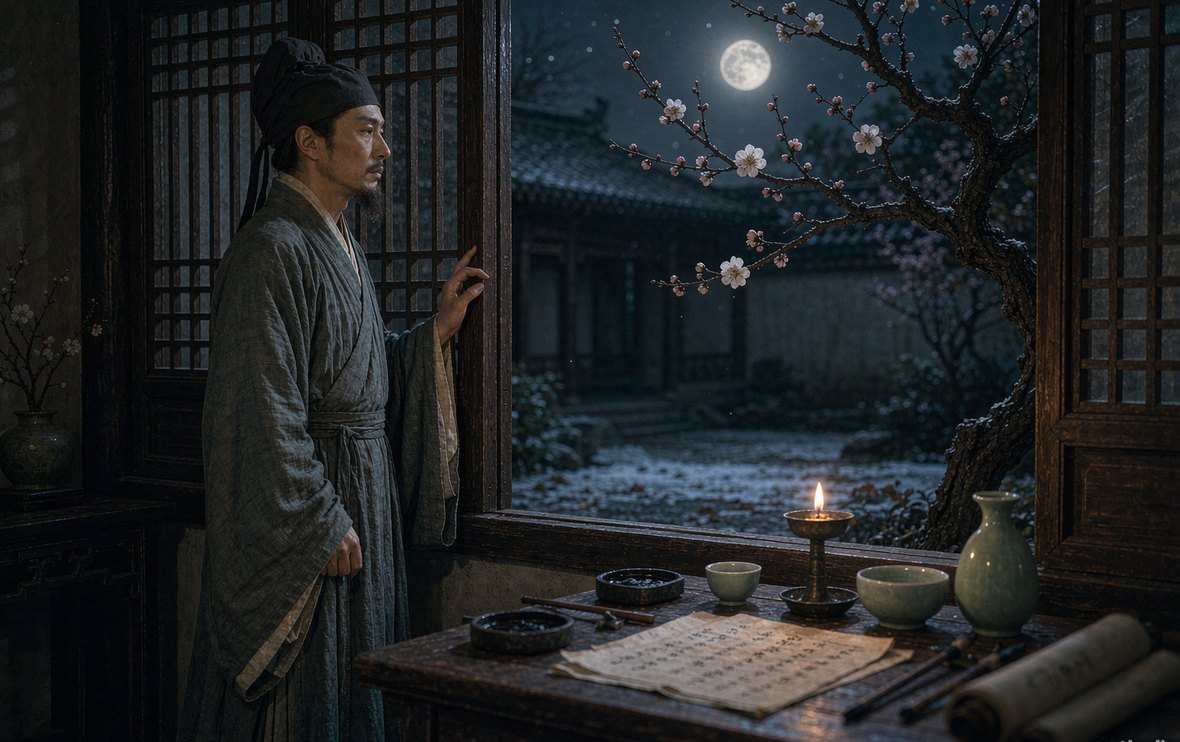
Song ci are lyric poems of uneven line length, written to the banquet music of the day — born in the late Tang and Five Dynasties, triumphant under the Two Songs. Born at wine feasts as mere song-words, they became the orthodox literary form of the Song: Wang Guowei observed that "each age has its own literature — the sao of Chu, the fu of Han, the parallel prose of the Six Dynasties, the shi of Tang, the ci of Song, the qu of Yuan." The uneven lines of ci are naturally attuned to subtle feeling: shi speaks the will, ci speaks the heart; shi belongs to the public square, ci to the inner chamber. Graceful and bold schools stood as twin peaks: Liu Yong’s lingering "willowed bank, dawn breeze, waning moon"; Su Shi’s breadth, "the great river flows east"; Li Qingzhao’s desolate "searching, seeking"; Xin Qiji’s tragic valor, "drunk, I trim the lamp and eye my sword." In three centuries ci grew from songstresses’ repertoire into the innermost thoughts of scholars, adding to Chinese literature its most delicate stroke.
From Banquet Song to Desk: A Genre Comes of AgeFrom Banquet Song to Literature
Ci began as lyrics to banquet music: court tunes and tavern strains to which literati "filled in words"; at first an amusement — the Among-the-Flowers poets "carved jade and chiseled jasper," Wen Tingyun and Wei Zhuang painting boudoir moods in rich colors, ci dismissed as "a byway beside shi." Liu Yong then devoted himself wholly to it — "wherever well water is drunk, Liu’s songs are sung" — and the long, slow meters flourished; here popular and refined literature met.
The turning point was Su Shi: treating ci as shi, he "washed away the silken perfumes," and ci could now carry historical meditation, philosophy, and pastoral ease — rising to the same spiritual height as shi. Li Qingzhao’s Discourse on Ci insisted ci was "a distinct house," defending its musicality and graceful essence; Xin Qiji then wrote ci as prose, sweeping freely in every direction. By the late Southern Song ci had fully completed its passage from banquet to desk: the tunes faded, but ci’s literary life endured.
❖
Graceful and Bold: Two Temperaments of the Song MindGraceful and Bold: Two Temperaments
The graceful school plumbed the genre’s native subtlety: Liu Yong’s "Tonight when I wake from wine, where shall I be? A willowed bank, dawn breeze, a waning moon" turns parting sorrow into landscape along the road; Yan Shu’s "Helplessly, flowers fall; swallows return, as if we had met before" sets the sigh of life’s impermanence within exquisite craft; Li Qingzhao’s early "blushing, I slip away, then lean at the door and turn back to sniff the green plums" is girlish charm; her late "searching, seeking, cold and clear, grief upon grief upon grief" — fourteen doubled characters, the uttermost of Chinese sound and feeling.
The bold school pushed ci toward history and mountains-and-rivers: Su Shi’s "The great river flows east, its waves washing away the heroes of a thousand ages" — meditation on Red Cliff as history in lyric form; "I would draw the carved bow to the full moon, gaze northwest, and shoot the Sky Wolf" — a hunting song with heroic breath. Xin Qiji’s "Drunk, I trim the lamp and eye my sword; dreaming, I return to camps of bugles" — a battlefield dream shattered in lamplight: "To finish the king’s task of all under heaven, and win renown in life and after — alas, white hair has come." Utmost boldness turns tragic. Graceful is the Song heart’s tenderness; bold is its pride of bone; soft and hard together make the full spectrum of the Song spirit.
无可奈何花落去,似曾相识燕归来。 — Helplessly, flowers fall; swallows return, as if we had met before.
——Yan Shu, "To the Tune of Huanxisha"
❖
The Aesthetics of Long and Short Lines: Closer to the Heartbeat than ShiThe Aesthetics of Long and Short Lines
Ci’s uneven lines naturally mimic the rise and fall of feeling: "Helplessly, flowers fall" — seven characters, one long sigh; "Such a mood — how could the single word ‘sorrow’ suffice?" — ragged as sobbing. Each tune-pattern carries its own sound-mood: Man Jiang Hong is vehement, Yu Lin Ling heartbreak-fine, Nian Nu Jiao exalted; to fill a tune so that sound and feeling match is an effect shi’s even lines can hardly reach.
Ci’s imagery is more inward: balustrades, water-clocks, painted screens, migrating geese — objects of the room and the heart, lyric distance close enough to touch the pulse. Wang Guowei read ci through the idea of jingjie (poetic realm): "On the apricot branches, spring is in full clamor" — the single word "clamor" and the whole realm appears; "Clouds part, moon comes, and flowers play with their shadows" — the one word "play" and the scene is alive. This word-smithing, a single character worth a thousand in gold, makes ci the most precise lyric instrument in Chinese literature — two or three lines, and a whole universe of mood stands complete.
❖
The Literature of an Age: Why Ci for the SongWhy Ci for the Song Age
Behind ci’s flourishing lay Song society: urban splendor, entertainment quarters, the culture of singing girls — popular amusement needed lyrics; refined literati life and elegant gatherings needed refined music; under civil government, beyond public achievement there was leisure for private feeling — shi carried the Way, ci released the moods, a fitting division of solemn and playful. Qian Mu noted that the Song developed a supreme art of living "amid affairs"; ci is the sound-form of that aesthetic.
Ci’s influence continues: "People have sorrow and joy, parting and reunion; the moon waxes dim and bright" is the state phrase of the Mid-Autumn Festival; "helplessly, flowers fall" is the universal idiom of time’s passage; the Chinese-flavor lyrics of pop songs and film scores still echo, at depth, ci’s cadences and images. Each age has its literature — Chu sao, Han fu, Tang shi, Song ci, Yuan qu — and in that relay, Song ci caught the softest part of the human heart: to speak love, sorrow, and the moon without ornament — precisely the hardest thing.
名篇选读Selected Masterpieces
The Beautiful Lady Yu
Li Yu (Southern Tang)
春花秋月何时了?往事知多少。
小楼昨夜又东风,故国不堪回首月明中。
雕栏玉砌应犹在,只是朱颜改。
问君能有几多愁?恰似一江春水向东流。
Spring blooms, autumn moons — when will they end?
How much of the past do we know?
The small tower saw east winds again last night;
my lost land, unbearable to recall under a bright moon.
Carved railings and jade steps must still stand —
only the rosy faces have changed.
How much sorrow can one man hold?
A river of spring water, flowing east.
A captive king’s death song. Sorrow given volume, weight and current — since then, "sorrow" in Chinese literature flows like a river.
Bells Ringing in the Rain
Liu Yong (Song)
寒蝉凄切,对长亭晚,骤雨初歇。
都门帐饮无绪,留恋处,兰舟催发。
执手相看泪眼,竟无语凝噎。
念去去,千里烟波,暮霭沉沉楚天阔。
多情自古伤离别,更那堪,冷落清秋节!
今宵酒醒何处?杨柳岸,晓风残月。
此去经年,应是良辰好景虚设。
便纵有千种风情,更与何人说?
Cicadas cry, chilled; at the pavilion, late, the shower just ends.
At the farewell tent we drink without heart; lingering, the boat calls to depart.
Hand in hand we gaze, eyes wet — speechless, choking on words.
On and on — a thousand li of misty waves; the southern sky sinks in haze.
The feeling heart has always grieved at parting — how much more in this cold autumn!
Where shall I wake from wine tonight? A willowed bank, dawn breeze, a waning moon.
The years to come — fine days and scenes will all be empty.
Even with a thousand tendernesses — to whom could I speak them?
The summit of farewell verse. Three images — willows, breeze, a waning moon — assemble a vast hung-over morning; the deepest goodbye says nothing at all.
Silk-Washing Stream
Yan Shu (Song)
一曲新词酒一杯,去年天气旧亭台。
夕阳西下几时回?
无可奈何花落去,似曾相识燕归来。
小园香径独徘徊。
A cup of wine, a new song — the old pavilion, last year’s weather.
The sun sets in the west; when will it return?
Helplessly, flowers fall; swallows return, as if known before.
Alone I pace the fragrant garden path.
The Song temper in a small lyric: what departs is gone; what returns is strangely familiar — the whole taste of life between loss and reunion.
Prelude to Water Melody
Su Shi (Song)
明月几时有?把酒问青天。
不知天上宫阙,今夕是何年。
我欲乘风归去,又恐琼楼玉宇,高处不胜寒。
起舞弄清影,何似在人间。
转朱阁,低绮户,照无眠。
不应有恨,何事长向别时圆?
人有悲欢离合,月有阴晴圆缺,此事古难全。
但愿人长久,千里共婵娟。
When did the bright moon first appear? Wine in hand, I ask the blue sky,
and wonder: in palaces of heaven, what year is it tonight?
I would ride the wind and return — yet fear those jade towers, too high, too cold.
Dancing with my clear shadow — better to be among men.
It rounds the vermilion tower, stoops through the lattice, shines on the sleepless.
It should bear no grudge — why full, always, at parting?
Men have sorrow and joy, parting and reunion; moons wax and wane — nothing has ever been perfect.
May we live long, and share this fair moon though a thousand li apart.
After this poem, all other mid-autumn poems fell silent. Personal regret set against the moon’s own phases — and sorrow becomes acceptance.
Sheng Sheng Man (Slow, Slow Tune)
Li Qingzhao (Song)
寻寻觅觅,冷冷清清,凄凄惨惨戚戚。
乍暖还寒时候,最难将息。
三杯两盏淡酒,怎敌他、晚来风急!
雁过也,正伤心,却是旧时相识。
满地黄花堆积,憔悴损,如今有谁堪摘?
守着窗儿,独自怎生得黑!
梧桐更兼细雨,到黄昏、点点滴滴。
这次第,怎一个愁字了得!
Searching, seeking; cold and clear; grief upon grief upon grief.
In weather that warms, then chills again, rest is hardest.
Three cups, two bowls of thin wine — no match for the evening wind.
Wild geese pass — old friends of mine — and my heart breaks anew.
Yellow chrysanthemums lie heaped, withered; who now would pick them?
Sitting by the window, how shall I endure the dark alone?
Wutong trees and drizzling rain, dripping, dripping at dusk —
how could one word, "sorrow," be enough for this?
Fourteen doubled syllables, moving from action to scene to heart — the expressive limit of Chinese tones. One person’s autumn, after nation, home and husband were all lost.
Zhen Zhen Zi — A Bold Song for Chen Liang
Xin Qiji (Song)
醉里挑灯看剑,梦回吹角连营。
八百里分麾下炙,五十弦翻塞外声,沙场秋点兵。
马作的卢飞快,弓如霹雳弦惊。
了却君王天下事,赢得生前身后名。
可怜白发生!
Drunk, I trim the lamp and eye my sword; dreaming, I return to camps of horn and drum.
Beef shared among the troops; fifty strings play frontier airs — the autumn parade on the battlefield.
Horses fly like the Dilu; bows crack like thunder.
To finish the sovereign’s enterprise, to win a name in life and after —
alas! white hair has come.
Nine lines of battlefield dream in one breath, and five characters wake from it — the fall from valor to pity is the whole ache of the Southern Song.