Author
Li Shizhen (1518–1593)
The great pharmacological compendium completed...
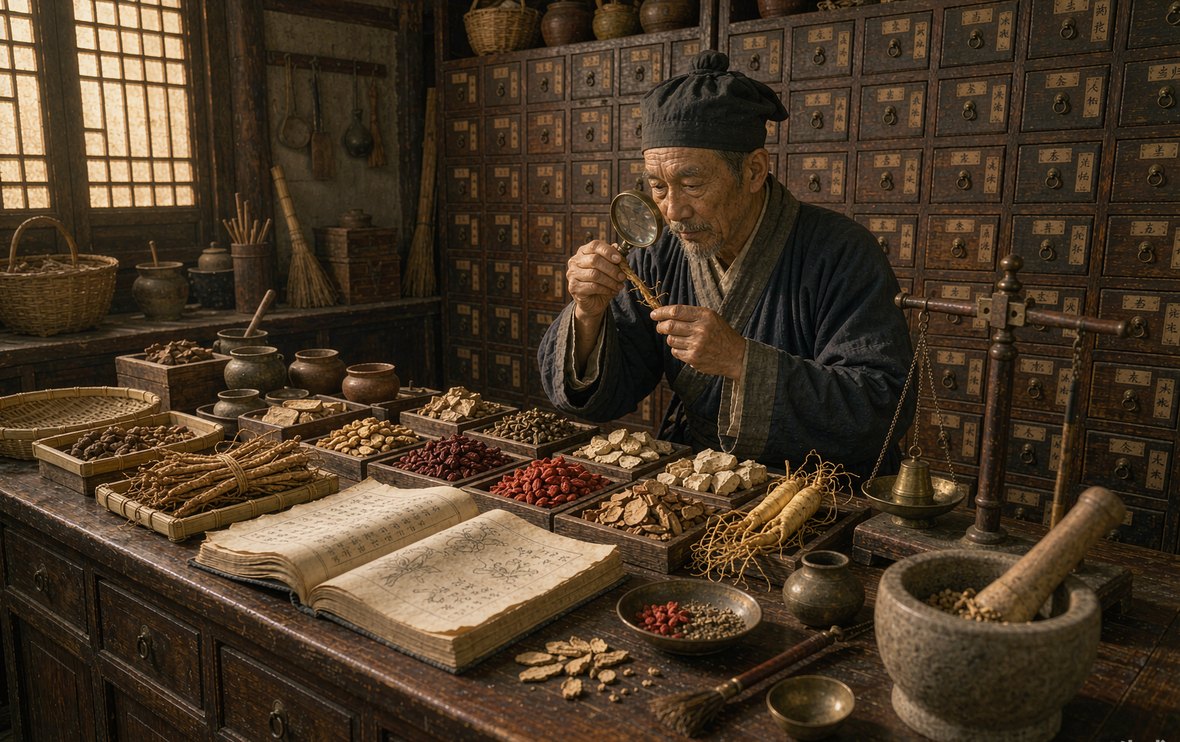
The great pharmacological compendium completed single-handed by Li Shizhen (1518–1593) over twenty-seven years: fifty-two juan, more than 1.9 million characters, 1,892 drugs (374 of them new), 11,096 prescriptions and over 1,100 illustrations, printed in the Jinling edition of 1593. Its revolution was taxonomy. Setting aside the old three-grade scheme, Li ordered the work on the principle "from the minute to the immense, from the humble to the noble" into sixteen sections and sixty classes, moving from minerals through plants to animals — a ladder of natural order that adumbrates evolution. Li "hunted through books, gathered from a hundred schools and inquired in all directions", travelling through Hubei, Jiangxi, Jiangsu and Anhui, collecting drugs and testing their properties himself. Darwin cited the book as "the Chinese encyclopaedia"; Joseph Needham judged it "the greatest scientific achievement of the Ming".
Li Shizhen came from a family of physicians. Thrice failing the provincial examination, he abandoned the scholar's path for medicine. He found the older herbals "endless in items but confused in name and reality" — one thing under many names, many things under one, poisons misplaced — and resolved to compile a new one. From 1552 he read: forty-one earlier herbals, and hundreds of histories and philosophical works. He also travelled, gathering herbs in the Wudang and Lu mountains and around Junzhou, questioning farmers, fishermen, hunters and herb growers, testing properties himself — proving, for instance, that datura wine hallucinates by drinking it and recording that he "laughed without stopping".
The book was finished in 1578. To get it printed he carried the manuscript to Taicang for a preface by the scholar Wang Shizhen, then spent ten more years finding a publisher in Nanjing. In 1593 Li Shizhen died; in the same year the Jinling edition appeared. He never saw his life's work in circulation. Those twenty-seven solitary years are among the most moving stories of individual courage in the history of Chinese science.
The central breakthrough is the system. Li discarded the old three grades and established sixteen sections — water, fire, earth, metals and stone, herbs, grains, vegetables, fruits, trees, clothing and utensils, insects, scaly creatures, shelled creatures, birds, beasts, and man — each divided into classes, sixty in all. The order runs "from the minute to the immense, from the humble to the noble": from lifeless water, fire, earth and stone, to plants, to insects, fish, birds and beasts, and last to man. A drug catalogue thus implies an ascending sequence of nature, a century and a half before Linnaeus.
Each drug is treated under headings: name, collected commentary, correction of errors, preparation, flavour, indications, discussion, prescriptions. Name and reality, habitat and form, processing, taste, action and historical case records are all covered. He corrected a great mass of received error, devoting entries to refuting the claims that cinnabar brings long life or that rotting grass turns into fireflies, insisting that drugs cure illness and do not confer immortality. The empirical spirit and the naturalist tradition meet here.
渔猎群书,搜罗百氏。凡子史经传,声韵农圃,医卜星相,乐府诸家,稍有得处,辄著数言。 — I hunted through books and gathered from the hundred schools; wherever the philosophers and histories, the classics and commentaries, phonology and farming, medicine and divination, astronomy and the poets gave me something, I set down a few words.——Li Shizhen, preface to the Compendium of Materia Medica
The book is a museum in prose. The seven classes of herbs describe hundreds of medicinal plants with careful attention to form, flowering and habitat; the section on birds records shape and habit; the section on fish traces migration; the section on insects notes the cast shell of the cicada and the honey of the bee — observation so exact that it often matches modern natural history. His notes on ecology, such as catfish "followed by shoals of fish feeding on its slime", come from the field rather than from books. Needham remarks on his unmistakable naturalist's eye.
It is also a demonstration of method. "In matters needing verification, never repeat what everyone says." Li worked through the errors of his predecessors one by one — that the ringed pheasant is not the hoopoe, that duckweed and floating heart are distinct — textual criticism that inherits Han learning and anticipates the Qing philologists. Wang Shizhen's preface praised the book as a garden of rare colours, "the essence of principle and the universal dictionary of the investigation of things". Within the frame of traditional learning it reached the summit of natural history.
After publication the book spread quickly. It was reprinted dozens of times in the late Ming and early Qing and carried to Korea and Japan, where more than ten annotated editions appeared and it became the textbook of Edo herbology. From the eighteenth century it was translated in part into French, English, German and Russian. Darwin, citing "an ancient Chinese encyclopaedia" on goldfish and on breeds of fowl, was quoting this book.
Modern research keeps finding value: the clue that led toward artemisinin against malaria lies partly in its pages, and its chemical notes on mercury poisoning and lead-white manufacture are being reassessed. In 2011 the Jinling edition entered UNESCO's Memory of the World register — an old Chinese pharmacopoeia became the heritage of all humanity. Li Shizhen lies buried at Qizhou; the couplet at his grave sums him up: "A pharmacopoeia for a thousand autumns, one sage in the forest of medicine."