Compiler
Liu Xiang (Western Han)
A compilation of Warring States materials coll...
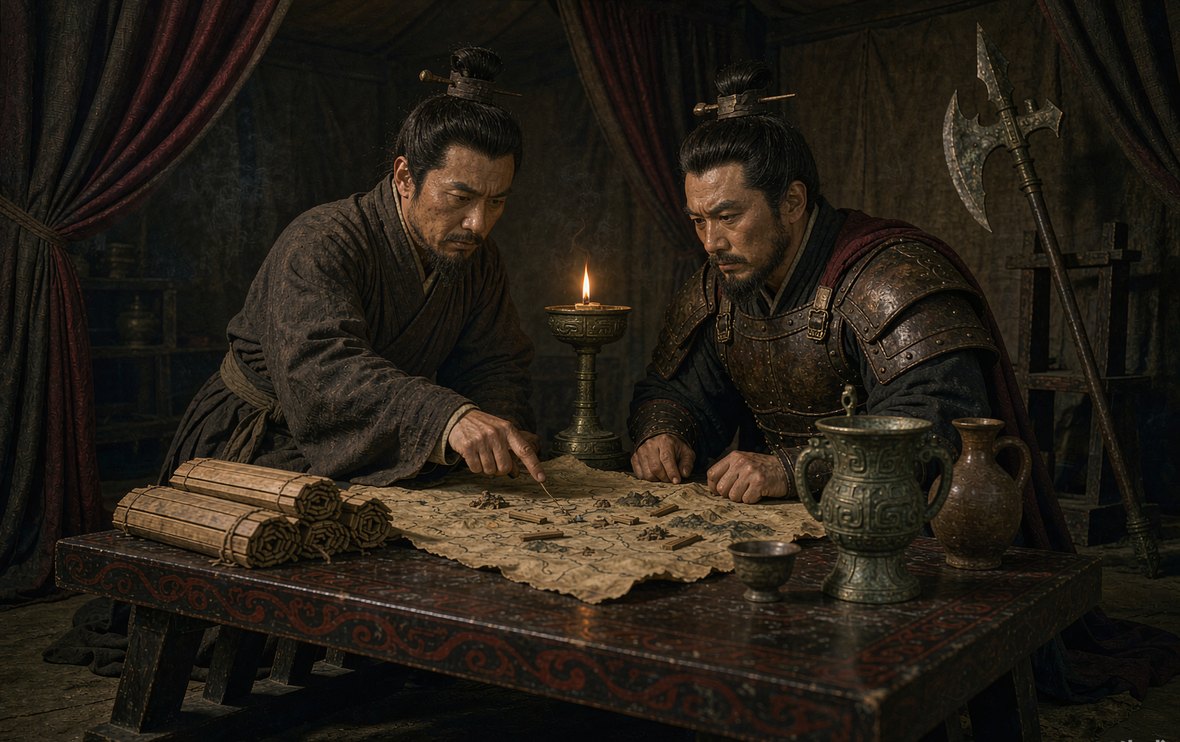
A compilation of Warring States materials collated by Liu Xiang of the Western Han: thirty-three fascicles covering the twelve states from Eastern and Western Zhou to Qin, Qi, Chu, Zhao, Wei, Han, Yan, Song, Wei, and Zhongshan, centered on the strategists’ schemes and speeches. It is a book full of drama: Su Qin stabbing his thigh to stay awake and ending with the seals of six states; Zhang Yi breaking the vertical alliance with horizontal ones; Feng Xuan burning debt-bonds to buy righteousness for Lord Mengchang; Jing Ke at the cold Yi River — with three inches of tongue the strategists shook the world; battles of ruler and minister, promises unto death leap from the page. Not always reliable history (the strategists’ embellishments are inevitable), it is the liveliest archive of the Warring States spirit: the rise of the shi, the summit of stratagem, the ultimate art of language. No text contributed more Chinese idioms — drawing legs on a snake, the fox borrowing the tiger’s might, the snipe and clam at odds, mending the fold after the sheep are lost. Reading it is like watching a two-thousand-year-old drama of high-stakes wits.
The protagonists are not kings but strategists: Su Qin, who "when sleep overcame his reading, stabbed his thigh with an awl," persuaded six states into the vertical alliance and wore six chancellors’ seals — "the states east of the mountains bowed like grass to the wind"; Zhang Yi unmade it with the horizontal — "serve one strong state to attack the weak many," defeating each in turn. Men of no fixed property and no fixed lord, serving Qin at dawn and Chu at dusk, they worked states with information, rhetoric, and insight into weakness — opening, beside realpolitik, a "battlefield of words."
Behind it stands an age in upheaval: hereditary office dissolved; commoners could become ministers; the shi first became a professional class that decided history. The Strategies record the golden age of the shi — valued not for birth and ritual but for schemes and eloquence. The Chinese tradition of "strategist," "aide," and "military counselor" begins here, with Su Qin and Zhang Yi as common founders.
The Strategies are China’s textbook of persuasion: Chu Long, to move the Queen Dowager of Zhao, began not with state affairs but domestic chat — "Does your appetite not fail?" — then led step by step through "parents who love their children plan far for them," until she gladly sent her son as hostage to Qi — empathy first, interest after; circuit, then victory. Zou Ji, to persuade the King of Qi to accept remonstrance, told not a homily but a household matter — "Am I not as handsome as Lord Xu of the north city?" — and from a mirror in the boudoir inferred the king’s blinders at court: "Great indeed is Your Majesty’s deception."
Allegory came at his fingertips: Su Dai stopped Zhao’s war on Yan with "when snipe and clam contend, the fisherman profits"; Jiang Yi’s "the fox borrowing the tiger’s might" showed King Xuan the hollowness of his power; Zhuang Xin’s dragonfly and sparrow warned King Xiang of Chu to think of danger in peace — one animal story, and kings understood at once. This wisdom of "parable as remonstrance" shaped China’s tradition of counsel and political communication: the sharpest words often come wrapped in the softest stories.
风萧萧兮易水寒,壮士一去兮不复还。 — The wind sighs, sighs; the Yi River is cold — the brave man goes, never to return.——Strategies of the Warring States, "State of Yan" — Jing Ke’s farewell
The Strategies hold not only calculation but the age’s most moving yi (honor): Feng Xuan "burned the bonds to buy righteousness" for Lord Mengchang — bonds worth a thousand gold went up in one blaze, exchanged for the "ten thousand hurrahs" of Xue’s commoners: long-run hearts beat short-run ledgers. Yu Rang avenged Zhi Bo, "lacquering his body like a leper, swallowing coals to make himself mute," only to fulfill "a gentleman dies for one who knows his worth"; Nie Zheng and Jing Ke set their word above their lives. In an age of broken rites, loyalty pointed no longer to clan but to the "one who knew my worth" — a more personal ethic.
That honor and scheme coexist is precisely the two faces of the age: schemes may have no floor; character must have weight. Sima Qian’s Biographies of Assassins and of Lord Mengchang drew much from these texts, because no stretch of history is richer in drama and humanity. Reading the Strategies, one marvels at the sharpness of schemes and is moved by those who died for the one who knew them — the romanticism of a utilitarian age.
As history it must be discounted: the persuasion-speeches were polished and inflated, and the strategists often invented to glorify their own school — Song scholars already doubted it as "shallow and unworthy of trust." Yet what it preserves is irreplaceable: first-hand material on the politics, wars, and diplomacy of the states, and a living record of the shi’s thought. Sima Qian, writing the Warring States portion of the Shiji, "drew on the Shiben and the Strategies" — without it, the era would be a blank in historiography.
As literature it won outright: narrative "brilliant and untrammeled," voices true to every speaker — Su Qin’s downfall ("my wife would not take me as husband, my sister-in-law not as brother-in-law") set against his homecoming ("brothers, wives, and sisters-in-law dared not look up") is the pre-Qin’s most vivid psychology. Han fu’s exuberance, historical prose’s cutting, the storyteller’s cadence of later huaben — all bear its mark. As for idioms — "three men make a tiger," "south shafts, north road," "precarious as stacked eggs," "a crafty rabbit has three burrows" — the Strategies are the Chinese language’s undisputed chief supplier.