Compilation
Warring States to early Han · author unknown
China’s oldest imagined cosmos: eighteen fasci...
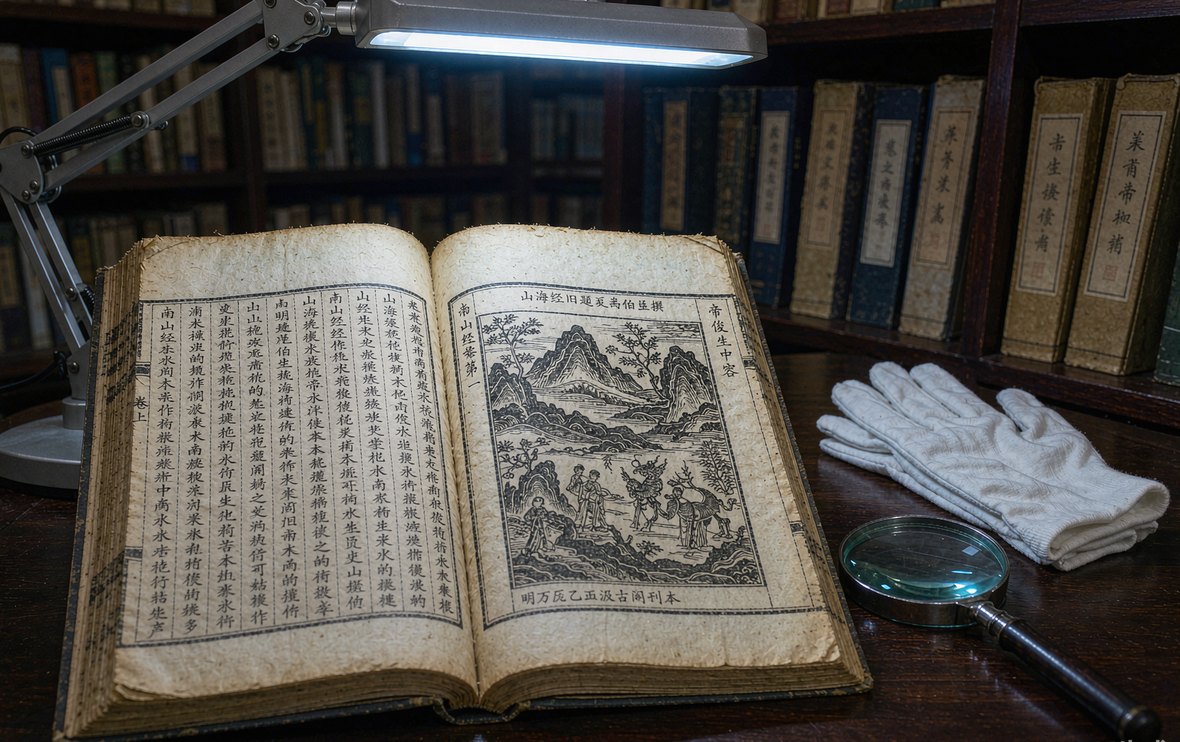
China’s oldest imagined cosmos: eighteen fascicles, thirty-odd thousand characters, recording five hundred mountains and rivers, hundreds of strange plants and beasts, dozens of far lands beyond the seas, interlaced with the myths of Kua Fu chasing the sun, Jingwei filling the sea, Xingtian dancing with shield and axe, and Yu the Great taming the flood. Compiled between the Warring States and early Han by unknown hands, it was read variously as geography or as tales of marvels; Lu Xun loved it in childhood and called it "an ancient book of shamans." Today the Classic of Mountains and Seas is seen as the master ledger of Huaxia imagination: genealogy of gods, bestiary of wonders, shamanic ritual, and geographical lore — source of Chinese literary imagination, mother-lode of games and film, gene bank of national memory. The West has Greek myth; this is the Chinese one: older, wilder, vaster.
The Classic takes mountains as warp and seas as weft to build a complete model of the ancient world: the five mountain-scriptures of South, West, North, East, and Center record five hundred peaks’ bearings, minerals, plants, birds, and beasts; the scriptures of regions beyond seas, within seas, and the Great Waste push ever farther, to lands where sun and moon rise and set. It may be a blend of real geography (ores, flora and fauna, tribal distribution) and rumor: mountain ranges may be surveyed fact, while fire mountains "whose light blazes" and beasts whose appearance "presages great drought" are the cosmic imagining of a shamanic age.
The model’s brilliance is its self-consistency: mountains have gods, marshes have sprites, beasts carry omens, far lands hold strange peoples — a schema of an animated world, everything in sympathetic response. It was a total mobilization of early cognition: known and unknown, experience and rumor, fear and longing, all entered on one map. Read the map, and you read the primal coordinate system of Chinese imagination.
The Classic preserves Huaxia’s oldest myth-cycle: Kua Fu "raced the sun... died of thirst on the way, and his staff became a peach grove" — chasing the sun in a losing body; Jingwei, the Yan Emperor’s daughter drowned in the Eastern Sea, "ever carries wood and stones from the Western Mountains to fill the Eastern Sea" — filling the ocean with twigs; Xingtian fought the Supreme Divinity for godhead, was beheaded, and "made his nipples his eyes and his navel his mouth, wielding shield and axe as he dances" — fighting on headless; Nüwa, the Queen Mother of the West, Gonggong, and Zhulong complete a pantheon in embryo.
Their character differs sharply from Greek myth: fewer nymphs, more tragic heroes of obstinate will — doing the impossible because it must be done. Jingwei, Kua Fu, and Xingtian became three archetypes of the national spirit: persistence in vengeance, pursuit of the ideal, unyielding resistance. Tao Yuanming read them moved: "Jingwei carries twigs... Xingtian dances with shield and axe — a fierce will forever endures"; Lu Xun found his childhood’s greatest joy in the copy Auntie Chang bought him. A nation’s childhood myths often decide its adult character.
刑天舞干戚,猛志固常在。 — Xingtian dances with shield and axe — a fierce will forever endures.——Tao Yuanming, "Reading the Classic of Mountains and Seas"
Lu Xun called it "an ancient book of shamans," touching its ground: it issues from the knowledge-system of shamanic culture — mountains and rivers have gods, sacrifices have their rites; the note "its sacrifice: one jade bi buried, millet offered" lets scholars reconstruct ancient cult; beasts "whose appearance means floods" or "whose appearance means pestilence" form a master catalog of omen-divination. Yet it is also a natural history: records of minerals (where jade, copper, iron are found), herbs, and animal forms preserve the real bedrock of early natural knowledge.
Precisely this mix of knowledge and imagination made it the shared treasury of philologists and poets: Guo Pu annotated it; illustrated editions continued through the ages, Ming-Qing print traditions of their own; Liu Xin presented the collated text in Han times; Guo Pu in Jin, Yang Shen in Ming, Bi Yuan and Hao Yixing in Qing all wrote commentaries. A small book of thirty thousand characters has moved two thousand years of learning and imagination.
Its nourishment of Chinese letters is unbroken: the mythic imagery of Zhuangzi and the Songs of Chu drew on it; Li Bai’s "hard roads of Shu" run along its weird passes; Ming-Qing novels of gods and demons (the beast-rosters of Journey to the West) are its distant descendants; Lu Xun retold its myths in Old Tales Retold; modern writers like Alai count themselves its readers. Its widest reach is contemporary: nine-tailed foxes, Zhulong, and Taotie in games; Kunlun and Guixu on screen; the monster-universe of Chinese animation and merchandise — an ancient text is being reopened by a new generation.
It is at the same time a puzzle of geography and ethnology: can its place-names match real ranges? Do the lands of the Great Waste record ancient migrations? Scholars still contend. But its deepest gift lies beyond verification: it proves that beyond its pragmatism, Huaxia civilization equally possessed a skywide imagination — Kua Fu still chases the sun, Jingwei still fills the sea, and these ancient obsessions are still inherited among the people of this land.