Region
Ansai, Yan'an, Shaanxi
The Ansai waist drum is a folk drum dance of A...
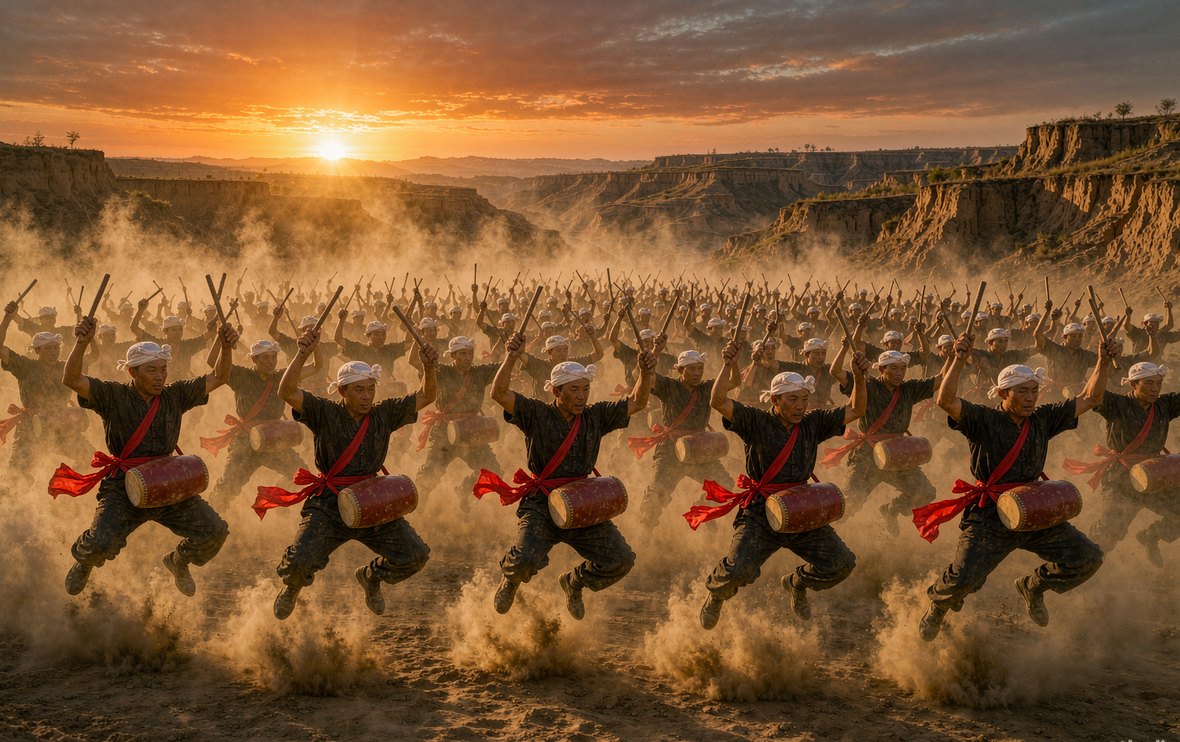
The Ansai waist drum is a folk drum dance of Ansai in northern Shaanxi: the drummer ties a small red-sashed drum to the waist, swings two sticks, leaps and turns, now sweeping like a gale, now falling like a downpour — "a drum formation running wild over the loess". Its roots are old: frontier garrison drums of Qin and Han and the folk processions recorded in the Song both leave traces, and it took modern shape within northern Shaanxi yangge and New Year festivities. It came into its own after the Yan'an new yangge movement of 1942, and the film Yellow Earth in 1984 and the 1986 Spring Festival gala made it famous across the country. Its aesthetic is unmistakable: a thousand people drumming and leaping at once, dust in the air, thunder on the ground — people, drum and loess as one, praised as an emblem of the Chinese spirit. It is in the first national list of intangible heritage, Ansai has been named the home of the Chinese waist drum, and from school playgrounds to international stages the cry of the plateau has never stopped.
The waist drum can be traced to the alarm and encouragement drums of Qin and Han garrison troops and to the drumming tradition of the old army; from the Song it entered folk processions, joining yangge, umbrella leaders and coloured silks in the full array of northern Shaanxi New Year custom. Ansai sat at a frontier crossroads, and the martial spirit and the endurance of loess farming meet in this small drum — the head is not large, but what it beats is the temper of a place.
The Yan'an new yangge movement of 1942 gave the drum a new voice for its time: teams went into the towns to offer greetings and celebrate victories, and "beating the waist drum" became the most infectious mass art of the liberated areas — a classic confluence of custom and history.
What overwhelms is the scale and the physicality: a hundred drummers or a thousand, kicking, leaping, spinning, stamping, red sashes flying and yellow dust rising. The "drummers on the ridge" style draws the line up onto the hilltops, answering from summit to valley. The technique is named like martial art: coiling the waist, cross-legged, horse-stance kicks, double take-off — stick on drum and foot on earth together make the percussion, and the dancers are the instruments.
Spectators reach for the word vitality: this is not refined, not decorated; it pours out at once the strength stored up by farming and frontier people. Dance scholars call it "the drumbeat cardiogram of the plateau" — every stroke is the loess breathing.
The Ansai waist drum quickly outgrew the folk category to become a cultural symbol of the loess plateau: the opening of Yellow Earth, the ten-thousand-drum formations of the Spring Festival gala, the Asian Games opening, national-day celebrations — grand national narrative repeatedly borrows its visual force. Drum, paper-cut, folk song and peasant painting are known as the four arts of Ansai, a complete ecology of loess folk art.
Its symbolic meaning has been summed up as the upward energy in the Chinese spirit: there is no lament in the drumming, only eruption. The portrait of a people is sometimes hidden in the posture of a dance.
The transmission system is substantial: every primary and secondary school in the district has drums for all, with drum exercises between classes; professional Ansai teams tour year-round, led by national-level inheritors; in cultural tourism, "drum villages" open their experience to visitors, and the gullies of the plateau become a natural stage.
From the village entrance to the Spring Festival gala to the school yard, the waist drum has shown a sustainable path for folk percussion: keep the soil on it, and embrace the stage — the drumhead will wear out, the drumming spirit will not.