Region
Wangmantian and others, Shexian, Huangshan, Anhui
The Huizhou fish lantern parade is a Lantern F...
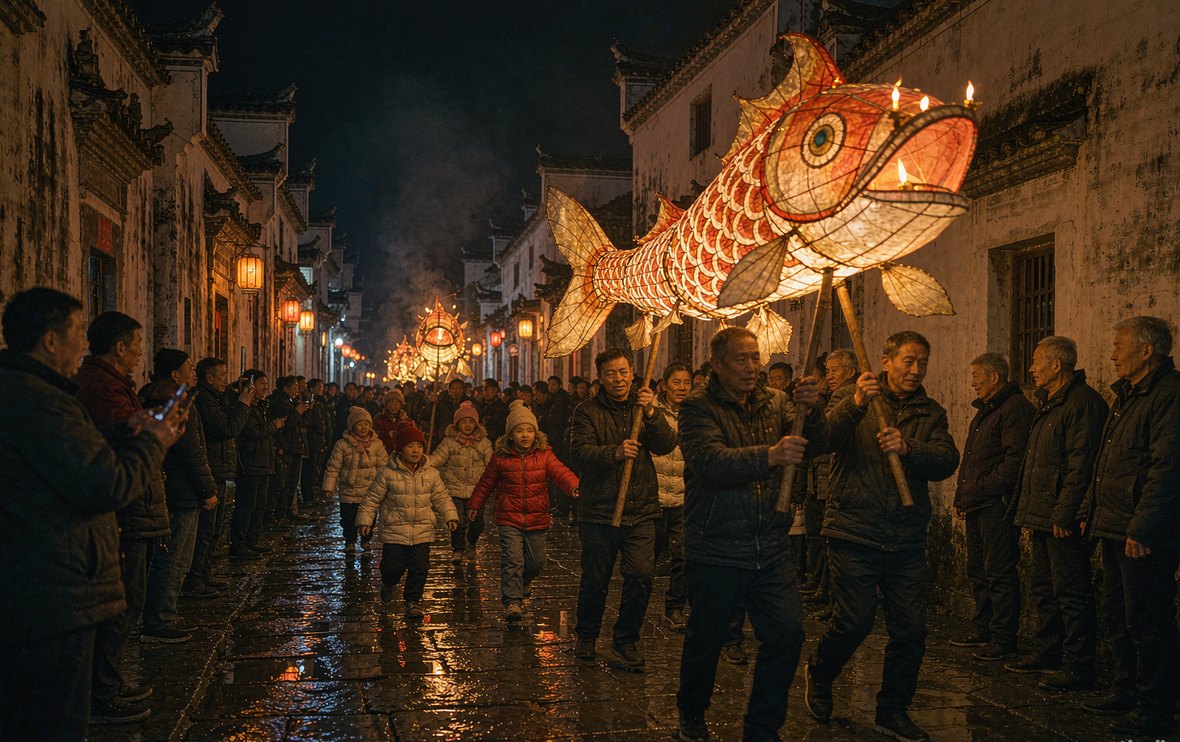
The Huizhou fish lantern parade is a Lantern Festival custom of old villages such as Wangmantian in Shexian, southern Anhui. Villagers build dozens or even a hundred great fish lanterns of bamboo frames, paper scales and candle cores, then light them and process through the night; wherever the fish pass, every doorway lights a candle to welcome them, firecrackers answer, and the stream carries their reflections — the Song lyric scene of "flutes sounding, the jade pot's light turning, a night of fish and dragon dancing" comes alive in a mountain village. Fish (yu) puns on surplus (yu), so the parade prays for abundance year after year and the flourishing of the clan. It is said to have begun in the early Ming, when villagers used fish lanterns to ward off fire and draw people together: six hundred years without a break. From the thirteenth to the sixteenth of the first month, villagers working away come home especially to build and carry the lanterns — the parade is also the annual reunion of a Huizhou clan. Made famous by documentaries and short video, the Wangmantian fish lantern has become a phenomenon of "new Chinese style" cultural tourism.
The Wangmantian parade is said to date from the early Ming: the village was built of timber and feared fire, so the people set fish against fire in the five phases, and took also the senses of "like a fish in water" and "surplus every year", parading fish lanterns to suppress fire and pray for peace — a plain piece of risk management that became a six-hundred-year clan occasion. Qing-era notebooks already record the custom in Shexian; its formation long predates the writing.
The parade quietly joins two older traditions, the exorcist rite and the Lantern Festival lamp: fire to drive off evil, procession to mark out territory. Every fish lantern is a swimming prayer, and every lane is its channel.
Lantern making is a collective craft project: bamboo splints bound into a frame (a great fish may be seven or eight metres long and need several people to lift), cotton paper pasted as scales, brushes painting fins, a beef-tallow candle burning inside — dozens of steps from splitting bamboo to dotting the eye. The ancestral hall becomes the workshop, elders teach the young, and the making is itself the transmission of clan craft. The eyes are dotted by the clan elder on the night of the first lighting: from then on the lantern has a soul.
Trial lighting on the thirteenth, the main lighting on the fifteenth, the closing on the sixteenth: four nights of procession along set routes through village and lane, firecrackers clearing the way. Children follow with small fish lanterns, students home from school take turns carrying the great ones — a parade with several generations in one frame.
What moves most is the cohesion beneath it: migrant workers begin preparations in the twelfth month, returned young people form a "fish lantern committee" to raise funds and draw up the roster; married daughters come back with their husbands to see the lights, and children follow the parade until late. The Lantern Festival fish lantern is Huizhou's annual valve for the return of its people.
The ancestral-hall-centred layout of a Huizhou village becomes fully visible in the parade: the lanterns set out from the hall and return to it — architecture, clan and custom serve as each other's stage on the same night.
In recent years the Wangmantian lanterns have spread through documentary and short video: photographers' night shots, travel bloggers' visits and national television coverage set off one wave after another, and "seeing the fish lanterns in southern Anhui" became a Spring Festival fashion. The village has developed lantern merchandise, hands-on workshops and heritage classes; young people, including a returning village doctor, are coming back — the traffic of custom is feeding rural revival.
The breakout also reveals a new rule of transmission: no advertising, only being seen — truly moving custom carries its own visual language. Six hundred years of lamplight have finally met their close-up.