Region
Chaoshan, Guangdong (Puning, Chaoyang)
Yingge is a collective square dance of the Cha...
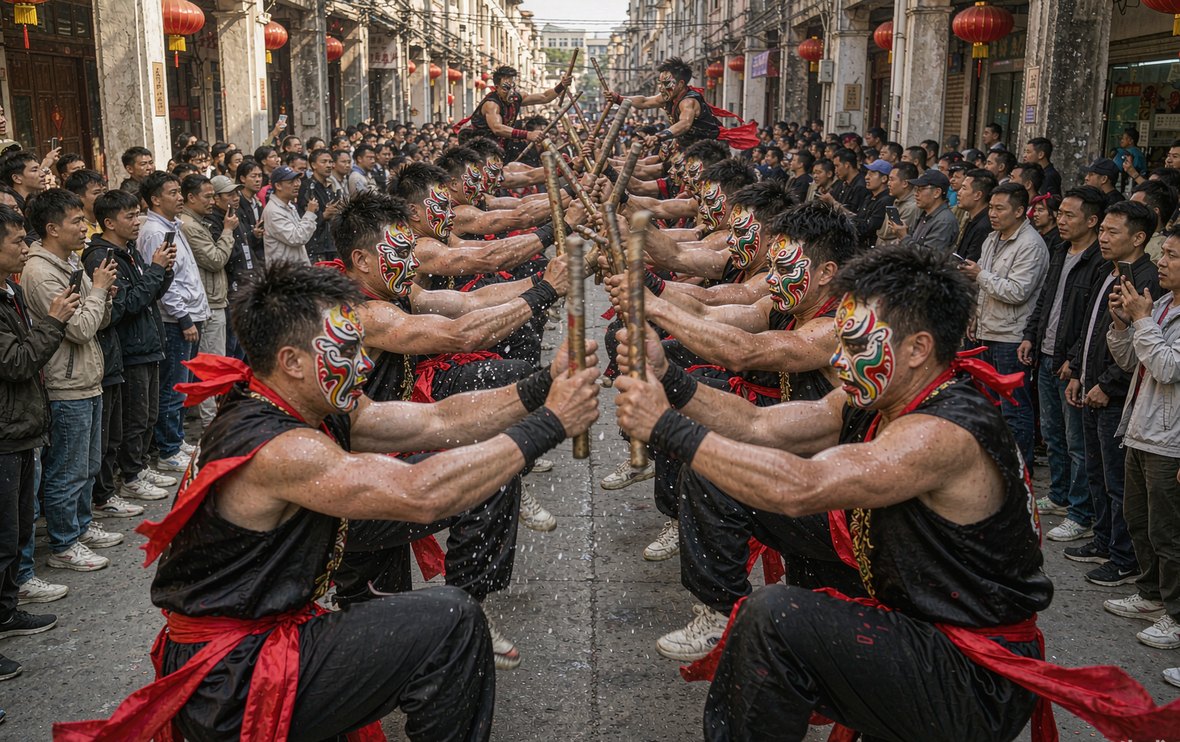
Yingge is a collective square dance of the Chaoshan region of Guangdong: dancers wear the painted faces of Water Margin heroes, carry a pair of short sticks in each hand, dance as they walk and shout as they strike, vigorous and overwhelming — it has been called "China's war dance". It grew out of ancient military exorcism and martial dance, appears in records by the Ming, and took fixed form in Qing-era Chaoshan processions. A troupe may number dozens or a hundred: Shi Qian leads with a snake, Li Kui and Lu Zhishen head the columns, and the stick work divides into fast, medium and slow schools — the fast clatters like rain, the slow rolls like surf. At New Year and at god processions the sticks sound and the streets empty. Both Puning and Chaoyang Yingge are national intangible heritage; in the 2024 Spring Festival videos of Chaoshan Yingge swept the internet and young dancers, the "Yingge girls" among them, filled every feed — an ancient war dance in the middle of a phenomenal youthful revival.
The lineage of Yingge runs back to exorcist dance and the dance of the battle array: the nuo rite against plague supplied the masks and the ritual frame, the old military formation supplied the vocabulary of stick strikes and stamping steps. The name itself is disputed — perhaps a corruption of "eagle song" or "oriole song", perhaps from the Chaozhou drum called yingge — but the temper is unmistakable: this is a dance born for driving off evil and for war. In the Ming and Qing it settled into the village god processions of Chaoshan, joining drums, banner teams and painted-face skits into a complete festive sequence.
The injection of the Water Margin story gave it a dramatic soul: dancers make up as the heroes of Liangshan and march out, and "the heroes of Liangshan attacking the Daming garrison" became its standard plot — folk tradition turned a novel into a walking stage.
The technical core is the stick: two short wooden batons struck and spun, with crouching jumps, turning and tossing. Fast Yingge beats like popping beans and the formation charges; slow Yingge gives one heavy stroke at a time. The painted faces are dense with colour: Shi Qian bears a serpent on his forehead (he leads with a cloth snake), Li Kui glares from a black face — each hero has his own pattern, a living specimen of Chaoshan folk art.
The formations are equally codified: two columns like twin dragons leaving the sea, a ring of men striking in unison like a hundred hammers. The first and second stick positions pass from master to pupil, and the stick mnemonics are handed down generation to generation — a Yingge troupe is a walking manual of martial art.
Yingge belongs to the god parades and New Year celebrations of Chaoshan: the deities go out, Yingge clears the way, drums fill the air, the whole village turns out. "When Yingge sounds, the soles of your feet itch" — Chaoshan men working away from home come back specially to dance or to watch. The Nanshan and Nigou troupes of Puning, the Zhongying troupe of Chaoyang each form a school, and inter-village contests are both contests of honour and occasions of sociability.
Yingge is thus deeply set in Chaoshan clan society: dancing it is a young man's coming of age, and the bond between senior and junior brothers in a troupe lasts a lifetime. Overseas Chaoshan associations form troupes of their own — in the Chinatowns of Thailand, Singapore and Malaysia the sound of drum and stick has never stopped.
At the 2024 Spring Festival Chaoshan Yingge went viral on short-video platforms: at the London celebration in Trafalgar Square it stunned the crowd, and domestic views ran into the billions — "China's war dance" became the year's symbol of cultural confidence. Local authorities have pushed Yingge into schools: primary and secondary pupils do Yingge exercises between classes, youth troupes are forming in numbers, and the "Yingge girls" have broken the gender line.
The explosion was no accident: it has everything short video wants — strong rhythm, high visual impact, collective heat, easy spread — and it is a complete heritage (dance, music, painted faces, costume). This revival proves that custom need not flatter the age; it need only be seen by it.