Time
Third lunar month, nine days and eight nights
The Dajia Mazu pilgrimage is the largest relig...
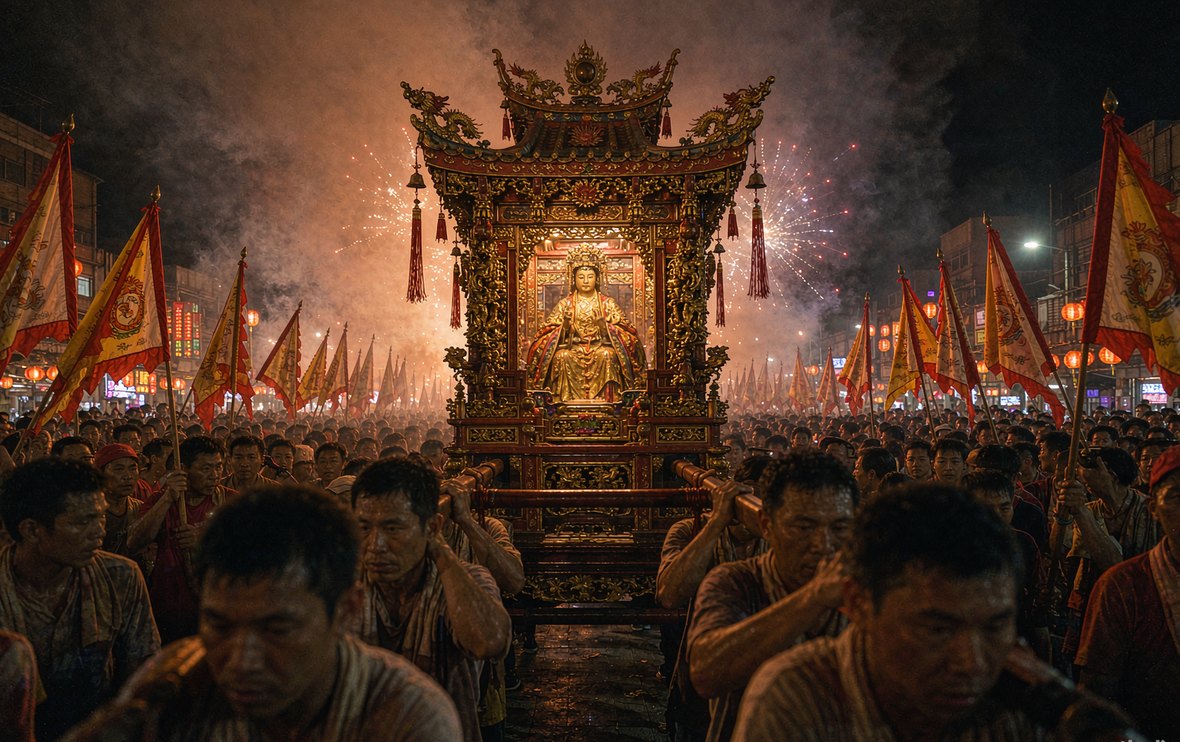
The Dajia Mazu pilgrimage is the largest religious folk event in Taiwan: each year in the third lunar month the image of Mazu sets out from Zhenlan Temple in Taichung and walks through Taichung, Changhua, Yunlin and Chiayi, nine days and eight nights, some three hundred and forty kilometres out and back, with devotees following the incense, setting out tables and ducking beneath the palanquin — participants run into the millions, which is why the month is known as "Mazu fever". The cult comes from Meizhou in Putian, Fujian: Lin Moniang, a Song-era woman famed for saving ships in storms, was honoured as a sea goddess after her death and ennobled through the dynasties up to "Empress of Heaven"; carried across the strait by migrants from Fujian and Guangdong, she became a shared object of faith. Since 2008 the pilgrimage has been described by UNESCO-affiliated bodies among the world's three great religious events, and since 2010 it has been listed as Taiwanese cultural heritage. A single procession walks out the extreme form of belief: measuring devotion with the feet, covering in nine days a promise between a people and their goddess.
The prototype of Mazu is Lin Mo, a woman of Meizhou Island in Putian in the Song dynasty. Legend gives her knowledge of medicine and of the tides, and repeated rescues of fishermen in storms; after her death at twenty-eight she is said to have answered prayers again and again. From "Numinous Woman of Universal Wisdom" to an imperial plaque under Huizong of Song, she was ennobled dozens of times — lady, consort, celestial consort, and finally, under the Kangxi emperor, "Empress of Heaven". A real rescuer, layer by layer, was shaped by a seafaring people's gratitude into a goddess.
The cult spread worldwide with emigrants from Fujian: today there are more than ten thousand Mazu temples and over three hundred million devotees. A faith born of real kindness, whose creed is safe passage, has become the largest spiritual common denominator of the maritime Chinese world.
The pilgrimage is a tightly ordered ritual system: the great birthday rite and the mounting of the palanquin before departure; halts, blessings and offerings along the way; the devotees' ducking beneath the palanquin to avert misfortune, following the incense on foot for the whole route, and exchanging incense for their home altars. Every step has a name and every day a climax. The outrider "reporting horse", the horn band, the embroidered banner teams, the palanquin societies and the tableau floats stretch for kilometres.
The core experience of nine days and eight nights is an ascetic gladness: walking tens of kilometres under a hard sun, sleeping in communal halls, eating at roadside tables — exhaustion and devotion together. Sociologists call it a collective training of body and mind: a custom that turns belief from an idea into blisters on the feet.
The route is a moving ethnography: shopkeepers set out incense tables and snacks, farming families offer tea and zongzi, volunteer teams pick up litter and provide medical support — a migration of millions proceeds in order. Television broadcasts and live streaming make the month a national event. Among the devotees are entrepreneurs, students and migrant workers: the custom levels every class.
Interaction of faith across the strait is another important dimension: groups of devotees travel to the ancestral temple at Meizhou to pay homage, and the exchange of consecrated images and their return forms a distinctive line of folk communication — Mazu is one of the most widely shared cultural symbols across the strait.
The contemporary transformation of the pilgrimage is exemplary: the traditional rites are kept intact while live streaming, apps that track the palanquin in real time and design merchandise embrace modern communication — young people follow Mazu as they follow a star. Recognition by UNESCO-affiliated bodies and coverage by global media have made it a world-class folk spectacle.
Its lesson is that custom lives not in freezing but in flowing: each year the devotees complete an ancient devotion in new ways. Nine days and eight nights, three hundred kilometres, along a road a thousand years in the laying: so long as someone will still walk for their faith, that road will have no end.