Elements
Sacrifice, market and popular entertainment
The temple fair was the most important scene o...
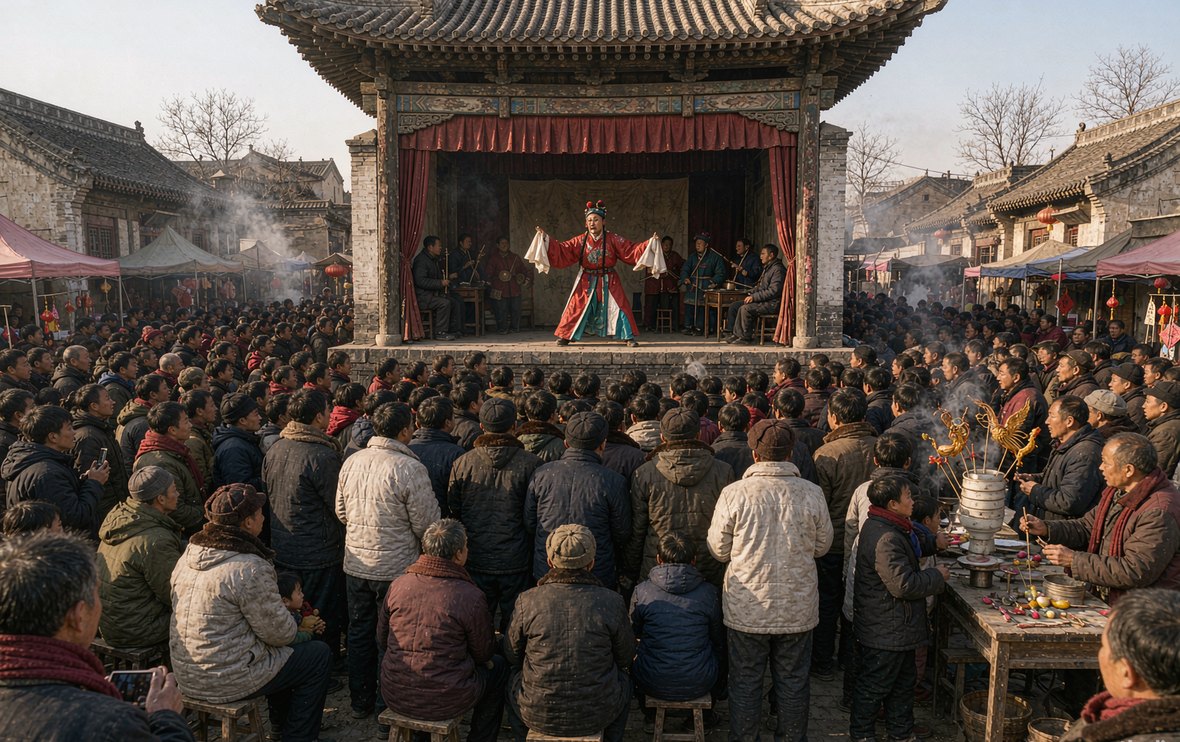
The temple fair was the most important scene of public life in Chinese rural society: anchored in the sacrifices of a temple or shrine, it fused market, street food, acrobatics, opera and incense into one occasion, held several times a year and drawing the whole town. It grew from ancestral and earth-god sacrifices; in Han and Tang the popular sermons at temples drew crowds, and by the Song the fair had become a settled commercial rhythm — the Dongjing Meng Hua Lu records that the Xiangguo Temple opened five times a month, "when the ten thousand surnames trade". Its essence is "gathering people around a god": worship is the pretext, human exchange the substance — goods, marriages, news and entertainment all transacted at the fair. Changdian in Beijing, Confucius Temple in Nanjing, the City God Temple in Shanghai, the flower fair in Chengdu: each metropolis had its own; Changdian and the Mount Tai Dongyue fair are national intangible heritage. The temple fair is the Chinese classical carnival: half faith, half the smoke of daily life.
The mechanism is simple and ingenious: sacrifice requires people to gather at fixed times; the gathered crowd generates demand for exchange; exchange in turn reinforces the gathering — "the fair thrives on the temple, the temple flourishes on the fair". A temple's incense was the traffic, and the square before it the oldest public space. Earth-god sacrifice, temple fair and market formed a trinity that set the annual rhythm of rural society.
The gods worshipped shifted with need: Bixia Yuanjun for children, the Medicine King for illness, Lord Guan for wealth, the Dragon King for water — the pantheon is a chart of wants. So the fair's function list writes itself: the need for faith, the need for market, the need for amusement. One place, three satisfactions.
The temple fair was the countryside's largest clearing house: farm tools and oxen, cloth and needles, mules and horses changed hands there; the "mule and horse fair" even became the main business of some northern gatherings. Craftsmen sold their specialities, pedlars filled in the last mile of rural commerce. The fair thus served as rural commercial infrastructure: the year's trading nodes were mostly tied to fair dates.
Courtship happened there too. The Book of Songs' "the Zhen and the Wei, how they swell and flow", with its springtrysts by the river, survived for millennia in the meetings of young people at fairs — matchmaking, betrothal, opera, food: the fair gave a closed village society the cross-village social space it so lacked.
The entertainments of the fair are half a history of folk art: shehuo processions, stilts, dry boats, bamboo horses, dragon and lion, peep shows, conjuring, monkey acts, storytelling, full-scale opera — crowds packed before the stage while every trade showed its skill. The food stalls were the other half: sugar painting, dough figurines, blown sugar, bean milk with fried rings, osmanthus taro — the taste of a temple fair is often cut deeper into childhood than any image of a god.
This ecology nourished a great many folk arts: the market that sustained numbers of national-level heritage genres was precisely the temple fair. The fair is the original trading floor of intangible heritage — craft is bought there, and in being bought, is passed on.
Urbanization and the rise of shopping centres once thinned the fairs, but the past twenty years have brought a revival in new forms: cultural fairs in parks such as Ditan and Longtan, light festivals and national-style markets taking over the incense trade, scenic areas running year-round "fair-style operations". The fair has shifted from "religion plus market" to "culture plus consumption", a festival IP.
The debate over commercialization diluting the flavour continues alongside experiment, but the underlying function is unchanged: people need periodic reasons to gather, and cities need public spaces with human warmth. So long as people will still step out for a good noise, the temple fair has another thousand years.