Origin
From the Han "fish and dragon" spectacles onward
Dragon and lion dance are the twin pillars of ...
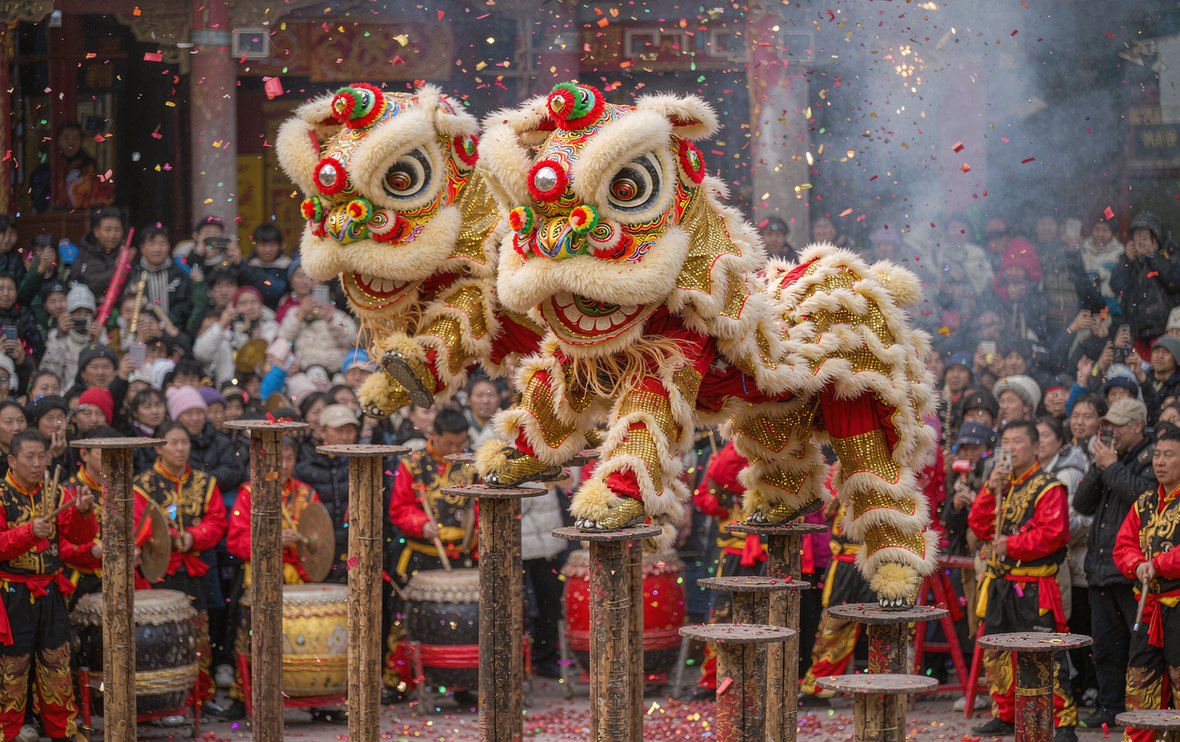
Dragon and lion dance are the twin pillars of the Chinese festive parade: the drums sound, the dragon soars, the lion leaps, and an ancient prayer to drive off evil and draw down blessing becomes the most exuberant of public carnivals. The dragon dance descends from the Han "fish and dragon" variety shows and from rites for rain; the long body may run to dozens of sections, each dancer lifting a pole, rolling, threading and coiling so that the dragon breathes above the crowd. The lion dance, said to have come from the Western Regions and then naturalized, divides into the northern lion, muscular and lifelike, and the southern lion, fierce and expressive, which climbs high poles to "pluck the greens"; Foshan's awakening lion, with its crafted heads, is national intangible heritage. Together they form the Chinese grammar of "dancing one's way to the gods": the dragon governs water and the good year, the lion guards the house and brings luck. At New Year, at shop openings, at temple fairs and celebrations, wherever there is joy the dragon and lion are dancing. The International Dragon and Lion Dance Federation has turned the custom into a world sport — China's noisiest intangible heritage is dancing to drums around the globe.
The art of the dragon dance is to give a static prop a life. The body is made of a head, a tail and dozens of sections, one pole and one dancer to each, led by the flaming pearl: the pearl-bearer is the conductor, and the whole team pivots from the waist and pulses through the poles into roaming, rolling, threading and coiling figures. The fire dragons of the night — Tongliang, Puzhai — move through showers of molten iron, "people inside the dragon, the dragon inside the fire", folk aesthetics at its most extreme.
The technique is entirely isomorphic with dragon myth: a dragon can be dark or bright, minute or vast, and the dance must produce exactly that mutability. "The dragon lowers its head and water comes; the dragon lifts its head and rain arrives" — the original function was rain-making; today it is luck-making. A dragon dance carries how many generations of imagining a good life.
The northern lion prevails in the north and looks like a real lion: male and female in pairs, thick fur and solid build, the movement built on pouncing, falling, tumbling and rolling, often with a senior and a junior lion on stage together — it prizes form. The southern lion prevails in Lingnan, its head coloured after Three Kingdoms heroes (red for Guan Yu, yellow for Liu Bei, black for Zhang Fei), and prizes intent: the high-pole "plucking of the greens", with lettuce hung aloft, requires the lion to leap, probe, pounce and eat, turning the animal's expressions into a blend of martial art and acrobatics.
"Plucking the greens" puns on "plucking wealth" and is the soul of the southern lion: lettuce on a pole, the lion climbing, taking it in its mouth, scattering the shreds on the ground — a complete narrative of good fortune. The Once Upon a Time in China films made Foshan's awakening lion famous worldwide, and lion-head making, with its four arts of binding, pasting, painting and assembling, is itself national intangible heritage: a single lion holds the whole toolkit of Lingnan craft.
Beyond the dragon and lion, the percussion is the other half of the soul. The drum is the conductor: rising, awakening, feinting, plucking, withdrawing each have their own pattern; suona, gongs and cymbals push the scene to boiling point. The dragon's formations are named like poetry — two dragons sporting with a pearl, a carp leaping the dragon gate, a flood dragon leaving the sea; the lion's moods are named like a play — sleeping, waking, probing, doubting, delighting, angering, startling. The script of this animal mime is written in drum notation.
This rhythmic system makes the dance a "living document" that can be transmitted: set routines, named movements, orderly succession — the oral, hand-to-hand teaching of master to pupil is itself a kind of movable type for custom.
Dragon and lion dance travelled with Chinese migrants: New Year parades in San Francisco, Paris and Sydney always open with them, and the international federation has pushed the competitive side, with world-championship scoring turning a folk performance into a global sport. In Southeast Asia the lion has localized deeply: Malaysia's high-pole lions are reckoned the best in the world, and Singapore's Chingay parade puts dragon and lion at its centre.
Its global vitality comes from low threshold and high contagion: no language is needed — the drums start, the beasts rise, and everyone feels it at once. The Chinese like to say the dance "brings out the spirit"; that spirit now belongs to the whole world.