Date
The fifteenth day of the first lunar month
The Lantern Festival on the fifteenth of the f...
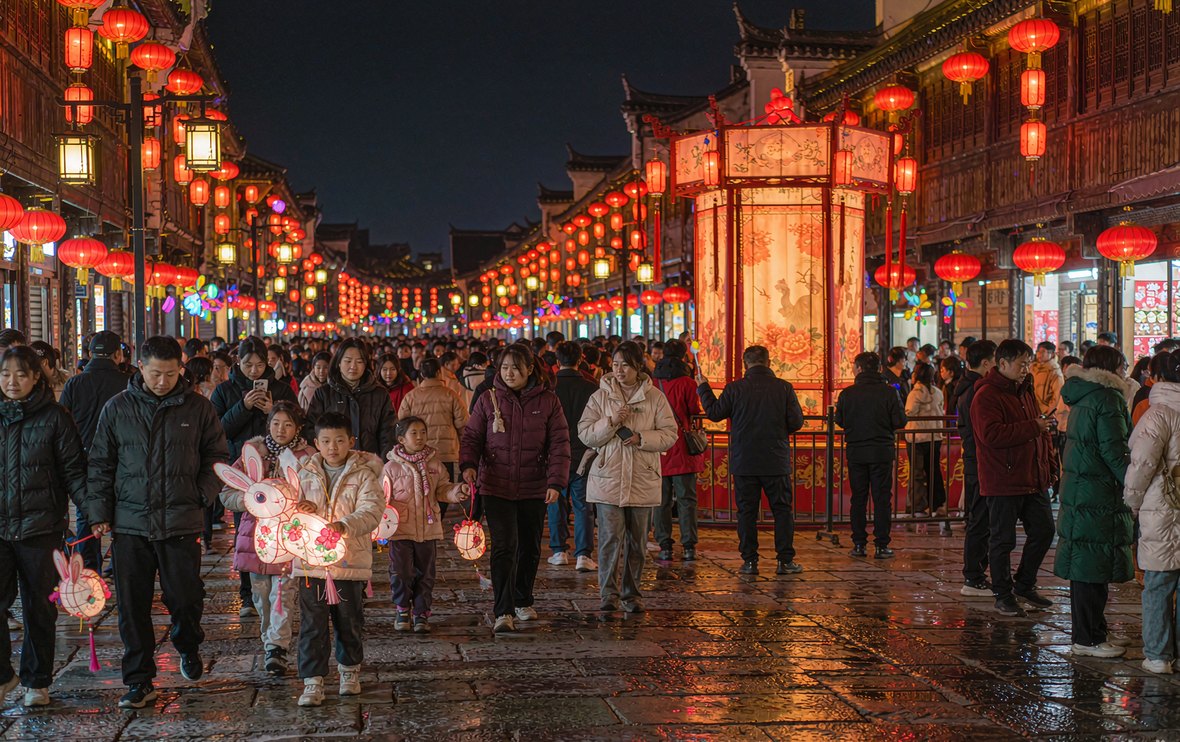
The Lantern Festival on the fifteenth of the first lunar month is the climax that closes the New Year: the first full moon of the year, when people light lanterns, admire them, guess riddles and eat tangyuan, lamplight and moonlight shining together, the human world and the heavens celebrating as one. The festival was anciently called Shangyuan and grew from the Han custom of burning lamps in sacrifice to the supreme deity Taiyi; Sui and Tang fixed it as a public carnival — "one night the east wind opens a thousand trees of light" is Xin Qiji's description of the Lin'an lantern fair at its literary peak. It was also one of the rare occasions in old China when unmarried women could walk abroad at night, and countless matches were made beneath the lantern market: "the moon rises over the willow tips, my love waits after dusk". Small wonder the festival has been called a Chinese Valentine's Day. Eating tangyuan stands for wholeness and reunion, while dragon and lion dances, stilt-walking and dry-boat parades carry the New Year mood to its height. A thousand years on, the lantern fairs of Zigong, Qinhuai and Yu Garden still write new verses to "a night of fiery trees and silver flowers".
Three accounts of the origin of lantern lighting run in parallel: the Han emperor Wu's sacrifice to Taiyi, kept "from dusk through the night until dawn", which involved burning lamps; the Eastern Han emperor Ming's Buddhist rite of "lighting lamps to honour the Buddha"; and the Daoist teaching of the three primes, which holds the upper prime to be the day the Heavenly Official bestows blessings. They do not contradict one another, and all point to one fact: from Han to Sui the lighting of lamps at the upper prime became established custom. The Tang allowed three nights of lanterns, the Song extended it to five, and the Ming at one point to ten — with the curfew lifted, the city revelled until dawn.
The lantern thus rose from a means of lighting to a cultural device: the mechanical wit of the revolving horse lantern, the engineering spectacle of a mountain of lanterns, the wordplay of riddles. The lantern fair was one of the few all-class exhibitions in ancient China where technology, art and entertainment met.
The old lantern fairs were vast. The Dongjing Meng Hua Lu records the Bianjing crowds beneath "towers stacked with lamps, hundreds of thousands of candles"; the Wulin Jiushi lists countless varieties from Lin'an, "each made of five-coloured glazed glass". Around the lantern market swarmed every kind of performance — dragons, lions, stilts, dry boats, acrobats. Merchants sold by lantern light, girls met sweethearts there, scholars wrote riddles on the frames: a highly fluid public space in which the usual social boundaries dissolved.
Sociologists therefore treat the festival as a model of "non-ordinary public time" in old China: hierarchy, gender and curfew were suspended, and the city made way for collective joy. Chinese romanticism and Chinese order coexist strangely well on a Lantern Night.
The round sweet eaten on the fifteenth is called yuanxiao in the north, where it is rolled, and tangyuan in the south, where it is wrapped. The technique differs by region; the meaning is national — reunion. Shaped like the full moon and floating in hot syrup, its roundness puns on yuan, the first and whole. One spoonful pins the moon in the sky to the family at the table.
From the "floating rounds" of the Song to today's black sesame, peanut, molten-custard and even savoury fillings, a thousand years of change — but the symbolic grammar of answering the first full moon with a round sweet has never altered. With one bowl of dessert the Chinese complete their earliest and deepest aesthetic blessing of the year.
In the old order women stayed indoors, and only at the upper prime could they dress in their best and walk out at night. Beneath the lantern shadows glances were exchanged: Ouyang Xiu wrote "the moon rises over the willow tips, my love waits after dusk"; Xin Qiji, "I turned suddenly, and there she was, in the dim light of the lanterns". The two most moving encounters in Chinese literature both take place on this night, which makes the festival, alongside Qixi, another source of the native Valentine's Day.
Contemporary fairs have gone high-tech: Zigong sends its giant lantern installations and craft skills abroad, the Qinhuai fair joined the first national list of intangible heritage, and Yu Garden wins young audiences with themes from the Classic of Mountains and Seas. The light source has changed; the heart has not — as long as people will still step out of doors for a lantern, the festival lives.