Time
Around the 24th of the sixth lunar month, three days
The Torch Festival is shared by the Yi, Bai, N...
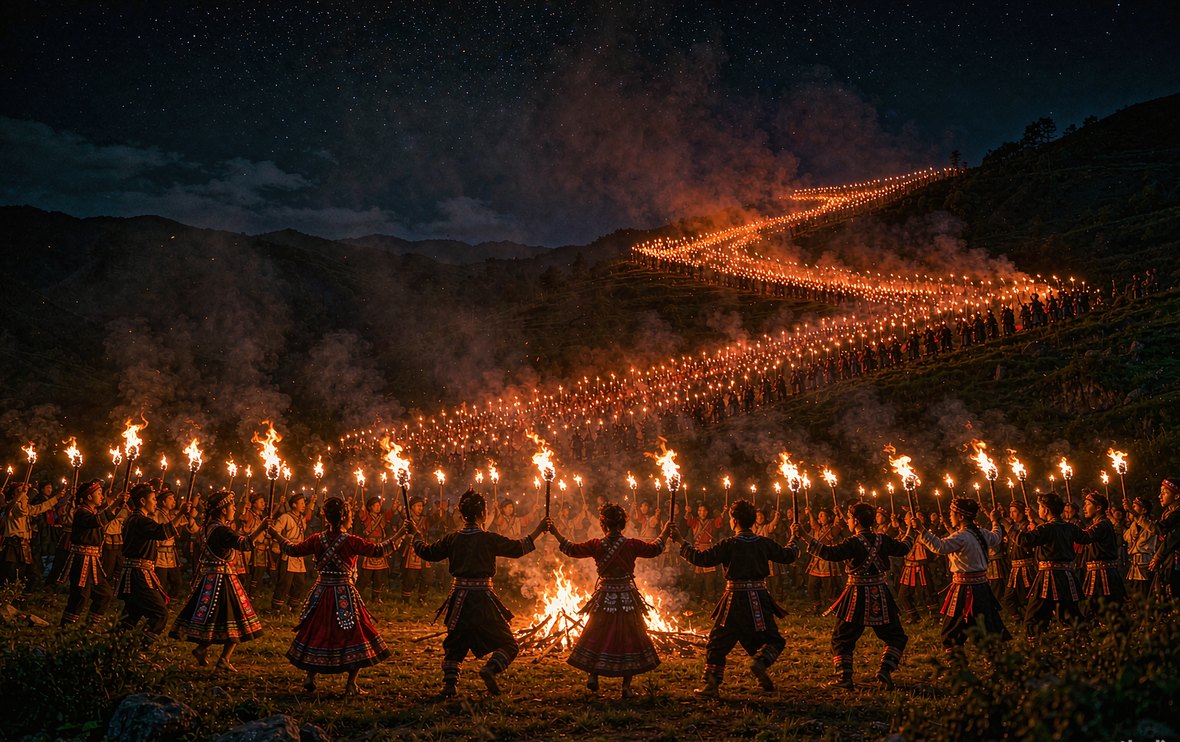
The Torch Festival is shared by the Yi, Bai, Naxi, Jino, Lahu and other peoples of southwest China, and is grandest among the Yi. Around the twenty-fourth of the sixth lunar month people light torches and process through fields and villages, dance the date dance, hold bullfights and horse races, and sacrifice to fire to drive off evil, for three days and nights — hence the name "carnival of the East". It grows from the Yi's worship of fire: the Yi call themselves children of fire, and an ever-burning hearth is the sign of a household's fortune; the tales of burning insects and plague away give the festival its full charge of praying for harvest and averting disaster. The Yi Autonomous Prefecture of Liangshan holds the largest: on torch night in Xichang ten thousand torches gather into a moving river of fire, while the dolho circle dance, the beauty contest, wrestling, bullfighting and racing follow one another — national intangible heritage since 2006. This is a festival of a people who dance with the flame in their hands: the deeper the night, the brighter the fire.
Fire stands at the centre of the Yi world view: in the creation epics it takes part in separating sky and earth; the dead are cremated to ascend, and the hearth never goes out — "born beside the hearth, dead upon the flame". Fire is both the source of life and a power of purification, driving off insects, burning away plague, cleansing the unclean, and the Torch Festival is the annual peak of that worship.
The date has an agricultural logic too: after the summer solstice, as the crops ripen, pests and disease are at their worst — carrying torches around the fields to burn the insects and lighting the ears to pray for harvest unites the practical experience of farming with sacred rite. Legend and season mirror each other, which is why the festival is so deeply rooted.
The traditional structure is three days and nights: the first for welcoming fire — taking the sacred flame and sacrificing livestock; the second for passing fire — torches in procession, every household lighting, every village relaying; the third for sending fire home, the wishes brought to a close. Daylight belongs to contest and song: bullfighting, racing, wrestling, the greased pole, the beauty contest for the "golden azalea", and dolho, in which lines of women in their best hold yellow parasols and dance arm in arm. At night ten thousand fires burn at once, torches join into a river, and people dance the date dance around the bonfires until dawn.
The structure displays the ritual aesthetic of the Yi in full: first honour the god, then pass the fire on, then send it back — fire is borrowed solemnly and returned respectfully. Inside the revelry there is courtesy toward nature at every step.
The festival is also the Yi women's moment in the light. Dolho is danced by dozens or a hundred women in full dress, holding yellow oil-paper parasols, arms linked, singing in a plaintive, winding line — an independent item of national intangible heritage. The beauty contest judges more than looks: character, skill and the workmanship of costume all count, and the "golden azalea" of the festival carries the Yi image of the ideal woman.
Historically the festival was also a window for courtship: a girl turns with her parasol, a boy speaks through the jaw harp — "the moon of the Torch Festival" is an eternal theme of Yi love songs. A festival of fire is at once a contest of beauty and a passage of love.
The contemporary festival has been remade for cultural tourism: Xichang draws hundreds of thousands of visitors a year, an international brand, modern staging and a bonfire party for ten thousand set side by side; the "torch homelands" of Butuo and Puge keep the more original village torches — tradition and performance running on two tracks, each in its place.
The lesson is the same as with iron flowers: raw, powerful custom suits contemporary visual media by nature — fire, crowds, song and dance are the camera's chosen language. Only remember that in its first meaning, a torch was a group of people carrying their faith along a field ridge through the dark.