Meaning
Mongolian for "play" or "games"
Naadam — "play" or "games" in Mongolian — is t...
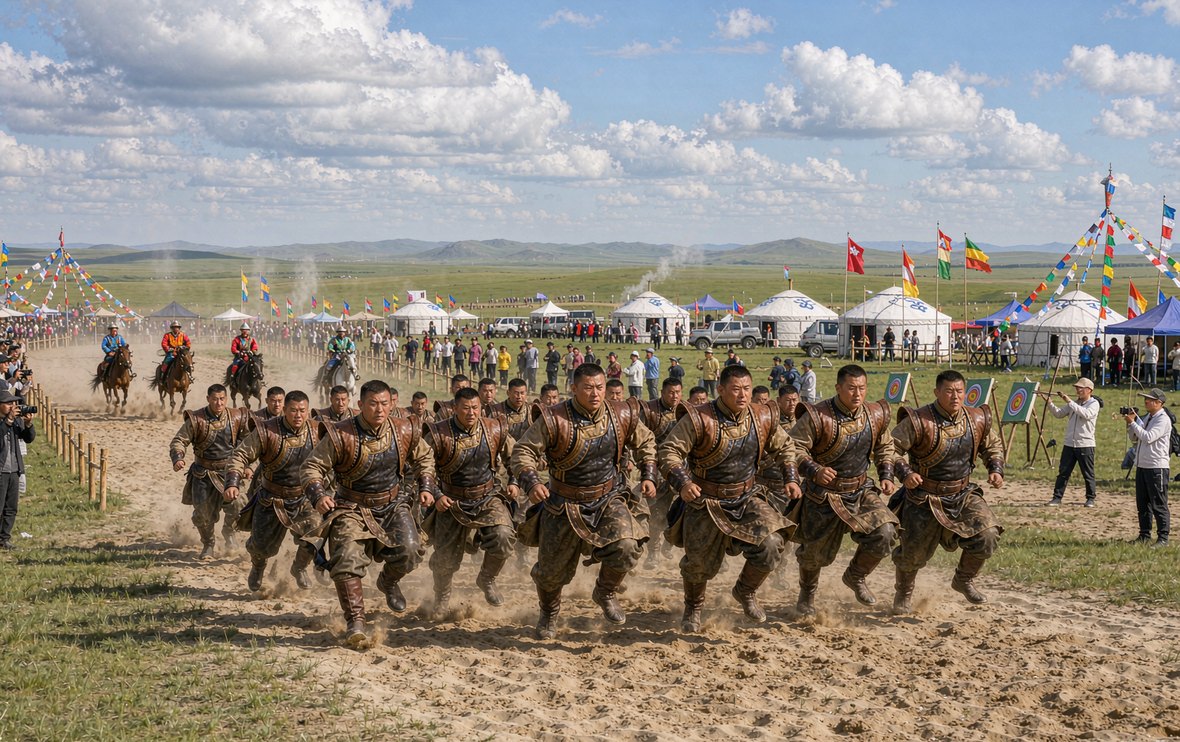
Naadam — "play" or "games" in Mongolian — is the greatest traditional festival of the Mongol people. Each year when grass and water are at their best, usually in July and August, the grassland communities gather for horse racing, wrestling and archery; the "three manly skills" form the frame, with song, dance, trade and feasting around them, whole encampments emptying and people travelling a hundred li to attend. The festival is old: it had taken shape by the time of Genghis Khan, and a record of 1260 under Kublai already shows the full three contests; in the Qing it was held regularly under the banner system, and today it is a calling card of Inner Mongolia — the Xilingol Naadam, with ten thousand horses and a thousand wrestlers, is the grandest of all. It is not merely a sporting meet but the annual exhibition of nomadic civilization: racing tests the union of rider and horse, wrestling tests strength and courtesy, archery tests stillness and aim — the grassland's entire definition of a warrior compressed into three skills.
The three contests answer the three capacities of nomadic life: racing tests horsemanship and the horse (the mobility of the steppe), wrestling tests body and technique (the fighting strength of the tribe), archery tests precision and calm (the skill of hunt and war). Together they were the full certification of a "good son" on the old grassland, which is why Naadam is called the festival of warriors.
Today's Naadam adds shagai shooting, Mongolian chess and trick riding, and both men and women may compete — the frame of the three skills remains, the boundary of participation has widened: the competitive spirit of the steppe is opening to more people.
A Naadam race may field hundreds or a thousand horses: boy jockeys, often around ten years old, light and skilled, ride without saddles for tens of kilometres while the crowd's roar lays a moving river along the track — the culture of small riders with large resolve is the most moving sight on the grassland. Wrestling, bokh, is more ceremonial still: the wrestlers wear the zoodog, the studded leather vest, enter with an eagle dance, and the winner receives the coloured collar of merit; a bokh champion with accumulated victories is honoured by all.
Bokh etiquette is exacting: the entry mimics an eagle spreading its wings, and at the end the two clasp arms and withdraw — force wrapped in courtesy, contest resolved into respect. The civilization of steppe sport is all in those gestures.
Historically Naadam served trade and society as well: banners exchanged goods, monks and laity gathered to recite blessings, young men and women met and pledged themselves — the Mongolian love songs are full of meetings at Naadam. The obo cairn rite often falls at the same time: three circuits, a stone added, an offering made — sacred sacrifice and exuberant contest side by side on one grassland.
The modern festival layers on a cultural festival, trade talks and tourism: markets of dairy products and handicrafts, long-song and morin khuur performances, photography festivals — one gathering delivers a three-dimensional display of steppe civilization.
Its deepest meaning is an annual confirmation of the nomadic spirit: in the season of good grass the scattered herders come together again and renew the understanding between rider and horse, people and grassland. Racing tests the bloodline of the herds, wrestling the vitality of the tribe — Naadam is the yearly calibration rite of a nomadic civilization.
Today Naadam is national intangible heritage and travels the world with Mongolian cultural export: from the Ulan Muqir touring troupe to the festival itself, steppe culture has found its mode of expression — vast, proud, reverent toward nature. Every drum and horn of Naadam is a confession written by nomadic civilization to the modern world.