Region
Queshan in Henan, Zezhou in Shanxi and elsewhere
Iron-flower striking is an ancient folk firewo...
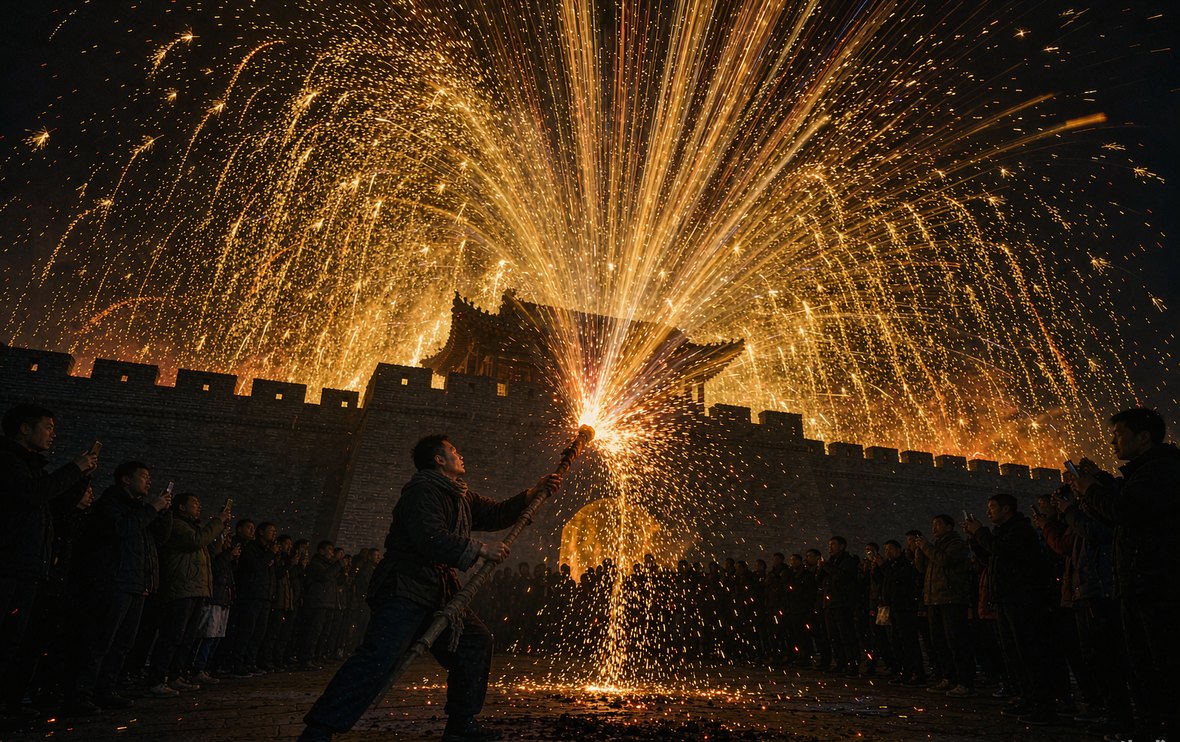
Iron-flower striking is an ancient folk firework of the Yellow River region in Henan and Shanxi. The craftsman melts pig iron to more than sixteen hundred degrees, ladles it out on a stick and strikes it hard into the air; the iron bursts in the night sky into ten thousand points of gold, a downpour of stars fiercer and more immense than any firework. It is said to have begun in the Northern Song and flourished in Ming and Qing: one account ties it to the founders' guild sacrifice to Laozi, another to celebrations at mines and smelters. Flower (hua) puns on prosperity (fa): the more you strike, the more you prosper. Queshan iron flower in Henan is national intangible heritage, and Zezhou in Shanxi is equally famed; in recent years short video has made the "iron-flower rain" a headline attraction of night tourism. Transmission of the craft is severe: the striker needs years of practice, nerve and care — every bloom of molten iron is an extreme of skill and courage at once.
The craft grew alongside the iron industry: the Yellow River region was rich in mines and smelting from early times, and smiths formed their own traditions of sacrifice and celebration at the furnace. The guild rite "striking iron flowers before the Laozi temple" is the most widely told; Northern Song texts already note something like molten iron bursting into flower, and Ming and Qing gazetteers increasingly list "iron flowers to greet the Lantern Festival". The pun of flower on prosperity made it the hardest-edged blessing rite of the New Year.
The Yang family of Queshan kept the technique secret for centuries and it nearly died out; reconstructed in the 1980s, it returned in glory — the survival story of a craft is itself a biography of the craftsman's spirit along the Yellow River.
Every link in the chain is alarming. Pig iron is melted to a thin liquid above sixteen hundred degrees; the smith uses two sticks, one holding the iron, one striking it, so that the metal shoots up and scatters, oxidizing and burning out in the air as fragments of gold. The performer wears a sheepskin coat inside out and a reversed gourd scoop on the head, protected by layer upon layer of "burning clothing" — the iron lands and rolls off and dies, a physical detail that gives the danger a scientific footnote.
The craft is summed up as nerve, hand and heart: too much iron and it falls, too hard a blow and it scatters without flower; years are needed for the feel. Apprenticeship under a master is close to ascetic practice — every rain of gold is one instant of bloom after a thousand hammerings.
The meanings stack. Flower is prosperity; to strike flower is to strike luck, and the more you strike the more you prosper. Iron flowers filling the sky like "gold scattered in all directions" foretell a good harvest and a thriving household; the iron is born of furnace fire, and a roaring furnace means a flourishing house — a complete semiotics of metallurgy.
Visually, iron flowers redefine the firework: a firework is cold chemical flame, an iron flower is molten metal — it turns the material of industrial civilization into the festival language of an agrarian one, coarse and splendid. Spectators describe "a golden river of stars pouring down", "a fiery version of a thousand trees of pear blossom" — the loveliest images in Chinese, restarted by one stick of iron.
In the short-video era iron-flower striking has become a phenomenon of the night-time economy: shows at Kaifeng's Qingming Riverside Land and in the old cities of Shanxi sell out, and videos repeatedly pass a hundred million views — a genuine headline act of intangible heritage. The form is evolving too: from a once-a-year New Year performance to regular residency, with expanded viewing areas, lighting design and narrative staging — the secret art has turned toward theatre.
The challenge of transmission remains: injury risk to performers and a gap in the ranks are the trade's pain, and localities are answering with insurance, teaching bases and support for young craftsmen. A craft poured from iron at a thousand degrees deserves a longer bloom.