Date
The fifteenth day of the eighth lunar month
The Mid-Autumn Festival on the fifteenth of th...
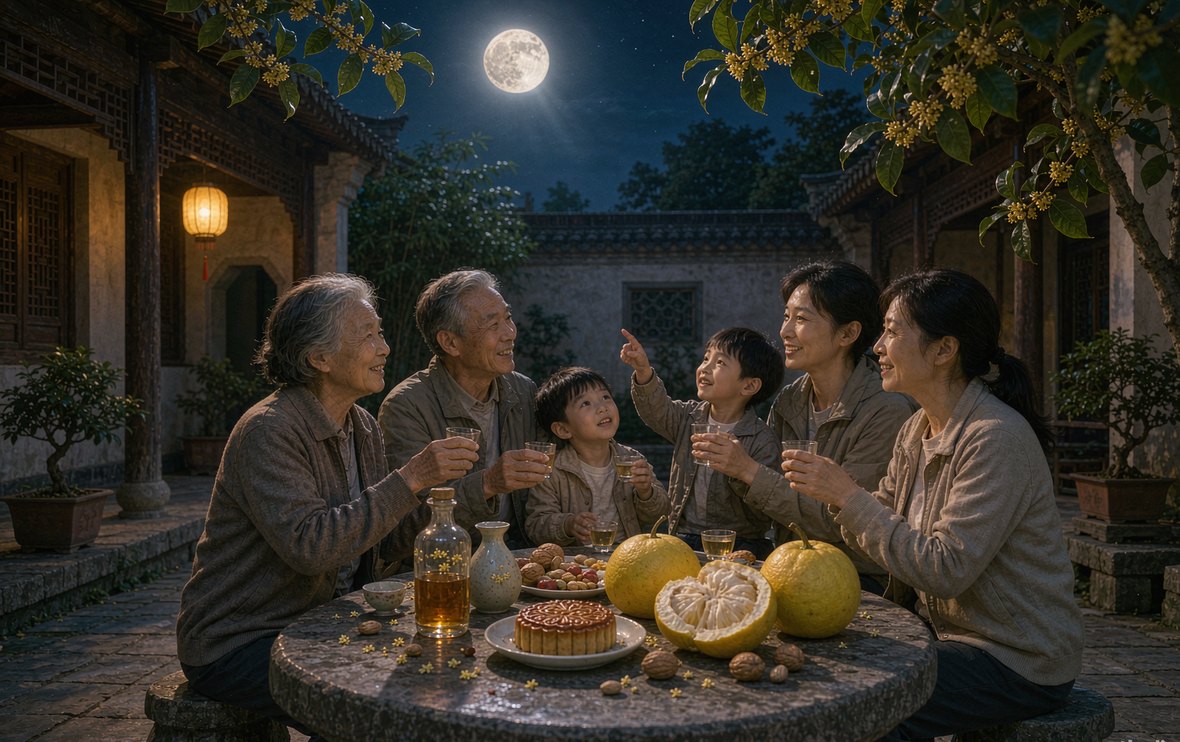
The Mid-Autumn Festival on the fifteenth of the eighth lunar month is the highest image the Chinese have of reunion: on the night of the full moon they admire it, offer to it and eat mooncakes, sharing the hour from the ends of the earth. It descends from the ancient autumn equinox sacrifice to the moon recorded in the Book of Rites, took fixed form as a festival in the Tang, flourished as never before in the Song, and by Ming and Qing stood beside the Spring Festival as a great occasion — "flowers in full bloom, the moon full, people reunited" is its entire grammar. Su Shi's "may we live long, and share this moonlight though a thousand li apart" turned the moon into a medium of feeling across distance, while the myths of Chang'e flying to the moon, Wu Gang hewing the cassia and the jade rabbit pounding elixir embroidered it with imagination. Eating mooncakes begins in the Ming, when they were "sent to one another for the meaning of reunion"; a family dividing one round cake is a rite that brings the perfection of the sky down to the table. Inscribed nationally in 2006 and a public holiday since 2008, it remains the second great emotional peak of the Chinese world after the Spring Festival.
Mid-Autumn begins with the autumn offering to the moon: around the autumn equinox, as the grain came in, the first farmers thanked the harvest by sacrificing to the moon — the moon was first of all a witness to abundance. The Book of Rites records that "the Son of Heaven faced the sun in spring and the moon in autumn", and the imperial rite of the autumn moon lasted a thousand years. In Tang and Song the solemnity of sacrifice gave way to the elegance of appreciation: "playing with the moon at mid-autumn" became a fixed item of literary gatherings, and the Dongjing Meng Hua Lu describes families building decorated terraces and commoners competing for the best wine-shop balcony.
The shift from reverence to appreciation is telling: the moon turned from god into friend, from object of worship into object of taste — one secularizing turn in the Chinese emotional world, written on the moon.
The moon is fullest on the fifteenth of the eighth month, and its roundness stands for the roundness of the family. Every rite of the festival turns on the circle: the whole family seated together, one round cake divided, one round moon watched by all. When the moon is full and the family is not, homesickness rises — "I raise my head to the bright moon, I lower it and think of home". Mid-Autumn is therefore both the festival of reunion and the festival of the wanderer: half the world is reunited, half is longing to be.
Here the Chinese organisation of emotion around celestial phenomena reaches its height: the sun sacrificed to at the spring equinox, the moon admired at mid-autumn — family ethics bound to the motion of the heavens, so that reunion acquires cosmic justification. It is a singular theology of time: the order of the sky endorses the ethics of the hearth.
The mooncake took its form in the Ming: Tian Rucheng's notes on West Lake record that "the fifteenth of the eighth month is called mid-autumn, and people send mooncakes to one another for the meaning of reunion". Its roundness directly imitates the full moon, and cutting and sharing it completes the rite of reunion — one cake unites moon, family and sweetness. The Cantonese style with its thin skin and rich filling, the Suzhou with its snow-white flaky layers, the Beijing with its two-tone crust, the Chaozhou with its scallion-scented lard pastry: four schools, four worlds.
The mooncake is also social currency: the custom of exchanging them at mid-autumn makes it the lubricant of the year's network of favours, and today's designer, low-sugar and co-branded cakes are new skins for that old sociability. The moon in the box reflects human feeling.
The myths of mid-autumn are radiant: Chang'e's regret and solitude after stealing the elixir, Wu Gang's futile, unending hewing of the cassia, the jade rabbit's companionship as it pounds the medicine — myth made the moon the Chinese's nearest neighbour. Those stories have even entered modern engineering: China's lunar programme is named Chang'e, its rovers Yutu (Jade Rabbit), its relay satellite Queqiao (Magpie Bridge) — the ancient dream of flying to the moon continued by later hands with technology.
The Chang'e programme began in 2004; Chang'e 5 returned with lunar soil in 2020, and Chang'e 6 brought back the first samples from the far side in 2024. "Sharing this moonlight a thousand li apart" has acquired an engineering footnote: as the Chinese truly set foot on the moon, those old lines cross from literature into reality.