Dates
1046–771 BC
Western Zhou was the adolescence of Huaxia pol...
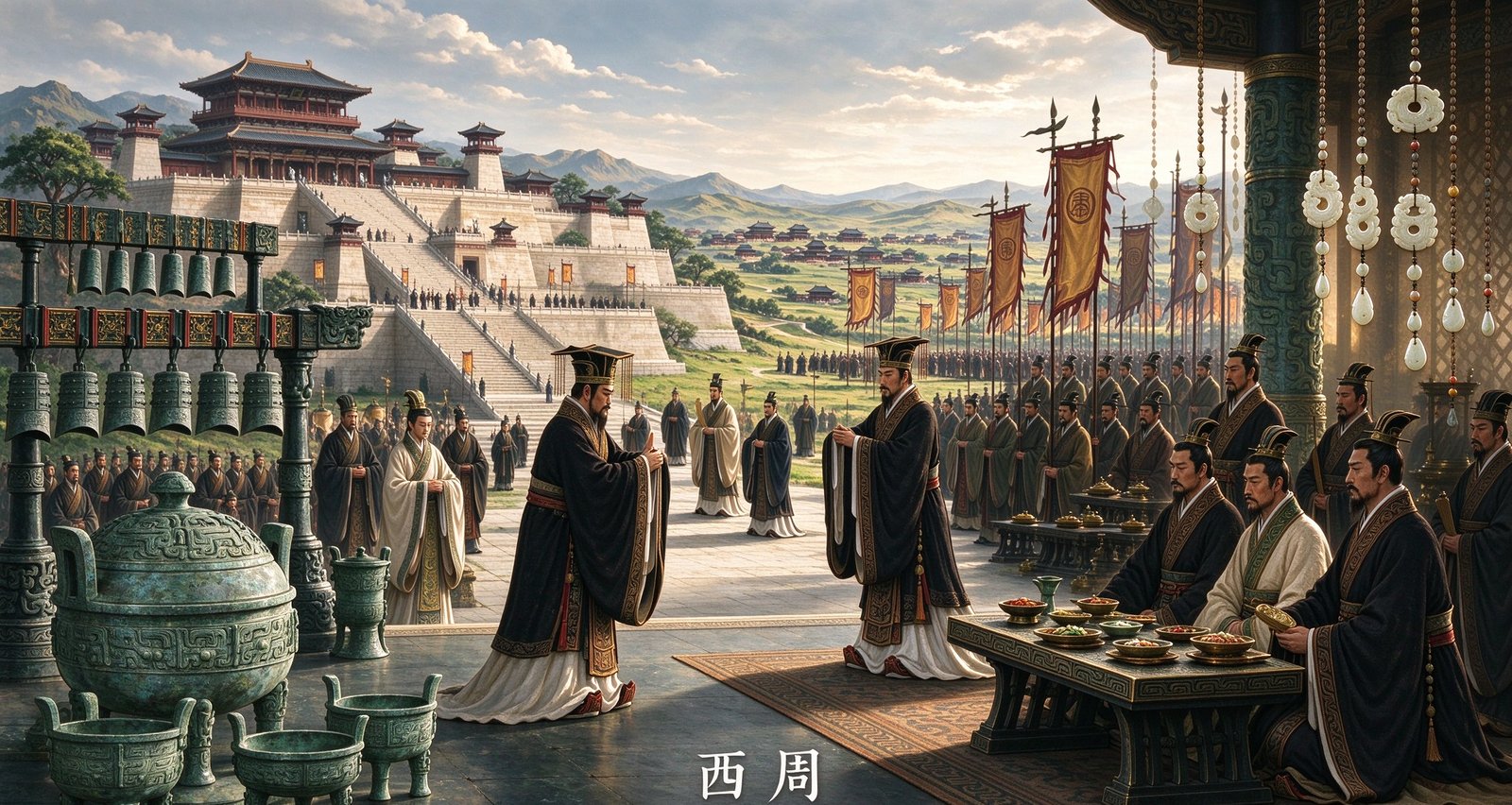
Western Zhou was the adolescence of Huaxia political civilization and the golden age Confucius dreamed of all his life. King Wu conquered Shang; the Duke of Zhou, as regent, designed a precise system: enfeoffment (fengjian) distributed the realm to kinsmen and meritorious allies; the lineage system (zongfa) fixed succession by the eldest son of the principal wife; the well-field system ordered land and tax; rites and music turned social norms into a performable order. This "enfeoffed states" system kept the Zhou king as common overlord for nearly three hundred years. In the late Western Zhou — King Zhao lost in the south, King Li's censorship of speech, King You's beacon-fire farce — the royal net unraveled; in 771 BC the Quanrong sacked Haojing, King Ping moved east to Luoyi, and China entered five hundred years of Spring and Autumn and Warring States. Yet Zhou ritual as a civilizational ideal never left the stage — Confucius's "How resplendent its culture! I follow Zhou" defined the restorationist imagination of the next two thousand years.
Duke Dan of Zhou was the true builder of Western Zhou: King Wu died of illness two years after conquering Shang; the young King Cheng reigned, and the Duke served as regent for seven years — quelling the Rebellion of the Three Guards, building Luoyi, creating rites and music, then returning power to Cheng. What he designed was not a set of ceremonies but a whole social operating system: the five rites (auspicious, inauspicious, military, guest, festive) ordered worldly rank; the courtly songs and dances internalized those norms as feeling; ritual and music were two sides of one fabric — "ritual differentiates, music harmonizes."
The Duke thereby became one of the wellheads of the Confucian orthodoxy: Confucius dreamed of the Duke of Zhou, and "dreaming of the Duke" became shorthand for longing after the sages. Cao Cao sang, "The Duke would spit out his food to greet the worthy — and the world's heart turned to him." Beyond ritual's skeleton, the Duke set another standard for Chinese politics: rulers must win people through humility and diligence.
The Zhou had a limited population yet had to rule vast new territory; their answer was enfeoffment: kinsmen (Lu, Jin, Yan), affines (Qi), meritorious ministers (the Duke of Shao), and descendants of former dynasties (Song) were established across the land — "enfeoff the kinsmen, to fence and screen Zhou." The lords received land and people and owed tribute, military service, and homage — a compound of kinship trust and military colonization; Huaxia's territory was stitched together by this web of relatives.
The lineage system (zongfa) arose to match: the eldest son of the principal wife inherited the great line, younger sons founded lesser lines, great and small lines nesting layer upon layer. It gave succession a clear rule and curbed wars of inheritance; it also planted the ethics of principal and lesser lines, filial and fraternal duty, and reverence for ancestors deep among the people — the source of the Chinese family feeling, ancestral rites, and seniority of today.
The deepest wisdom of Zhou ritual and music was this: order was maintained not by force but by "trained feeling." The scales of the chime-bells, the tallies of dings and guis, the depth of a bow, the grades of mourning garments — each coded "where you stand and how you should act" into every aristocrat's body. Music balanced ritual's bias: ritual honored distinction, music sought concord; when bells and drums sounded, the members of a graded society shared the same solemn joy.
The sixty-five chime bells from the tomb of Marquis Yi of Zeng, unearthed in 1978, still sound true across five octaves — ritual-music civilization's surviving symphony in bronze. When "ritual collapsed and music broke" in the Spring and Autumn era, Confucius spent his life trying to restore Zhou's rites; this double vision of order and human feeling shaped Chinese politics and aesthetics for two thousand years.
Western Zhou's decline is a book of warnings: King Zhao drowned in the Han River on a southern campaign; King Li's censorship by shamans provoked the "riot of the commoners"; King Xuan's revival could not reverse the tide; King You lit the beacons to amuse Baosi (perhaps embroidered by later tellers), and in 771 the Quanrong and the Marquis of Shen together broke Haojing, King You dying beneath Mount Li. King Ping moved east to Luoyi; royal authority collapsed, and the age of "ritual, music, and campaigns issuing from the Son of Heaven" was over.
Yet Western Zhou did not truly die — it became an idea. Whether in the warring states or the Qin-Han unification, "Zhou" remained Huaxia's name for ideal order: the kingly way, enfeoffment, rites and music, orthodoxy. Confucius edited the *Book of Songs* and composed the *Spring and Autumn Annals*, measuring everything against Zhou. A dynasty died; a standard of civilization lived on.