Dates
c. 1600–1046 BC
Shang is the first dynasty with direct written...
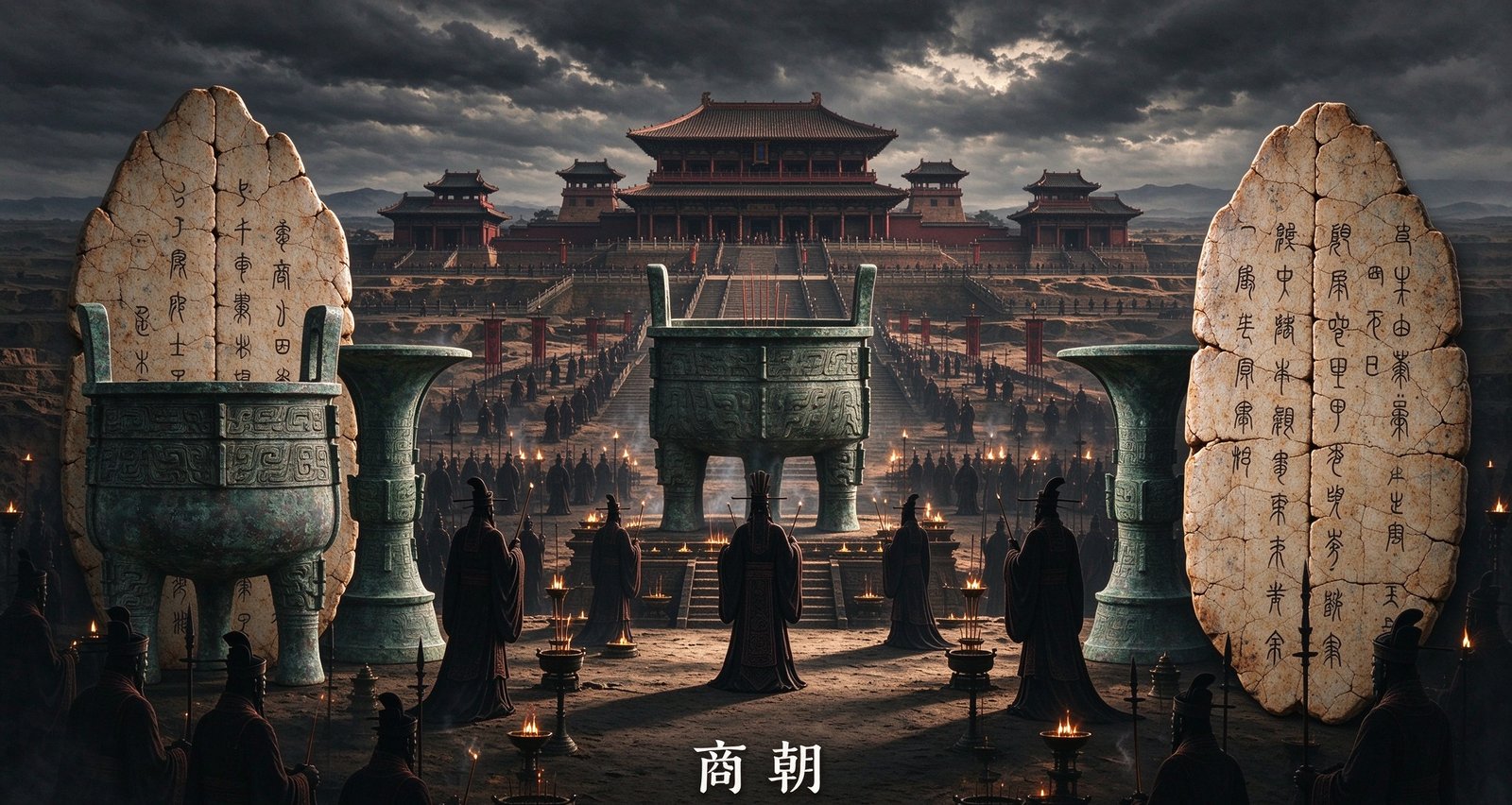
Shang is the first dynasty with direct written evidence. The discovery of oracle-bone inscriptions moved Shang from legend into documented history: divination records from the reign of King Wu Ding can be cross-checked with major events, and the Shang king list in the *Records of the Grand Historian* proved to fit the bones astonishingly well — inspiring Wang Guowei's landmark study of the former lords and kings seen in the Yin oracle records. The Shang revered the spirits and divined about everything — sacrifice, war, hunting, weather, illness, even childbirth — asking the bones each time; they cast the most brilliant corpus of ritual bronzes in world history, the Simuwu ding weighing over eight hundred kilograms and still the king of bronzes. Around 1046 BC King Zhou fell at Muye, and Shang ended — yet its writing, bronze, and divination culture form the deepest stratum of Huaxia civilization.
In 1899 the antiquarian Wang Yirong recognized carved characters on the "dragon bones" sold as medicine, and oracle-bone studies began. Anyang's Yinxu site has yielded roughly 150,000 inscribed bones bearing about 4,500 distinct characters, a third now read. Oracle-bone script already possessed the full repertoire of character formation — pictographs, simple and compound ideographs, phono-semantic compounds — and modern Chinese characters descend from it in an unbroken line across three thousand years, a continuity unique in the history of writing.
Even greater is the historiographical import: the inscriptions record Shang king lists, wars, and sacrifices, and once checked against the *Records of the Grand Historian*, Shang was struck off the "doubting antiquity" list for good. China's documented history begins with Shang — a single tortoise shell is at once the starting point of literature, of history, and of archaeology.
Shang bronze casting reached its summit: the Simuwu (Houmuwu) ding weighs 832.84 kilograms and required hundreds of workers to pour; the Four-Ram Square Zun achieved its exquisite form by section-casting; the bronze sacred trees and protruding-eye masks of Sanxingdui hint at a separate Shang-world cosmos in the Yangtze basin. Bronze was then called "auspicious metal"; inscriptions commemorated merit and ritual was stored in vessels — the number of dings one might own marked rank, and this "ding system" was Huaxia ritual order made material.
The taotie motif (animal mask) is the signature of Shang aesthetics: fierce, symmetrical, charged with divine menace. The aesthete Li Zehou called it "the beauty of the ferocious" — made not to please but to overawe, a visual declaration of kingship and priesthood fused. That solemnity remains the undertone of Chinese museum aesthetics today.
The Shang divined about everything, several times a day: Will it rain? Is the campaign auspicious? Is the king's toothache an ancestor's doing? Divination was a communication system with the ancestor-spirits, and the diviners — masters of script and of divine will — were the embryo of China's earliest civil service. Di and the ancestor lords formed a pantheon; a Shang king after death "attended upon Di," the human king reaching the High God through ancestral mediation — a distinctive religion of ancestor worship, profoundly unlike the monotheisms or polytheisms of other civilizations.
After Zhou conquered Shang, Jizi presented the Hongfan's nine categories to King Wu, the Duke of Zhou made rites and music, and a humanistic turn — "revere the ghosts and spirits but keep them at a distance" — began. Yet the Shang traditions of divining, ancestral sacrifice, and writing seeped into Huaxia's bones: today's ancestral rites at Spring Festival and the oracle slips of temple fortune-telling are thousand-year echoes of the Shang spirit.
In the traditional narrative King Zhou of Shang is the extreme of tyrants: lakes of wine, forests of meat, the burning-pillar torture, the heart of Bi Gan cut out. Modern historians remind us that his image was shaped by Zhou's victorious pens and accreted over the ages; but the exhaustion of the campaigns against the eastern Yi and the sharpening of internal conflict are fact. Around 1046 BC King Wu of Zhou led the allied states against Shang; at Muye the Shang ranks defected, and Zhou burned himself at Lutai.
Shang's fall and Zhou's rise rewrote the grammar of Chinese politics: the Zhou declared "the Mandate of Heaven is not constant; it aids the virtuous" — Heaven's mandate belonged to no single clan, and the virtueless lost the world. Shang's fall proved it for the first time and supplied the theoretical warrant for every later change of dynasty. Zhou inherited Shang's bronzes and writing wholesale, while its religious fervor was absorbed into a humanistic transformation — precisely where the resilience of Huaxia civilization shows.