Representative remains
the Forbidden City · Temple of Heaven · Temple of Earth
The dynasties of old built a visible order of ...
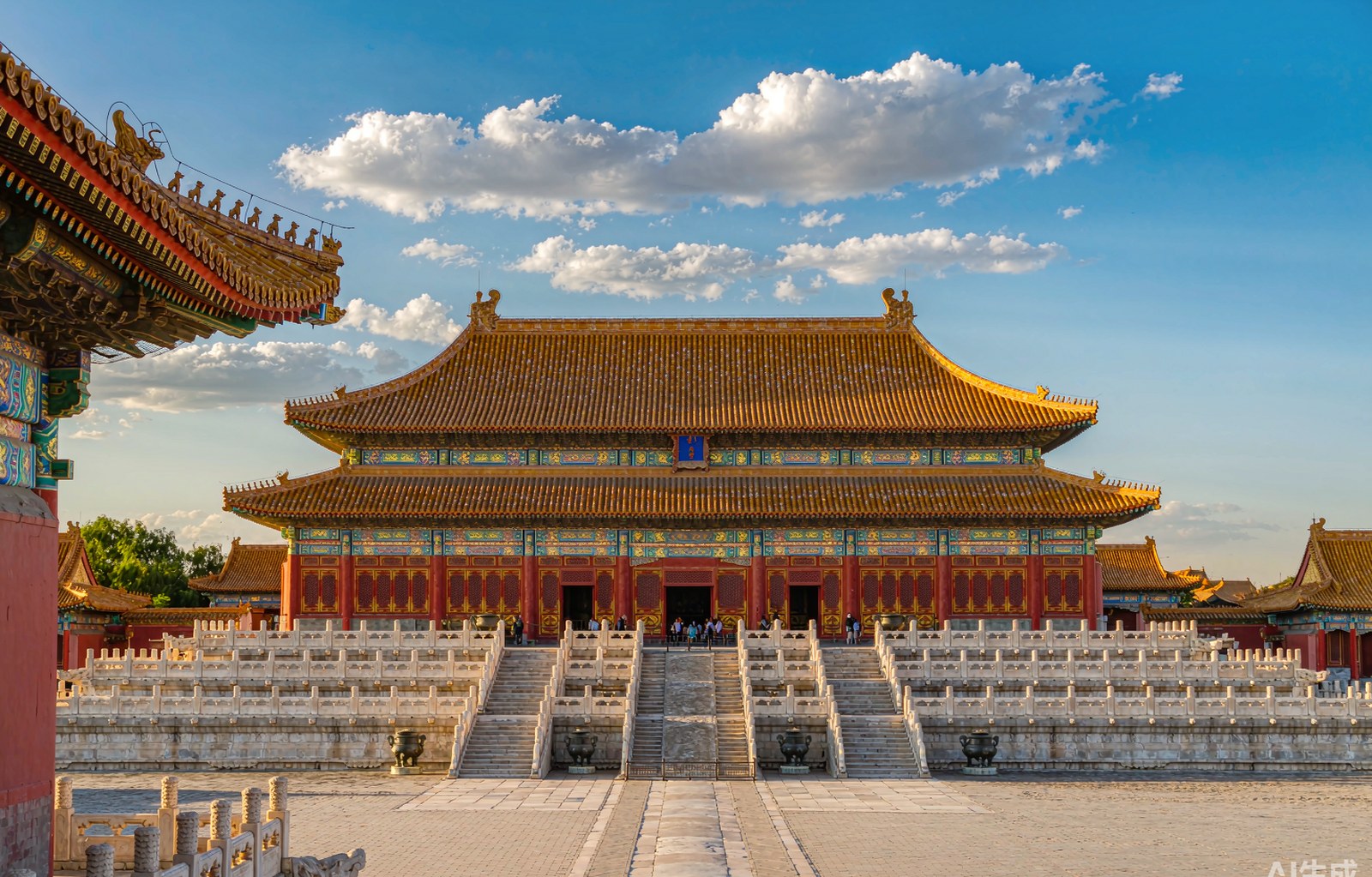
The dynasties of old built a visible order of empire out of palaces and altars: the Forbidden City as the seat of power where emperors ruled and dwelt; the Temple of Heaven and Temple of Earth offering separate sacrifices to heaven and earth, their forms — a round mound to mirror heaven, a square pool to mirror earth — encoding the cosmos. Together palaces and altars formed the spatial symbol-system of the empire, fixing imperial authority, ritual and family-state ethics along a single central axis: the highest material embodiment of dynastic ritual order.
The Beijing palace, long known as the Purple Forbidden City, was completed in 1420, the eighteenth year of the Yongle reign; twenty-four emperors of the Ming and Qing lived and ruled here. Measuring 961 meters north to south and 753 east to west, with more than 8,700 rooms still standing, it is the largest and most completely preserved wooden palace complex in the world. The three great audience halls of the Outer Court — Supreme Harmony, Central Harmony, Preserving Harmony — are lifted on towering three-tiered white marble terraces; the Hall of Supreme Harmony, eleven bays wide under a double-eaved hipped roof of yellow glazed tiles, is the sole surviving example of ancient Chinese architecture's highest grade.
The Forbidden City's sense of order seeps into every inch of space: from the Great Qing Gate through Tiananmen, Duanmen and Wumen to the Hall of Supreme Harmony, space narrows step by step and then suddenly opens vast, building the petitioner's awe architecture by architecture. The pattern of court in front and residence behind, ancestral temple to the left (the Taimiao) and altars to the right (the Altar of Soil and Grain), follows the ideal royal city of the Rites of Zhou: "the ancestral temple to the left, the altars to the right; the court in front, the market behind."
Built in the Yongle era, the Temple of Heaven was where Ming and Qing emperors sacrificed to Heaven and prayed for harvests. The Hall of Prayer for Good Harvests, its three roofs clad in deep-blue glazed tiles, stands on twenty-eight columns of golden nanmu wood with no spanning beam, an image of the twenty-eight lunar mansions; the Circular Mound Altar is a three-tiered round terrace of white marble whose balustrades and paving stones all count nine or its multiples — nine, the supremely yang number, the arithmetic of heavenly power. The Echo Wall and the Triple-Sound Stone add their acoustic wonders to the altar's mystery.
九天阊阖开宫殿,万国衣冠拜冕旒。 — "Through the ninth heaven's gates the palace opens; in robes of ten thousand nations they bow before the crowned head."—— Wang Wei, "Morning Audience at the Daming Palace" (Tang dynasty)
The Temple of Earth, also called the Fangze Altar, faces the Temple of Heaven across the city. Built in 1530, it held the sacrifice to earth at the summer solstice; its square, two-tiered form echoes the cosmology of "round heaven, square earth." Around them stood the Temple of the Sun, where the sun was honored at spring equinox, and the Temple of the Moon at autumn equinox: four altars ringed the capital on its four sides, completing the ritual geography of the imperial city. The five-colored earth of the Altar of Soil and Grain declared that "no land under Heaven is not the king's"; ancient cypresses shade the Imperial Ancestral Temple — all of them the projection of a ritual state onto the fabric of the capital.
This spatial order shaped East Asia for a thousand years: Seoul's Gyeongbokgung and the imperial city at Hue both followed it. Today the Forbidden City and the Temple of Heaven are World Heritage sites, and the listing of Beijing's Central Axis has placed the whole 7.8-kilometer ceremonial line under protection — "a masterpiece of the ideal Chinese capital's order."