Location
Lintong District, Xi'an, Shaanxi
An underground army buried for more than two t...
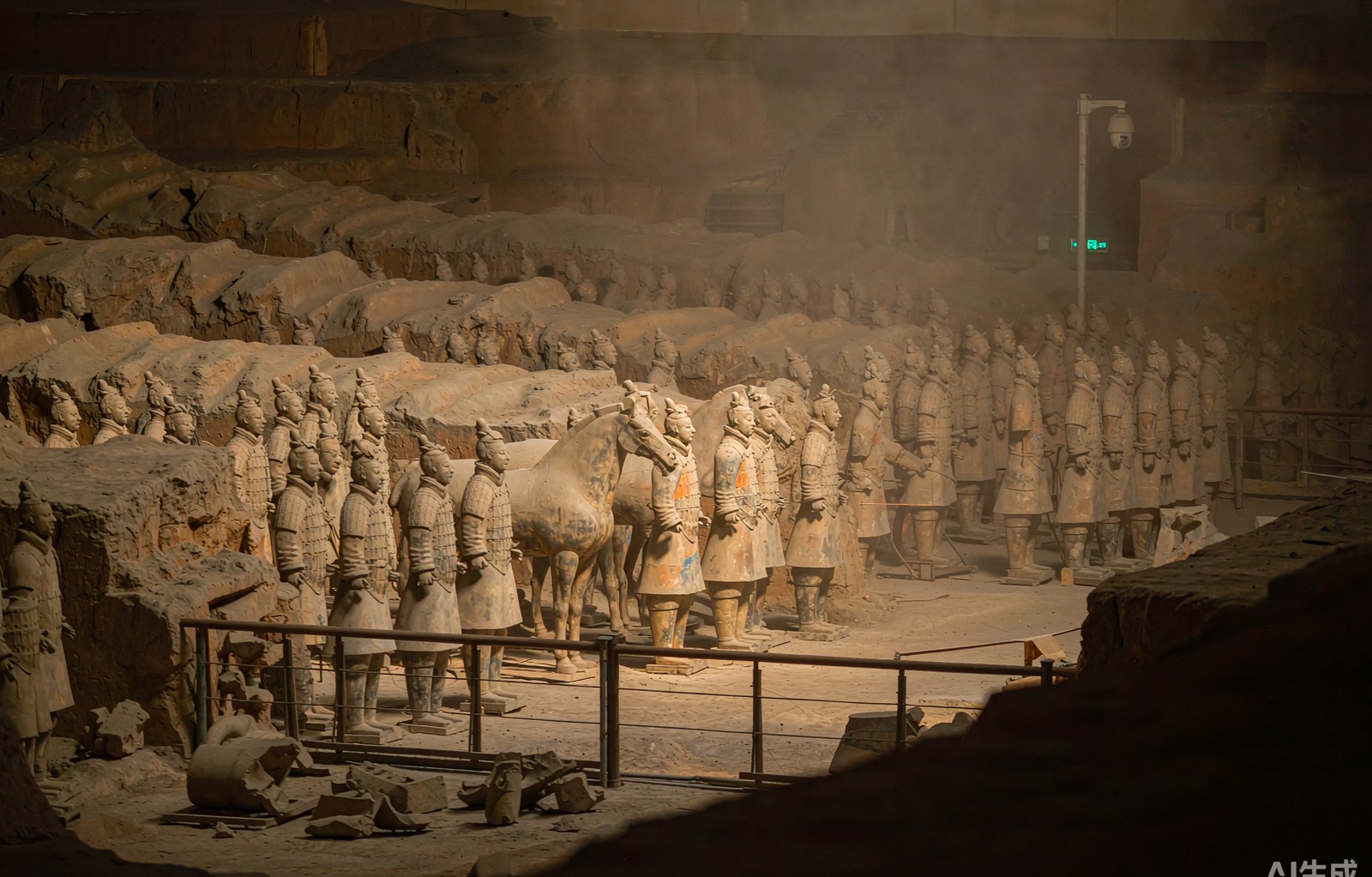
An underground army buried for more than two thousand years, and with it the might of the Qin empire that swept up the six states. In 1974 farmers digging a well in Lintong, Shaanxi, struck a terracotta head, and a buried battle formation of more than eight thousand warrior figures, chariots and horses astonished the world — hailed as the "Eighth Wonder of the World." It is part of the funerary complex of Qin Shi Huang's tomb, and at once a double marvel of Chinese sculpture and military history.
In March 1974, villagers digging a drought-relief well in Xiyang village, Lintong, unearthed pottery shards and a figure's head, drawing in the archaeologists. Three pits were then revealed in succession: Pit One, 230 meters long, an infantry-and-chariot main battle array; Pit Two, a mixed formation of crossbowmen, cavalry and chariot troops; Pit Three, the command post. An estimated eight thousand figures stand in working battle order, all facing east — toward the old lands of the six states Qin had conquered. Few discoveries in world archaeology have recovered a complete field army so intact.
The figures were made by combining molds with hand finishing: torsos were mass-formed, but every head was carved individually, so no two of the eight thousand are alike — the generals composed, the kneeling archers taut, the horsemen lean; hair buns, armor and even the stitching on shoe soles are rendered without omission. The figures were originally painted in mineral pigments — vermilion, pink-green, azure, purple — but on excavation the colors often curl and flake within minutes of touching air; conservation science is still racing against time.
Beside Pit One were found two large painted bronze chariots and horses, assembled from more than three thousand parts, their canopies and harness reproduced to the finest detail — the summit of Qin bronze casting and engineering. The tomb precinct has also yielded pits of stone armor, of acrobat figures, of civil officials: the First Emperor brought the whole empire's bureaucracy and trades down into the earth with him.
祖舜宗尧自太平,秦皇何事苦苍生。不知祸起萧墙内,虚筑防胡万里城。 — "Following Shun and Yao brings peace of its own; why did the First Emperor grind down his people? He never knew the trouble rose within his own walls, and built ten thousand li of rampart against the Hu in vain."—— Hu Zeng, "On History: The Great Wall" (Tang dynasty)
The Records of the Grand Historian describes the tomb at Mount Li: "bored through three springs, its coffin cased in bronze, with rivers and seas of mercury made to flow by machinery" — and modern surveys of anomalous soil mercury levels lend the account support. The mound rises like a hill; the burial chamber has never been opened. Visiting in 1978, French President Jacques Chirac remarked that one who has not seen the pyramids cannot truly have been to Egypt, and one who has not seen the terracotta army cannot truly have been to China — and the phrase "Eighth Wonder of the World" spread around the globe.