Location
eastern foot of the Mingsha dunes, Dunhuang, Gansu
A thousand years of cave temples in the desert...
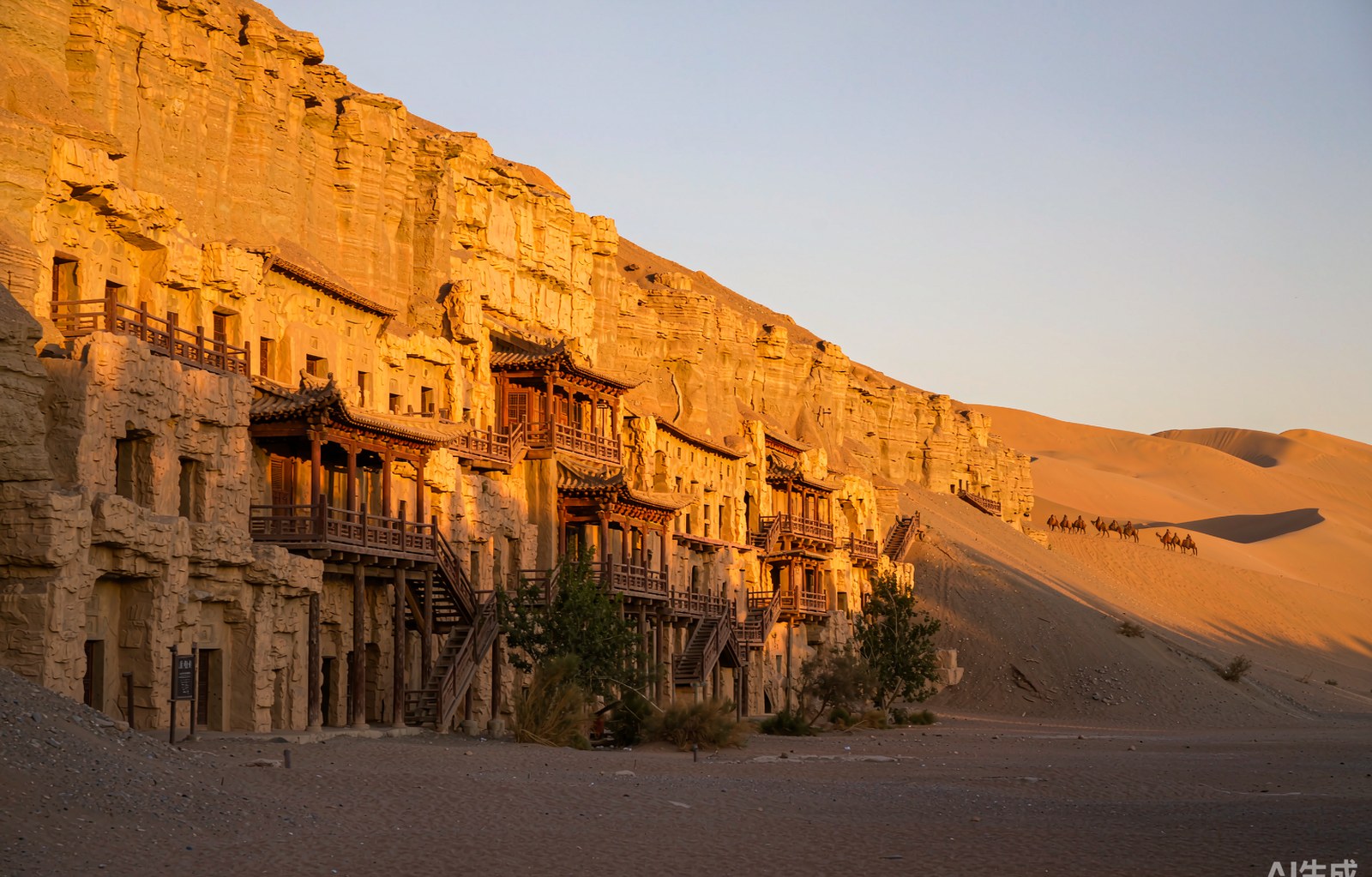
A thousand years of cave temples in the desert, where the civilizations of the Silk Road met. From the first cave cut by the monk Yuezun in AD 366, building continued through a dozen dynasties, leaving 735 caves, 45,000 square meters of murals and more than 2,000 painted sculptures — the largest and longest-enduring treasury of Buddhist art in existence. The accidental discovery of the Library Cave in 1900 gave rise in turn to Dunhuang studies, a field of international scholarship.
In 366, the monk Yuezun reached the eastern foot of the Mingsha dunes and saw the mountain of Sanwei suffused with ten thousand rays of golden light, like a thousand Buddhas; he cut the first meditation cave into the cliff. Faliang continued after him, and through the Northern Wei, Sui and Tang, princes, nobles, monks and lay donors vied to fund new caves until the grottoes covered the whole cliff face. By the High Tang the precinct held more than a thousand monks' cells; morning bells and evening drums mingled with camel bells — the most solemn lighthouse of the spirit on the Silk Road.
The murals of Mogao cover 45,000 square meters; laid out two meters high they would stretch twenty-five kilometers. Their subjects run from jataka tales of the Buddha's lives through sutra tableaux to donor portraits, landscapes, boats and carts: the serial narrative of the Nine-Colored Deer in Cave 257 became an animated memory for generations of Chinese; the heavenly musician playing the pipa behind her back in Cave 112 freezes the most graceful instant of Tang music and dance; the Wutai Mountains panorama of Cave 61, over thirteen meters long, is the largest bird's-eye landscape map of the ancient world. The painted sculptures run from the ascetic elegance of the Northern Dynasties to the full-bodied splendor of the High Tang — a standing history of Chinese sculptural style.
劝君更尽一杯酒,西出阳关无故人。 — "I urge you to drain one more cup of wine; west of Yang Pass you will meet no old friends."—— Wang Wei, "Song of Weicheng" (Tang dynasty)
On June 22, 1900, the Daoist priest Wang Yuanlu, clearing away drifting sand, broke by chance through a hidden door in the passage of Cave 16 — inside Cave 17, the Library Cave, more than fifty thousand documents had lain sealed for nearly nine hundred years: sutras, contracts, music scores, star charts and transformation texts in Chinese, Tibetan, Sogdian, Khotanese and Old Uyghur, covering everything of the medieval world. Most of the manuscripts then dispersed abroad; the historian Chen Yinke grieved that "Dunhuang is the saddest chapter of our nation's scholarship." Today Dunhuang studies flourish worldwide, and the Digital Dunhuang project has opened high-resolution imagery of thirty caves to all — the thousand-year treasure has found immortality at last.
South of the caves, the dunes of Mingsha Shan sing — slide down them and the sand roars like thunder; at their foot, Crescent Lake has resisted burial by sand for two thousand years, a curve of green water mirroring the dunes — a geographic enigma of sand and water coexistence still not fully explained. Desert, caves, oasis and camel caravans together complete Dunhuang's image of what its name promises: great and flourishing.