Region
Liping · Congjiang · Rongjiang, Guizhou
The Grand Song of the Dong (in the Dong langua...
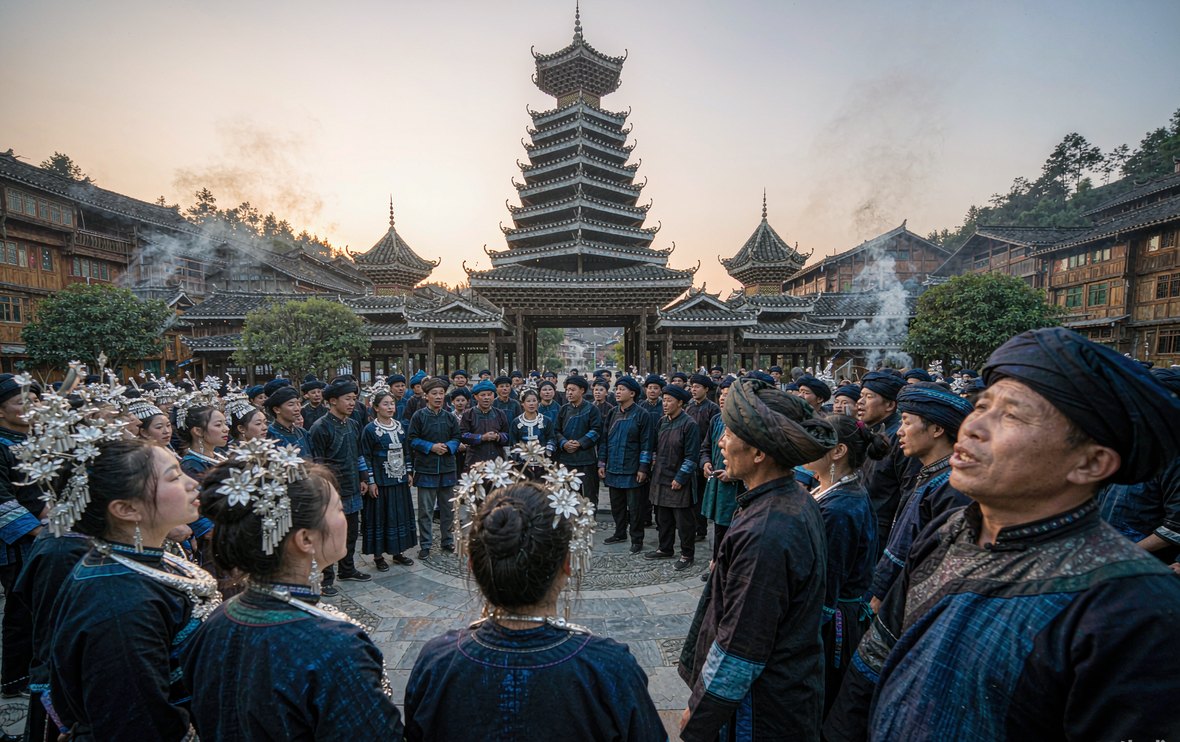
The Grand Song of the Dong (in the Dong language, gal lao) is unaccompanied polyphonic choral singing from the Dong communities of southeast Guizhou: no conductor, no instruments, no fixed score, one voice leading and many answering, the many low and one high, imitating cicadas and birds, streams and wind, sung in the drum towers and across the villages for a thousand years. European choirs who first heard it could hardly believe it: a people with no tradition of professional musical training preserving so mature a polyphony. The system is precise: drum-tower songs, sound songs (gaso, which imitate nature), narrative songs and children's songs, each with its place. "Rice feeds the body, song feeds the heart" is Dong philosophy; song masters teach and generations pass it on by mouth — "the Han keep books in writing, the Dong keep songs in singing". Inscribed nationally in 2006 and on UNESCO's Representative List in 2009, the singing in the drum tower is the unique surviving document of China's polyphonic tradition and the Eastern summit of the world's choral art.
Western music history once held that Chinese folk music had no polyphonic tradition; the Grand Song refutes it. Its voicing is mature (a sustained bass under a varying high line), its intervals natural (thirds predominating), its form complete (prelude, body, coda). A people without writing sustaining so precise a system by ear for centuries is what anthropology calls a miracle of oral music.
More remarkable still is how it is taught: no conductor, no instruments, no score, everything held in the song master's ear and the group's mutual attunement — which implies a highly self-consistent musical education inside Dong society: the drum tower is the conservatory classroom.
The sound song (gaso) is the most moving category: it values imitation over narrative — the buzz of cicadas, the murmur of a stream, the chatter of forest birds all woven into the voices. In *Song of the Cicada* a high call rises, the chorus lays a sustained bass beneath it, and the upper voice imitates the summer cicada swelling out of silence, so that the listener sits in the woods. This wish to reproduce nature in the human voice follows directly from where the songs are made: Dong villages sit between mountain and water, and the singing is part of the landscape.
The drum tower is the physical body of the song: every Dong village has one, and at festivals, weddings, funerals and welcomes the choirs gather there to answer one another — the drum-tower song gathering is the centre of public life.
The transmission of the Grand Song rests on the song master and the song group: the master is the village music teacher, teaching without pay; children are formed into groups by sex and age — boys' and girls' groups, children's and young people's groups — learning in the slack season, rehearsing in the drum tower, practising in antiphonal song. A Dong life is threaded through the groups: children learn, the young court (song is the medium of courtship), adults teach, the old become masters.
The social function of this system reaches far beyond music: the Grand Song carries historical memory (migration narratives sung), ethical teaching (songs of exhortation) and social ease (night singing in the moonlight) — "song feeds the heart" is a complete social psychology in three words.
In 1986 the Grand Song was performed at the Paris Autumn Festival and the European musical world was shaken — "music that glitters like spring water", the reviews said, and the songs became famous overnight. Since then the choirs have appeared on international stages again and again, the Dong villages of southeast Guizhou have become a field site for ethnomusicology, and the Liping Grand Song Festival is held every year.
The worries are real too: migrant labour leaves the song groups short of successors, and the gap in song masters was once acute; in recent years songs in the classroom, subsidies for song groups and cultural tourism have worked together, and the "song nest" of Xiaohuang village is loud again. The drum tower still stands, the masters are still there — and that unaccompanied human voice will rise again.