System
Twelve Muqam · Dolan Muqam and others
The Uyghur muqam is a large composite art unit...
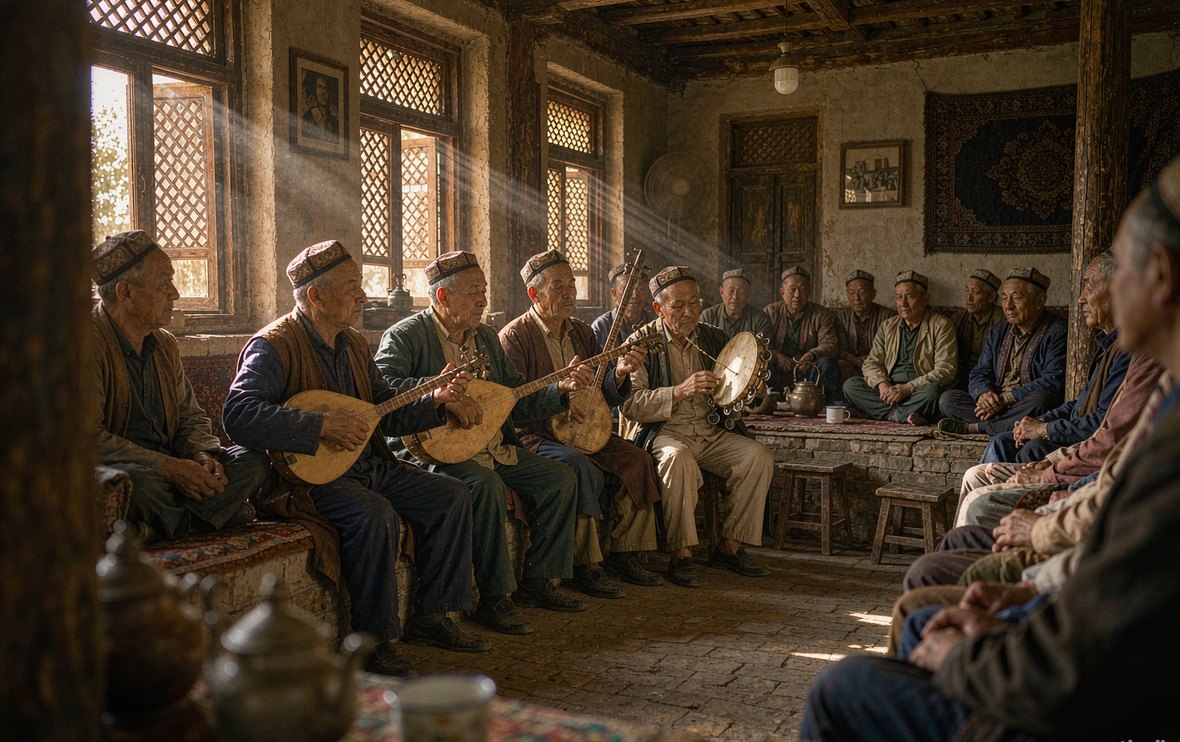
The Uyghur muqam is a large composite art uniting song, dance and instrumental music: muqam means mode, melody, cycle, and a complete set of the Twelve Muqam contains more than 170 pieces and 72 dance tunes, taking over twenty hours to perform in full — a musical epic grown along the Silk Road. Its ancestry is mixed: rooted in the Arab-Persian muqam system, it absorbs Central Plains music and dance, Indian music and the local manners of the Western Regions. The instruments are splendid — satar, tanbur, rawap, daf — and the singing sets a lapis-like throaty longueur against the quick daf rhythms while the dancers spin like whirlwinds. In the sixteenth century Amannisahan, consort of the Yarkent Khanate, systematised the muqam, a service for the ages; in the twentieth the Twelve Muqam was recorded and notated in full after heroic rescue work. In 2005 the Uyghur Muqam of Xinjiang was inscribed on UNESCO's Representative List — the song between oasis and desert is the loudest living witness of Silk Road civilisation.
The genome of the muqam is the Silk Road itself: the modal theory of the Arab muqam, the melodic manner of Persian music, Central Plains song and dance (Western-Region music once nourished the Ten Ensembles of the Tang), the ornamentation of Indian music, the folk-song ground of the Tarim oases — the Twelve Muqam is a piece of amber enclosing a millennium of Eurasian musical exchange. It belongs to the Uyghurs, and to the whole Road.
The character of oasis civilisation is written into it as well: the delicate lyricism of settled farming coexisting with the openness of the caravan routes — every prelude of the muqam is the negotiated result of several cultures at once.
Each muqam is vast in structure: the chong naqma (the great body of the cycle, moving from prelude through song to instrumental passage), the dastan (narrative song) and the meshrep (the danced revel) — from morning to night, a marathon of more than twenty hours covering aria, narrative, dance and instrumental music: twelve books of history sung aloud. The texts draw on classical poetry (Navoi and others) and folk song alike, literature and music lending each other surface.
Its rescue was poignant: on the eve of 1949 only a handful of people in all Xinjiang could sing the Twelve Muqam complete; from the 1950s a mass effort recorded and notated it, and the full sound of the cycle survives — a preservation of civilisation run almost as a race against time.
The native setting of the muqam is the meshrep, a village gathering: at weddings, harvests and festivals neighbours sit in a circle, players lead, singers answer, dancers spin until everyone is on their feet — the daf quickening, the Dolan dance pairing off like eagles in flight. The meshrep is entertainment, moral instruction (songs of exhortation) and customary arbitration (the settling of disputes) at once: here music is part of the machinery of society.
The Dolan muqam is its wildest branch: the descendants of hunters on the Yarkant River sing the desolation of the desert in hoarse longueurs over dense drumming, and its shout-like jäkhtimän passages are unique in the musicology of the world.
After the UNESCO inscription of 2005 a full protection system was built: muqam ensembles and transmission centres in Xinjiang, muqam departments in universities, stipends for the old village masters, the muqamchi; in 2010 the regional regulation on the protection of muqam art was issued — China's first local legislation devoted to a single item of intangible heritage.
Muqam ensembles have toured Europe and America many times, and performances in Kashgar have become a calling card for travellers. This twenty-hour musical project is a reminder to the world: great music need not live in a concert hall — it can grow at a banquet in an orchard, in the dusk of an oasis.