Author
Xu Hongzu, "Xiake" (1587–1641)
The diary record of more than thirty years of ...
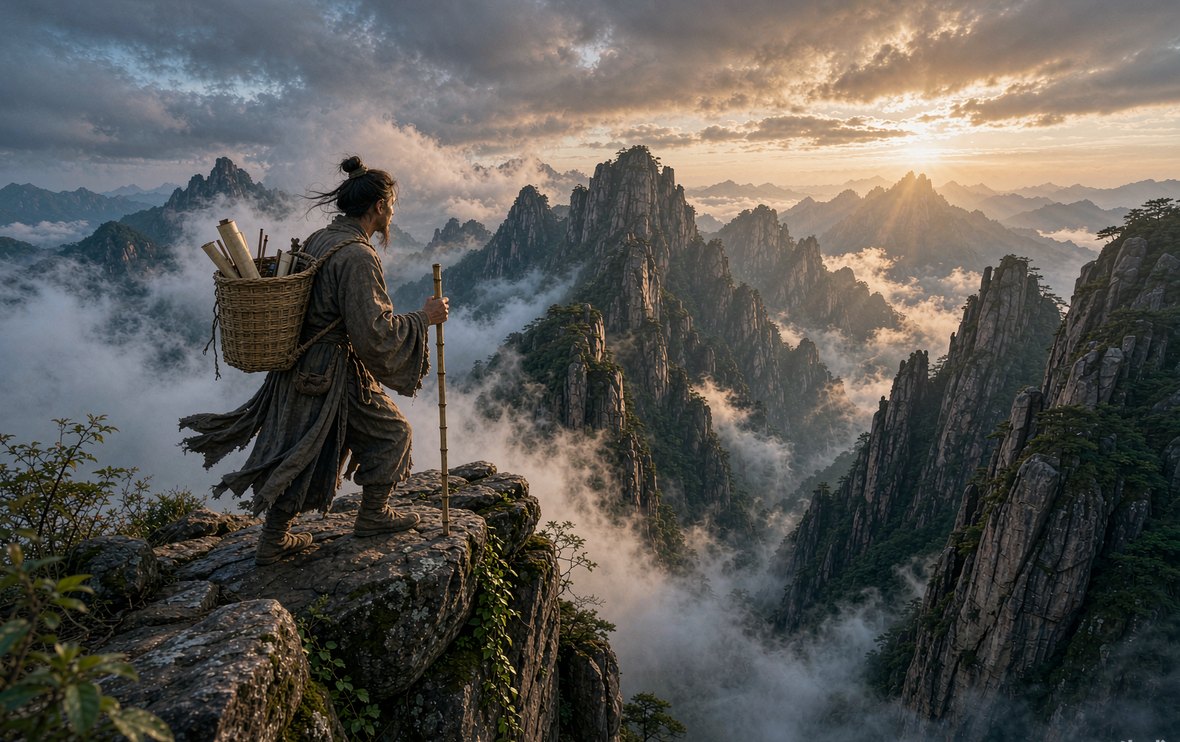
The diary record of more than thirty years of travel and field study by the Ming geographer Xu Hongzu, styled Xiake (1587–1641): some 600,000 characters survive, describing mountains and landforms, hydrology and geology, local custom and produce. At twenty-two he turned from the examinations to "seek the wondrous in famous mountains and great rivers", fearing neither weather nor wild beasts, robbed three times and starved four, and never swerving. In old age he made a journey of ten thousand li into Yunnan and Guizhou, traced the source of the Yangtze and concluded correctly that "in tracing the river's source, one must begin with the Jinsha" — overturning the millennium-old claim of the *Classic of Documents* that the Min River was its head. His systematic study of karst — cave forms, the origin of stalactites, tower-and-cone landscapes — ran a century or two ahead of European work, and British historians of science have called the diaries the finest informed travel writing of the seventeenth century. To reach where others have not reached, to probe what others have not known: a man who rewrote the geography books on foot, and the most romantic embodiment of the Chinese empirical temper.
Xu was born to a family of letters in Jiangyin, "peculiarly fond of rare books, widely read in histories and geographical works", and on seeing a map or a mountain gazetteer would say that he wished to seek out the wondrous in famous mountains and great rivers. In the age of examinations, to abandon office for travel was close to rebellion. He set out at twenty-two, "fearing neither wind nor rain, nor tigers and wolves, keeping company with the long wind and lodging with cloud and mist", and for thirty years went "where others had not reached, probing what others had not known". His mother, a woman of understanding, made him a travelling cap and at eighty went with him to Jingxi — a family's blessing that is itself a fine story in the history of Chinese travel.
His journeys were not excursions. Out at dawn and back at dusk, he climbed cliffs, crossed sheer faces, forded floods and entered caves, sleeping in ruined shrines and monkey hollows, "in places no man had come since the beginning of time". On his last great journey, 1636 to 1640, past fifty, he went deep into the miasmal country of Yunnan and Guizhou, his feet half ruined, and pressed on to Mount Jizu. Carried home at last by men sent by the Naxi chief Mu Zeng of Lijiang, gravely ill, he told a visitor: "Zhang Qian opened the way to the West but never saw Kunlun; Xuanzang travelled by imperial command… I, an old commoner with a bamboo staff and a pair of straw sandals, have traced the river sands and climbed Kunlun. I die without regret."
The value of the diaries lies in the word field. He logged each day's stage and measured distances on foot; every landform he describes he saw himself. The Yangtze inquiry is the model. Against the millennium-old authority of the *Classic of Documents*, he went upstream — "north through the three Qin, south to the five ranges, west out through Shimen and the Jinsha" — and, matching his own eyes to the texts, concluded that the Jinsha was the true source: "in tracing the river's source, one must begin with the Jinsha." Not to worship the classics but to test books with his feet: one of the earliest declarations of empiricism in Chinese scholarship.
The precision of his observation is astonishing: more than three hundred karst caves, with stalactites explained as "all condensed from dripping water"; the sources and courses of the north and south Pan rivers, correcting dozens of gazetteer errors; hot springs, volcanoes and geothermal ground at Tengchong. Needham observed that the diaries "read not like the work of a seventeenth-century scholar but like the field notes of a twentieth-century surveyor".
大丈夫当朝碧海而暮苍梧。 — A true man should be at the blue sea in the morning and at Cangwu by evening.——attributed to Xu Xiake in his youth
The southwest, where he concentrated his last years, is the largest karst region in the world. He recorded it with a scientist's patience: the position, structure and deposits of caves; the shape and origin of tower karst — "the hills are pure stone, and trees grow upon them, breaking out through the crevices". In caves he measured depth by torchlight and was lowered on ropes, describing "stone milk hanging down like lotus flowers, like sceptres, like canopies". Three hundred cave records make the earliest systematic literature of karst in the world, a century or two ahead of comparable European work.
He also proposed causes: the work of water, the transforming breath of the earth — limited by his age, but right in direction. Geographers today call him the father of world karstology, and the route of his journeys is being nominated for World Heritage by the cities along it. A scientific map drawn by an old man on foot is still a living object of research.
The diaries are also first-rate prose. Plain description with the density of a painting: "white sand like flour, paving the cliffs and filling the valleys… I alone was granted this great sight". Of Mount Lu: "cloud and vapour surge, mist rises like tide." Of Huangshan: "on the fourth day I sat still and listened to the snow slide all day long" — one line of snow, and stillness becomes music. Qian Qianyi praised him for "the true writing, the great writing, the strange writing of the world" — true in its record, great in its spirit, strange in what no one else had seen.
Its legacy is cultural as much as literary. Since the late Ming, "Xiake" has been a byname for the traveller and the explorer, and the opening date of the diaries, 19 May, is China's National Tourism Day. A people's character needs someone to prove that the world is not only in books and that truth lies among mountains and rivers. Xu Xiake demonstrated that way of living with his whole life: a true man should be at the blue sea in the morning and at Cangwu by evening. The sentence still quickens the pulse of young Chinese.