Author
Jia Sixie, of Qingzhou in the Northern Wei
Written by Jia Sixie of the Northern Wei in th...
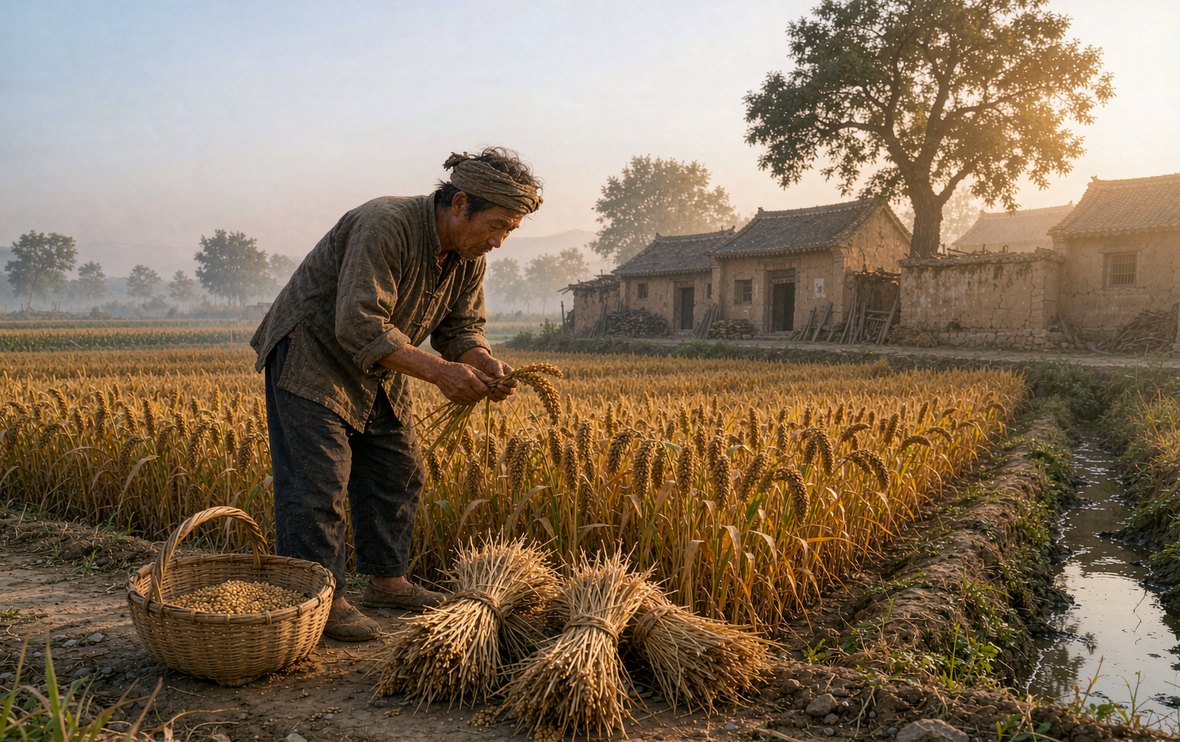
Written by Jia Sixie of the Northern Wei in the 530s and 540s, in ten juan and ninety-two chapters, more than 110,000 characters: the earliest and most complete comprehensive agricultural manual to survive from China, and one of the great works of world agronomy. Its scope is unprecedented — ploughing, seed selection, sowing and manuring; grafting, orchards and timber; livestock and poultry; brewing, sauce, vinegar and cooking — "beginning with the plough and ending with the vinegar jar; of the trades that sustain life, nothing is left unwritten". Jia gathered more than a hundred ancient farming texts, questioned old farmers and worked the land himself: "I asked the experienced and tested it in practice." The book argues no metaphysics, only that the essential thing is to bring peace to the people, to enrich them and then to teach them. Historians of agriculture call it an imperishable encyclopaedia of farming; on Chinese tables today its flavours can still be tasted.
The book is ordered by the shape of a life. Juan one and two cover tillage and grain — ploughing, seed saving, millet, panicled millet, wheat, rice. Juan three to five take in vegetables, orchards and trees — mallows, scallions, jujubes, mulberry and silkworms. Juan six is livestock: oxen, horses, donkeys and mules, pigs, sheep, chickens, ducks, fish. Juan seven to nine are brewing and food processing: starter cakes, wine, sauce, vinegar, fermented beans, cured meats, glue. Juan ten records the grains and fruits that do not grow in China proper, quoting more than a hundred products of south and north.
Nearly every one of the ninety-two chapters is a workable set of instructions. The chapter on millet runs from season ("grain ripens early or late"), through seed selection ("when the wheat is ripe for harvest, choose the ears with the largest, strongest grains"), sowing rate and field care, to harvest and storage. That ambition of total technical coverage is rare among farming books before the nineteenth century: it is China's first attempt to put the whole learning of eating between covers.
The agronomy runs ahead of its time. Crop rotation and green manure — "for enriching a field, mung bean is best" — using legumes to restore the soil, a practice Europe would only systematise in the eighteenth century. Grafting is described in full detail for pears, rootstock and scion alike. Ingenuity is everywhere: planting melon seeds in the same pit as soybeans, so that the sprouting beans break the crust and help the melon through. The chapter on sheep records fodder storage and byre hygiene; the chapter on wine records the "sour starter" method that keeps a brew from spoiling — an empirical science of microbes.
More valuable still is the method. Jia writes that he "gathered from the classics and their commentaries, took in songs and rhymes, asked the experienced, and tested it in practice" — text, folk rhyme, the old farmer's word and his own trial, four chains of evidence together. He records failures too, the lessons of those who "were deceived by greed for profit and sowed rashly". This empirical temper makes the book one of the rare pre-modern texts that can be repeated: modern historians of agriculture have reproduced Northern Wei brewing and sauce-making from its pages, and succeeded.
采捃经传,爰及歌谣,询之老成,验之行事。 — I gathered from the classics and their commentaries, took in songs and rhymes, asked the experienced, and tested it in practice.——Jia Sixie, preface to Essential Techniques for the Common People
The book holds the earliest systematic record of Chinese food culture. The brewing chapters list more than forty kinds of starter and the processes for sauce, vinegar and fermented beans — the ancestor of soy sauce, "bean juice", and the solid fermentation of vinegar take their form here. Nearly three hundred dishes are described — roasting, stews and soups, steaming, pickling and drying, each with its rules. For the first time the table of ordinary people is fully written down. Many traditional brews and dishes of Shandong and the Huai region still find their prototypes in these pages.
It also records the taste of a merging people: "barbecued mutton, Hu style" and "Qiang boiling" enter the book, and the sesame flatbread is already everyday fare. Steppe and sown land met for the first time on the dinner table. Japanese scholars call it one of the points of origin of East Asian food culture: a farming manual that is also half a cookbook, a combination almost unique in world literature.
The title says it: qimin, the common people; yaoshu, the essential arts of making a living. This is a book written for ordinary people getting by. In his preface Jia quotes the tradition — "life lies in diligence, and diligence is never in want" — and a proverb: "wit like Yu and Tang is no match for constant ploughing." He attacks the armchair talkers who "discuss sowing without ever touching a farm". In an age when great clans despised manual work, a provincial governor writing a book for farmers and herdsmen was itself a declaration of values.
Its transmission bears the same stamp. The Northern Song printed and distributed it, the imperial library collected it, and Wang Zhen's *Book of Agriculture* and Xu Guangqi's *Complete Treatise on Agriculture* took it as model. It is now translated into English, Japanese and Korean; Needham called it "an agricultural encyclopaedia of the sixth century". Fifteen hundred years on, its eight characters remain the best self-portrait: bring peace to the people, enrich them, and teach them. The true business of a state is written in every seed.