Scope
305 poems · Western Zhou to Spring and Autumn (c. 1100–600 BC)
China’s earliest anthology of poetry: three hu...
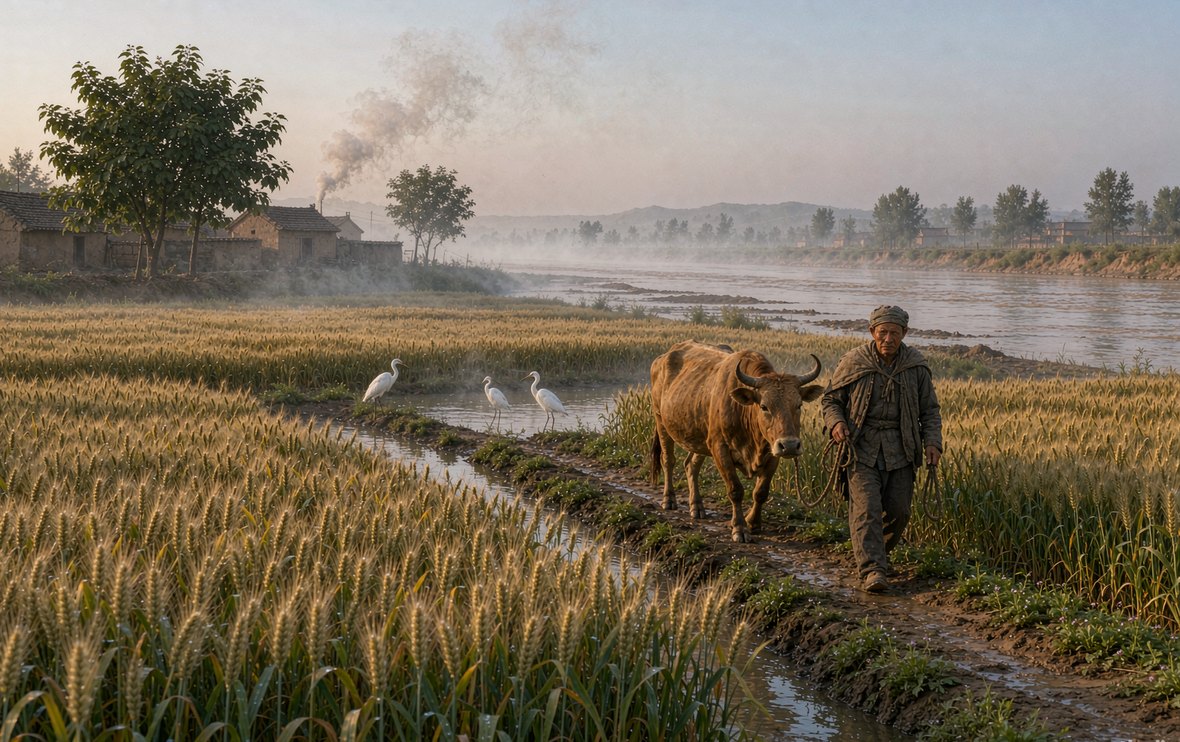
China’s earliest anthology of poetry: three hundred five poems spanning roughly five hundred years, from the early Western Zhou to the mid-Spring and Autumn — the songs and court music of half a millennium. The Zhou is said to have kept officials who “collected songs, whereby the king observed the customs and learned his gains and losses”; Confucius edited it as a textbook — “the three hundred poems may be summed up in one phrase: no depraved thought.” The book divides into feng (Airs of the Fifteen States, folk songs), ya (Elegantiae, court music), and song (Hymns, temple music); its three methods — fu (direct narration), bi (comparison), and xing (evocative image) — founded the rhetoric of Chinese poetry. It records everything the ancestors lived: love and labor, war and corvée, feasting and sacrifice, politics and satire — the joys and griefs of twenty-five centuries ago read today without the least distance. “Guan-guan cry the ospreys,” “the reeds are lush and green,” “when I left, the willows swayed” — these lines long ago dissolved into the bloodstream of the Chinese language, becoming the softest mother-tongue at the bottom of Chinese hearts.
The most moving thing about the Airs of the Fifteen States is that they are “the voice of ordinary people.” “Qi Yue” (The Seventh Month) records month by month a farmer’s year — in the first month repair the plow, in the second set foot to the field, in the seventh eat melons, in the eighth cut the gourds — an encyclopedia of farmwork in verse. “Shuo Shu” (The Great Rat) likens the heavy tax-collector to a great rat — “I swear I will leave you for that happier land” — the earliest song of revolt. In “Cai Wei,” the soldier returning home sings “when I left, the willows swayed; now I return, snow fills the sky” — sixteen characters laying bare the plunder of war upon an individual life.
The ya and the song preserve the memory of the court: “Sheng Min” and “Gong Liu” are the founding epics of the Zhou people; “Wu Yi” and “Min Lao” are the upright voice of political admonition. Taken together, the Book of Songs is a social archive written in poems — later historians recorded emperors and generals, while these three hundred poems recorded the plowman, the garrison soldier, the abandoned wife, the longing wife, letting the nameless speak in history for the first time.
Zhu Xi defined them: fu states the matter plainly and at length; bi compares one thing to another; xing speaks first of something else to lead into what is meant. Fu is plain sketch and amplification — the seasonal narrative of “Qi Yue” is the model. Bi is metaphor — “her hands like tender shoots, her skin like congealed lard,” likening a beauty to plants. Xing is the subtlest — “guan-guan cry the ospreys” rises from the birds’ harmonious calls to introduce the lady and the lord; “the reeds are lush and green” rises from autumn waters vast and pale to set forth the one who can be glimpsed but never reached.
Xing above all established the distinctive lyric mechanism of Chinese poetry: feeling is not stated outright but wells up through images of things, scene and emotion fused, reticent and inexhaustible. All later poetic craft flows from here — Qu Yuan’s fragrant herbs and fair ones, the poetic moods of Tang poetry, the metaphorical consignments of Song lyrics — all move within these three methods. One may say that with the Book of Songs, the Chinese language finally possessed a complete grammar for “speaking poetically.”
蒹葭苍苍,白露为霜。所谓伊人,在水一方。 — The reeds are lush and green, the white dew turned to frost. The one of whom I speak is somewhere across the water.——Book of Songs · Airs of Qin · “Jianjia” (The Reeds)
Confucius placed deep hopes in poetry: “If you do not study the Songs, you will not be fit to converse” — at diplomatic occasions of the Spring and Autumn, verse-recitation was the aristocracy’s common tongue. “The Songs can inspire, can be observed, can bind men together, can voice grievance” — to stir resolve, observe custom, gather human feeling, satirize the times: four functions pushing poetry from the aesthetic into social practice. “Summed up in one phrase: no depraved thought” — the three hundred poems, sorrow or joy, all issue from true feeling, and so move with purity.
This poetics of “genteel sincerity” shaped the character of Chinese literature for two thousand years: poetry was more than lyric; it bore the mission of instruction, criticism, and communication. Du Fu’s “Three Officers and Three Partings,” Bai Juyi’s satirical poems — continuations of the tradition of “grievance.” And the Chinese obsession with “being able to compose verse” as a mark of cultivation began in that academy of Confucius where string-song never ceased.
The Book of Songs passed first from mouth to ear, sung to music; after the Qin burning of the books, the scores were scattered while the texts survived in scholars’ recitation. Four schools transmitted the Songs in the Han — Lu, Qi, and Han, and the Mao school; the first three gradually perished, and the Mao recension alone came down. Commentary never ceased: Zheng Xuan’s annotations, Kong Yingda’s Rectified Meanings, Zhu Xi’s Collected Commentaries on the Songs — the commentary history of the Songs is half the history of classical learning.
Its mark on the Chinese language reaches into daily life: “a fair and graceful lady,” “hold your hand,” “stones from other hills,” “a lovely smile dimpling,” “trembling with care” — hundreds of idioms come straight from the three hundred poems. The program “poetry expresses intent” (shi yan zhi) was fixed here, and China became “the land of poetry”: from Qu Yuan to Lu Xun, every poet carried the Book of Songs in the knapsack. The waterbirds on the river islet of twenty-five hundred years ago are calling still at the source of the Chinese language.