Date
The fifth day of the fifth lunar month
The fifth day of the fifth lunar month is the ...
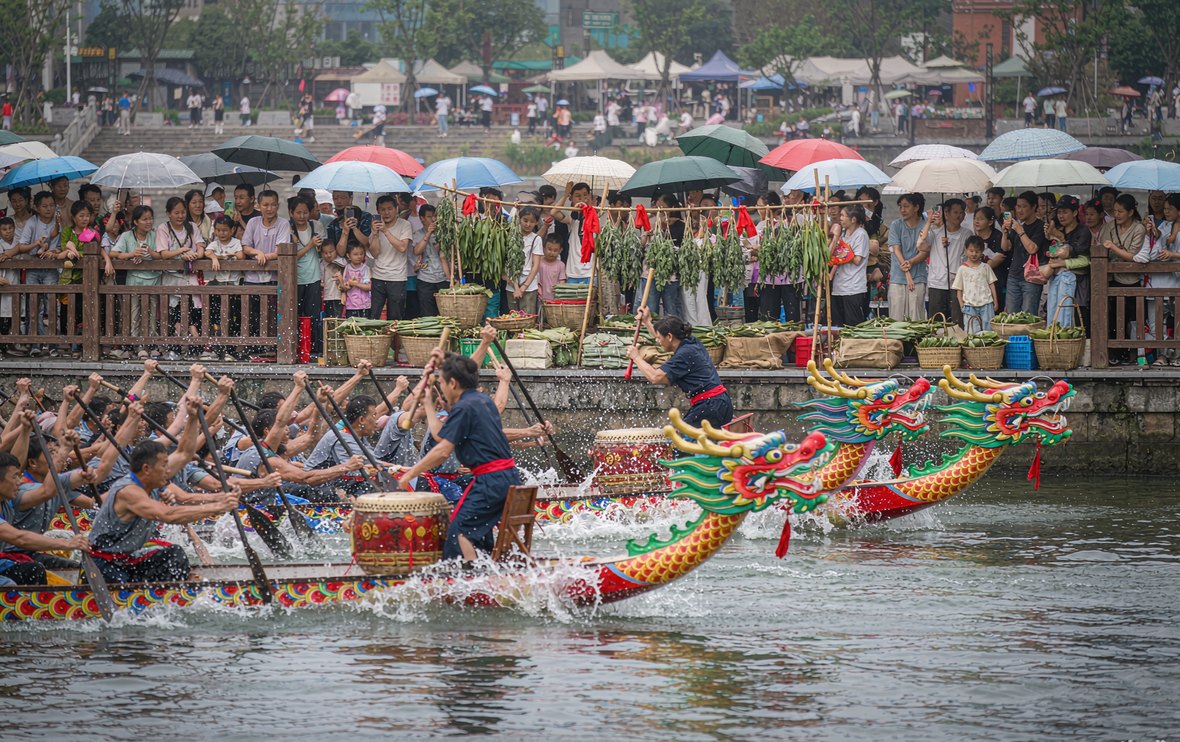
The fifth day of the fifth lunar month is the first great festival of summer: dragon boats race, mugwort and calamus hang at the doors, zongzi are eaten and scented sachets worn — a composite day of commemoration, exorcism and exuberance. Its origins have several explanations: the dragon-totem rites of the ancient Yue peoples of the lower Yangtze, the old custom of driving off poison and plague in an ill-omened month, and the legends of Qu Yuan, Cao E and Wu Zixu. Since the Six Dynasties the story of Qu Yuan has prevailed: "who first decreed this festival day? Through all ages the tale is told for Qu Yuan." A poet's leap into the river gave the festival a literary soul and a patriotic undertone. It entered the first national list of intangible heritage in 2006 and UNESCO's Representative List in 2009, the first Chinese festival so honoured. Dragon boats have moved from ritual races to international sport, zongzi from seasonal food to cultural symbol — two thousand years on, the festival still cuts through the waves of time.
The festival is a build-up of layers. At the base lies seasonal adaptation to midsummer: the fifth month brings damp heat, epidemics and the "five poisons", hence a whole system of hanging mugwort and calamus at the door like swords and banners, drinking realgar wine, wearing scented sachets and tying five-coloured threads — a technology of protection. Above that lie the dragon-totem rites of the watery Yue lands: Wen Yiduo argued that Duanwu began as the day the ancient Yue honoured the dragon, with the boat race as the moving part of the sacrifice. Only on the surface do the legends of individual heroes attach.
Qu Yuan, Wu Zixu, Cao E, King Goujian of Yue — each region installed its own loyal minister or filial daughter on the same day. This is how folk tradition integrates: a festival is a great river, taking in every tributary and finally flowing with the branch that tells the strongest story. Qu Yuan won with the character and the poetry of the Li Sao.
In 278 BC, when Qin's army took the Chu capital, the poet Qu Yuan took a stone and drowned himself in the Miluo River. Villagers rowed out to recover him and threw in rice to protect his body — and the race and the zongzi found the start of their story. This layer of commemoration lifted the festival beyond plague-averting into the only great Chinese festival defined by a literary figure: every zongzi eaten at Duanwu wraps a piece of that "long, long road, I will search high and low".
In 1953 Qu Yuan was named one of the four great cultural figures of the world. Japan, Korea and Vietnam all keep Duanwu traditions; Korea's Gangneung Danoje was inscribed in 2005 (honouring mountain gods and shamanic custom, cognate with the Chinese festival but diverging). The controversy that followed only prompted the Chinese to rediscover and revalue their own Duanwu.
The original function of the boat race was sacrifice and the averting of disaster; by Tang and Song it had become mass sport — "three beats of the drum, the red flag falls, two dragons leap out on the water". Today it has gone international: the International Dragon Boat Federation counts dozens of member countries and regions, the sport is on the Asian Games programme, and world championships tour the globe. A waterway from the Miluo in Hunan to the banks of the Seine has been cut by paddles.
The cultural core has shifted too, from "driving off evil and praying for blessing" to "crossing the river in one boat": a crew must paddle in unison to win, which makes the dragon boat the best metaphor for teamwork. Corporate retreats and community regattas borrow the symbol — the ancient sacrificial vessel has become a coaching boat for modern collaboration.
The Duanwu pharmacopoeia is a manual of ancient public health: mugwort contains volatile oils with antibacterial effect, calamus leaves hang at the lintel like swords, realgar wine was dotted on children's foreheads (no longer taken internally), and sachets of atractylodes and angelica were worn against the body. "Driving out the five poisons" is the folk expression of midsummer epidemic prevention — the festival was sometimes simply called the Hygiene Festival, and its scientific core is the control of summer disease.
The system shows how custom is generated: effective experience is ritualized, and ritual is then made sacred. Science and belief shake hands inside a single sachet. Today the mugwort still hangs and the sachets are still worn: the survival wisdom inside the old rules still guards a summer.