Date
The seventh day of the seventh lunar month
Qixi, on the seventh of the seventh lunar mont...
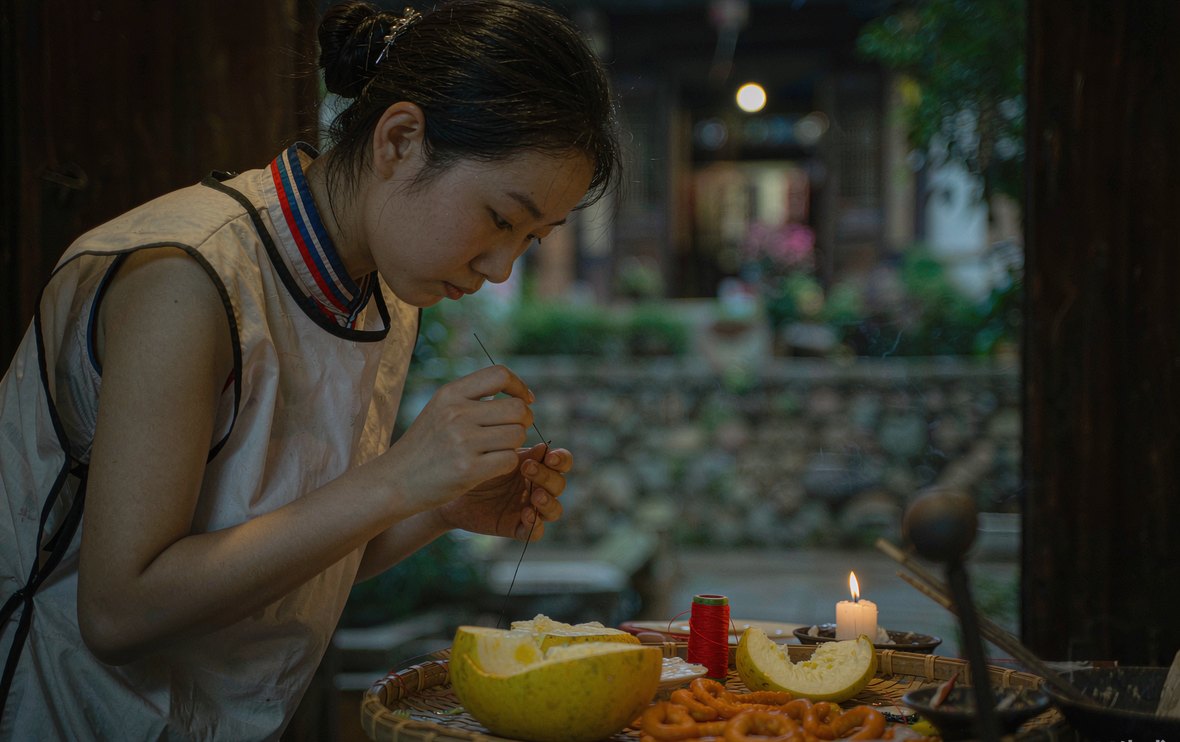
Qixi, on the seventh of the seventh lunar month, grew from the ancient worship of the star lodges and from women's custom of begging for skill. The Herd Boy and the Weaver Girl face each other across the Milky Way and meet once a year on a bridge of magpies; on earth, girls that night thread needles to vie in dexterity and bow to the moon in prayer, asking for skilled hands and a good match. At root Qixi is the Festival of Skill — first of all a women's day and a day of craft: floating needles to test nimbleness, worshipping the Weaver, airing books and clothes, eating qiaoguo pastries, all of it a celebration of women's handiwork and wit. The love story of the Herd Boy and Weaver Girl then gave the day its modern identity as a Chinese Valentine's Day. "If love between both sides can last for aye, why need they stay together night and day?" — Qin Guan's lines made Qixi the classic Chinese philosophical statement of love. Inscribed nationally in 2006, the festival today is growing new forms between the old contest of skill and contemporary romance.
The astronomical setting is the Weaver star climbing to the zenith at dusk in the seventh month. The Herd Boy (Altair) and the Weaver (Vega) gaze at each other across the Milky Way; the Book of Songs already sings of "the Weaver, tripping along, and the Herd Boy, shining bright", and the Nineteen Old Poems of the Eastern Han fixed the narrative: "far off, the Herd Boy star; bright, the River of Heaven's girl... a shallow span of water between, and no word can pass." Once the stars were personified they began to carry human sorrow and joy.
The seventh day of the seventh month is a doubled number, and the ancients regarded doubled days as auspicious. In the Han people aired clothes and books on this date, and the palace had a "tower of open lapels" where seven-holed needles were threaded. The contest of skill and the auspicious double seven locked the festival's coordinates in place.
The core rite belonged to women: threading a needle by moonlight, where the first to pass the thread through a seven-holed needle "obtained skill"; floating a needle on water and reading its shadow to divine clumsy or deft hands; bowing to the Weaver in silent prayer. Qiaoguo, a fried pastry, was the festival food, and the rhyme "we beg for deft hands, for beauty; for understanding hearts, for fair faces" sang out the whole wish list. In an age that confined women to the inner chambers, Qixi was their annual exhibition of skill and longing.
At heart the contest was a festive affirmation of the value of women's labour: weaving, embroidery, sewing, cooking. On this day the "productivity" of women was seen, praised and matched. To understand qiqiao is to understand the earliest gender meaning of the festival: it celebrates skill first, and love only second.
The full form of the Herd Boy and Weaver story settled in the Six Dynasties. The Records of the Seasons of Jing-Chu tell of the Weaver crossing the river on the seventh night to meet the Herd Boy, and with it arose the bridge of magpies; local variants in which magpies build the bridge and crows fill the river rewrote an astronomical tale as an ethical one: a goddess married a mortal, the rules of Heaven tore them apart, one meeting a year was the punishment, and the depth of their feeling moved the heavens to allow it.
This paradigm means to the Chinese what Romeo and Juliet means to the West: it is about the conflict between love and order. But the Eastern solution differs — not dying together but keeping faith: once a year, for ever. Qin Guan distilled it into "if love between both sides can last for aye, why need they stay together night and day" — a philosophy of love that prizes promise over proximity, and remains the most dignified Chinese imagining of romance.
In the past twenty years Qixi has changed identity, from the "daughters' festival" to a Chinese Valentine's Day, as commerce and young people's emotional needs resonated together. Traditional elements have returned at the same time: qiqiao activities have revived in Guangzhou and in Xihe, Gansu (a national ecological zone for qiqiao culture), and needle-threading and worship of the Weaver are experienced afresh by the young as "national-style romance".
The shift has raised worries about losing the original meaning, but the better reading is that Qixi is undergoing another accretion — historically it has always stacked meanings: star worship, airing books, the contest of skill, love. Today two flowers open on the same stem: skill, the respect for craft, and love, the respect for promise. That is precisely the secret of its endurance.